Why Understanding Industrial Air Compressors Types Actually Matters
Compressed air powers countless operations across manufacturing, construction, and processing facilities. The equipment generating this air—often tucked away in utility rooms or forgotten corners—quietly determines operational efficiency, energy costs, and maintenance headaches for years after installation.
Two dominant technologies compete for attention when facilities need industrial air compressors: rotary screw designs and reciprocating piston systems. Both compress air. Both have proven track records spanning decades. Yet they work differently, cost differently, and suit different applications in ways that aren’t always obvious from spec sheets alone.
Choosing between them involves tradeoffs that matter more than most buyers initially realize. Getting this decision wrong means living with equipment that’s either overkill for actual needs or struggling to keep up with demand. Neither situation ends well financially.
How Piston Industrial Air Compressors Work
The Basic Mechanism
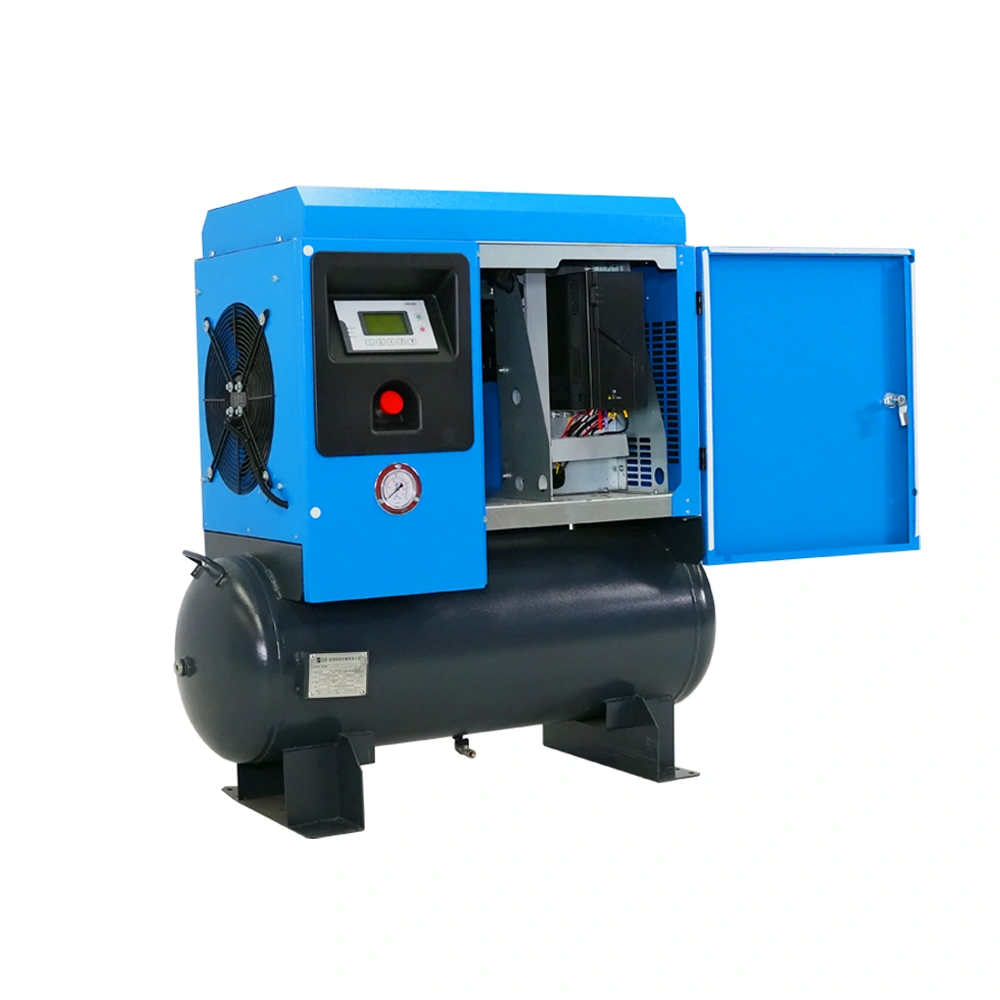
Piston compressors (sometimes called reciprocating compressors) operate on principles most people intuitively understand. A piston moves up and down inside a cylinder—similar to automotive engines, really. Downward motion draws air in through intake valves. Upward motion compresses that air and pushes it out through discharge valves.
Simple enough conceptually. The mechanical reality involves:
- Crankshafts converting rotational motor power to linear piston movement
- Connecting rods linking crankshafts to pistons
- Cylinder heads containing valve assemblies
- Cooling systems managing heat from compression
Single-stage units compress air in one cylinder stroke. Two-stage designs compress air partially in one cylinder, cool it, then compress further in a second cylinder. The two-stage approach achieves higher pressures more efficiently, though it adds complexity.
Where Piston Compressors Excel
These machines shine in certain scenarios. Intermittent duty cycles suit them well—applications where compressed air demand varies significantly throughout shifts or days. Auto body shops, small fabrication operations, and construction sites often find piston units perfectly adequate.
They also reach higher pressures more easily than screw alternatives. Applications requiring 175 PSI or above typically favor piston designs without the exotic engineering that high-pressure screw units demand.
How Rotary Screw Industrial Air Compressors Work
The Basic Mechanism
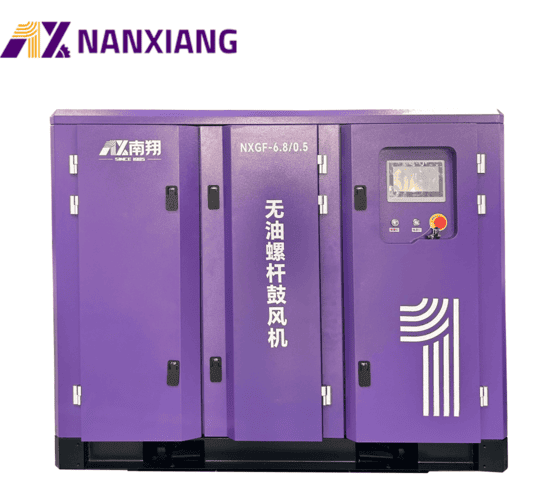
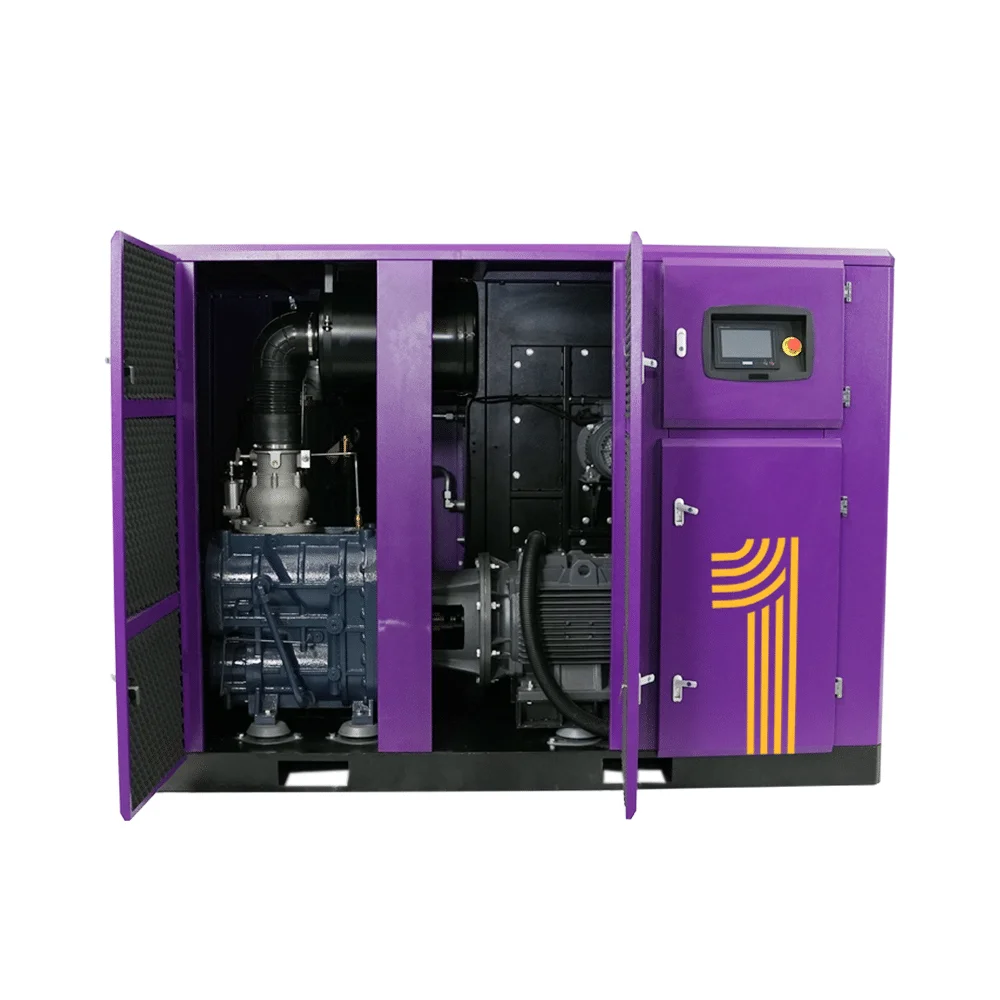
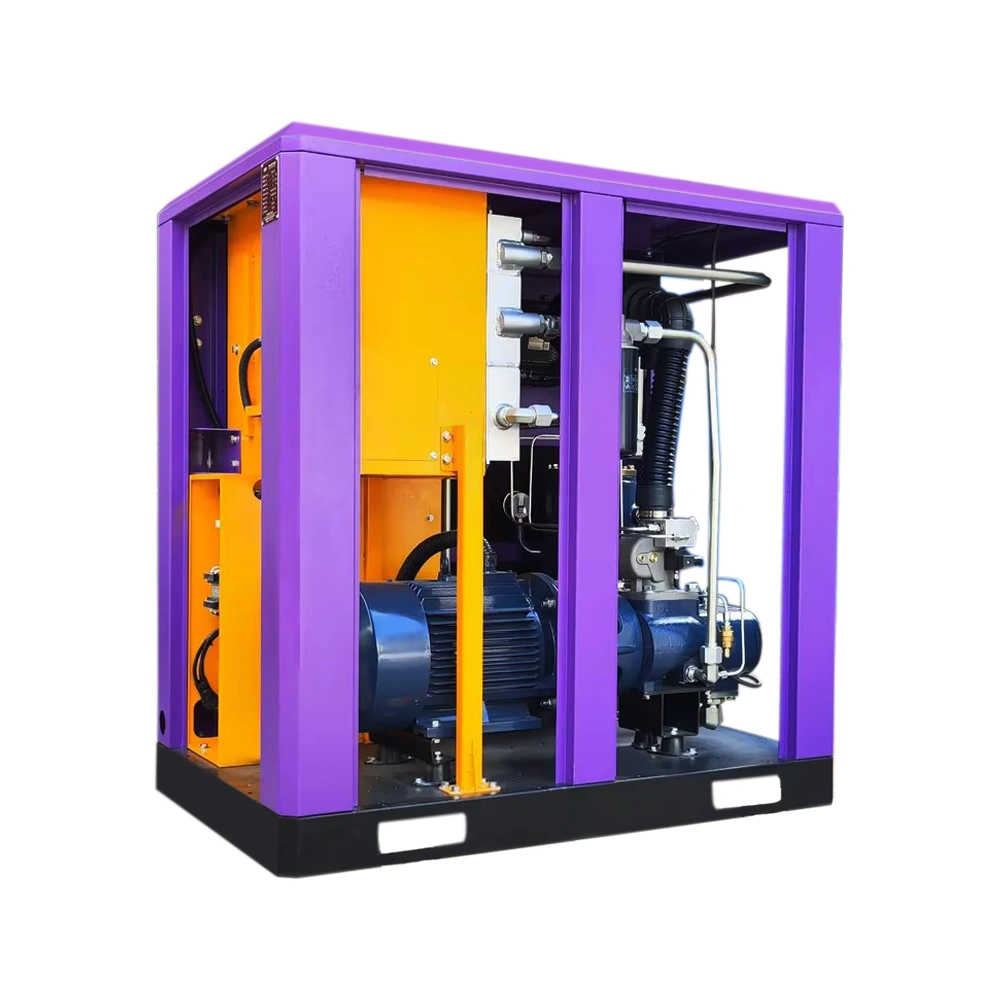
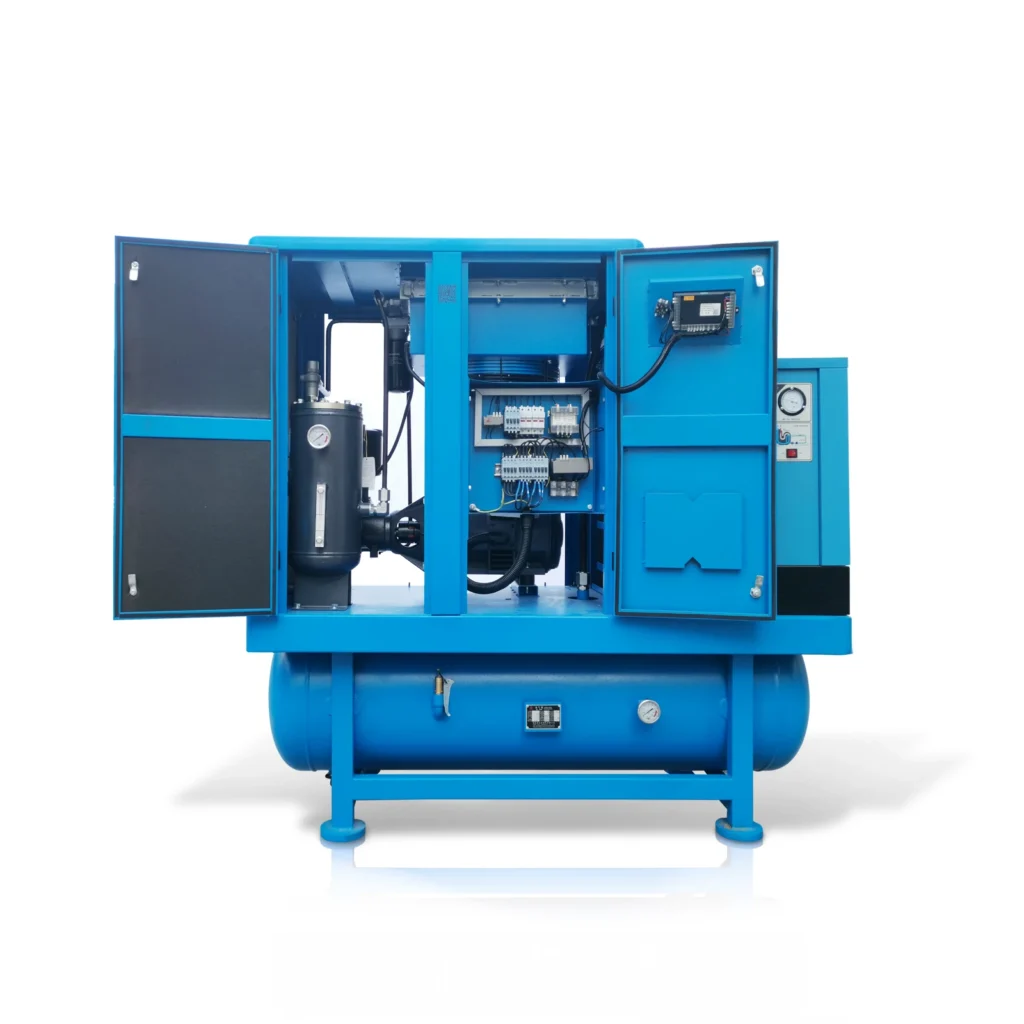
Rotary screw compressors take a fundamentally different approach. Two helical rotors (screws, hence the name) mesh together inside a housing. As they rotate, air gets trapped between rotor lobes and the housing wall. This trapped volume progressively shrinks as it moves along the rotor length, compressing the air continuously.
No valves opening and closing. No reciprocating motion creating vibration. Just smooth rotational movement producing steady airflow. Oil-injected versions use lubricant for sealing, cooling, and lubrication simultaneously. Oil-free variants achieve compression without oil contact—important for food, pharmaceutical, and electronics applications.
Where Screw Compressors Excel
Continuous operation showcases rotary screw advantages dramatically. Facilities running compressors constantly (or nearly so) find screw units more efficient over time despite higher purchase prices. Manufacturing plants with steady pneumatic tool usage, process industries, and large-scale operations typically favor this technology.
The smooth air delivery eliminates pulsation issues that sometimes affect piston compressor systems. Downstream equipment and processes benefit from this consistency.
Comparing Industrial Air Compressors Side by Side
| Factor | Compresores de pistón | Compresores de tornillo rotativo |
|---|---|---|
| Coste inicial | Lower (often 30-50% less) | Higher upfront investment |
| Ciclo de trabajo | Intermittent (50-60% typical) | Continuous (100% capable) |
| Nivel de ruido | Louder, more vibration | Quieter operation |
| Maintenance Frequency | More frequent attention needed | Longer service intervals |
| Eficiencia energética | Good for variable demand | Better for constant loads |
| Typical Lifespan | 10-15 years with care | 15-20+ years common |
| Space Requirements | Compact for capacity | Larger footprint generally |
| Maximum Pressure | Higher pressures achievable | Standard models cap lower |
This comparison oversimplifies somewhat—specific models vary considerably. But general patterns hold true across most industrial air compressors in both categories.
Making the Right Choice for Specific Applications
Several questions help narrow decisions:
- What’s the actual duty cycle? Measure or estimate honestly—not best-case scenarios.
- How much does energy cost locally? Higher rates favor efficiency over purchase price.
- What’s the noise tolerance at the installation location?
- Does oil-free air matter for the application?
- What maintenance capabilities exist in-house?
Facilities with engineering staff comfortable maintaining complex equipment might accept either technology. Operations relying entirely on service contractors sometimes prefer the simpler piston approach, though screw units genuinely require less frequent attention.
If you want to know more about industrial air compressor, please read Compresor de aire industrial: La guía definitiva para 2026.
Preguntas frecuentes
Can piston and screw compressors work together in one system?
Absolutely. Some facilities run screw compressors for base load—the minimum constant demand—while piston units handle peak requirements. This hybrid approach captures advantages from both technologies, though it complicates system design and maintenance coordination.
How much do industrial air compressors typically cost?
Small piston units start around $2,000-5,000. Comparable screw compressors begin near $8,000-15,000. Larger industrial air compressors scale dramatically—major installations exceeding $100,000 aren’t unusual. Installation, accessories, and air treatment equipment add substantially to base prices.
Which technology is more reliable overall?
Neither enjoys clear reliability superiority when properly matched to applications. Piston compressors running within rated duty cycles last decades with basic maintenance. Screw units operated continuously often outlast piston alternatives. Problems typically stem from misapplication or neglected maintenance rather than inherent technology weakness.