
Air compressor quotations are usually decided by one figure: airflow. Buyers compare datasheets, see 100 CFM on one page and 100 SCFM on another, and assume the machines are interchangeable. They are not. A raw airflow number reflects the weather in the compressor room as much as the machine itself, and a hot, humid or high-altitude site can lose a fifth of rated capacity without a single component changing.
SCFM, or standard cubic feet per minute, is the airflow an air compressor delivers once its inlet volume is recalculated to a fixed reference of pressure, temperature and humidity. CFM is the actual volume of air moving per minute at whatever local conditions exist. SCFM removes the influence of location and weather, CFM records it, and only SCFM lets two machines in two different places be compared on equal terms.
That distinction governs sizing, acceptance testing and energy accounting, so the two figures are worth separating carefully.
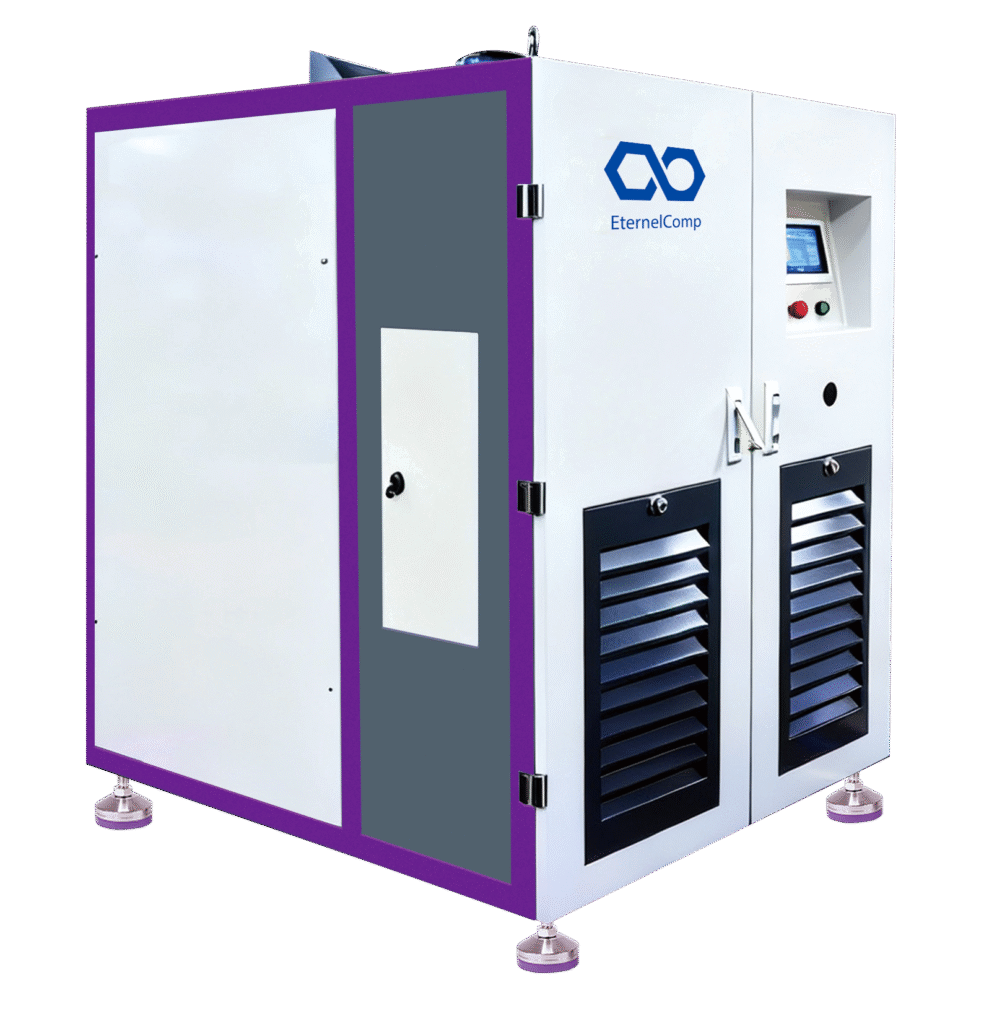
SCFM vs CFM: What Is the Real Difference?
CFM is an unqualified count of the cubic feet of air passing a point each minute at the pressure, temperature and humidity that exist at that moment. SCFM is that same flow recalculated to a fixed reference state. CFM describes local reality, while SCFM describes comparable capacity.
The distinction matters differently depending on who asks. A manufacturer publishing catalogue figures uses SCFM, because it allows fair comparison across a product range and across regions. A plant engineer sizing a line uses SCFM for demand, because tool consumption data is published on the same basis. A commissioning engineer reaches for CFM instead, because that is what a flow meter reads on site at line pressure. Problems appear when one basis is substituted for the other without conversion, which is the most common single source of undersized installations.
Are SCFM and CFM the Same Thing?
They are the same number only where the measurement is taken at exactly the reference conditions. Everywhere else the figures diverge, and the gap grows with distance from the reference point.
In a temperature-controlled room near sea level the difference is small enough to ignore. Move the same machine to a hot workshop in a high-altitude city and the gap is large enough to change the equipment selection. The trap is that a label reading 100 CFM and a requirement for 100 SCFM look identical at a glance. Treating them as interchangeable means buying a machine that is short of capacity before it is switched on, with the shortfall surfacing later as slow tools, low pressure at the far end of the line, and a compressor that runs when it should be idle.
When SCFM Runs Higher or Lower Than CFM
The direction of the shift is predictable once you know which way the site deviates from the reference.
| Состояние | How the equivalent CFM figure moves |
| Inlet air warmer than the reference | Warm air is less dense, so more cubic feet carry the same mass. The figure rises, reaching roughly 1.07 at 100°F against a 68°F reference. |
| Inlet air colder than the reference | Cold air is denser, so fewer cubic feet carry the same mass. The figure falls to roughly 0.89 at 32°F. |
| Inlet absolute pressure below the reference | Thin air at altitude behaves like warm air. The figure rises, reaching roughly 1.20 near 5,000 feet. |
| Inlet absolute pressure above the reference | Denser air carries more mass per cubic foot, so the figure falls. |
| Высокая влажность | Water vapor displaces dry air, so dry air mass per cubic foot drops. The size of the correction depends on the humidity basis published. |
Because the reference state is a convention rather than a physical constant, the safest habit is to state the basis whenever a flow figure changes hands. This ambiguity is long standing and well documented for standard cubic feet per minute, where standard pressure may be defined as 101,325 pascals, 1 bar, 14.73 psia or 14.696 psia, and standard temperature as anything from 60°F to 77°F.
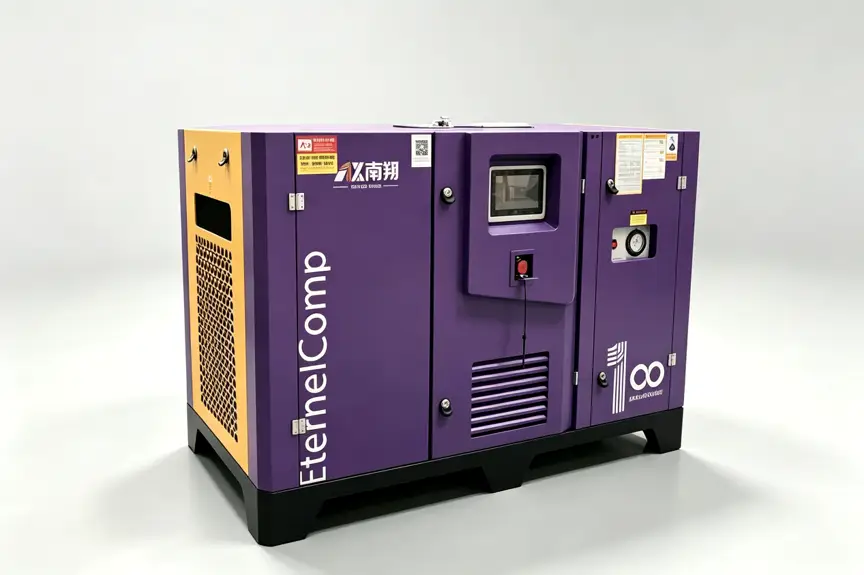
How to Convert CFM to SCFM
CFM and SCFM convert in either direction as long as the absolute pressure and absolute temperature at the measurement point are known. The relationship is a ratio rather than a fixed multiplier, so the result depends on how far actual conditions sit from the reference.
The conversion follows the combined gas law, which holds that pressure multiplied by volume and divided by absolute temperature stays constant for a fixed mass of gas. Two consequences matter. Pressures must be absolute rather than gauge, so a reading of 100 psig is about 114.7 psia at sea level. Temperatures must also be absolute, so Fahrenheit readings are converted by adding 460 to give degrees Rankine. Using gauge pressure, or Celsius that has not been converted, is the most common arithmetic error in airflow work, and it produces answers that look plausible while being wrong by a wide margin.
How Many CFM Is 1 SCFM?
One SCFM equals exactly one CFM only at the reference conditions themselves. At any other combination of temperature and pressure, one SCFM corresponds to a different number of actual cubic feet.
| Состояние | Approximate CFM equivalent of 1 SCFM |
| 68°F at 14.7 psia | 1.00 CFM, the reference point where the two figures coincide |
| 100°F at 14.7 psia | About 1.07 CFM, because warm air must expand to carry the same mass |
| 32°F at 14.7 psia | About 0.89 CFM, because cold air is denser and packs the mass into less space |
| 68°F at 12.2 psia, near 5,000 feet elevation | About 1.20 CFM, because lower atmospheric pressure thins the air |
| 68°F at 18 psia | About 0.82 CFM, because higher absolute pressure compresses the mass into less volume |
These figures show direction and magnitude rather than precise factors. For equipment selection, use the measured absolute pressure and temperature at your own site.
Can You Convert CFM to SCFM?
Yes. Divide actual absolute pressure by reference absolute pressure, multiply by the ratio of reference absolute temperature to actual absolute temperature, and apply the result to the measured CFM figure.
The sequence is as follows.
- Record the measured flow in CFM at the point of interest.
- Measure absolute pressure at the same point by adding local atmospheric pressure to the gauge reading.
- Measure air temperature and convert it to absolute units by adding 460 to the Fahrenheit value.
- Insert the reference values, using 14.7 psia and 528 degrees Rankine for the common North American convention.
- Multiply the terms together to obtain SCFM.
A worked example makes the effect visible. Suppose a compressor delivers 100 CFM measured at 14.2 psia and 85°F. The actual absolute temperature is 545 degrees Rankine. Applying the ratios gives 100 multiplied by 0.966, then by 0.969, which is about 93.6 SCFM. The same machine at a coastal site at 60°F would show close to its nominal 100. The machine did not change; the correction did. When a calculation must cross metric and imperial units as well, a reference such as an Air Compressor Unit Conversion Guide saves a step and prevents unit slips.
Related Terms: ACFM, ICFM and FAD
Three further terms appear on datasheets and test reports, each answering a different question.
| Срок | What it means and when it is used |
| ACFM | Actual cubic feet per minute. Volumetric flow at a stated point at that point’s pressure and temperature. Used for sizing piping, valves and dryers, which respond to volume and velocity. |
| ICFM | Inlet cubic feet per minute. Flow at the compressor intake flange, corrected for pressure drop and temperature rise caused by inlet filters and piping. Used to check whether inlet losses are eroding capacity. |
| FAD | Free air delivery. Delivered flow referred back to inlet conditions, usually in cubic metres per minute or litres per second outside North America. |
| SCFM | Standard cubic feet per minute. The normalized basis used to compare capacity and state demand. |
A workable summary: SCFM is the term for comparing, ACFM is the term for building, and FAD is the term a test report will quote. Because the underlying gas flow is the same in all three cases, discrepancies among them reflect the state of the gas rather than a defect in the compressor.
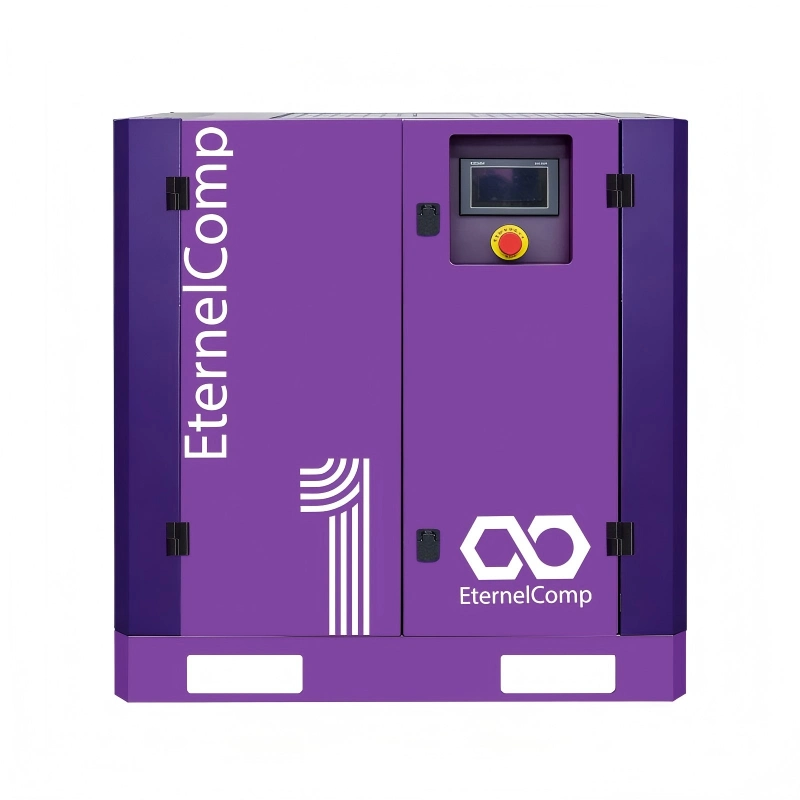
What Is a Good SCFM for an Air Compressor?
There is no universally good SCFM figure. A rating is good only when it exceeds the total simultaneous demand of everything connected downstream, with deliberate margin for leakage, altitude, temperature and future growth. Good and bad are determined from the demand side, never by the number printed on a machine.
Once corrected demand is known, matching it to a capacity band is straightforward. A small workshop running one tool at a time may need only 5 to 30 SCFM. A mid-size fabrication shop with several simultaneous tools usually lands between 50 and 150 SCFM. Plants in food processing, packaging, electronics or laser cutting often run from 300 SCFM upward, where multiple machines and a deliberate loading strategy become normal.
The corrected figure also determines which capacity band to shop in. A site whose measured requirement lands between roughly 80 and 120 SCFM normally fits inside the 100-300 CFM air compressor range once buffer and future load are added, while a requirement above 250 SCFM points toward larger frames and a different control philosophy.
Matching SCFM to Air Tool and Equipment Demand
Tool consumption is the starting point for any demand calculation, and manufacturers publish it on a standardized basis for a reason.
| Tool or end use | Typical SCFM demand and operating pressure |
| Гвоздодер | 0.5 to 1.0 SCFM at 60 to 100 PSI |
| Гвоздодер | 2.2 to 2.5 SCFM at 100 to 130 PSI |
| Half inch impact wrench | 4.0 to 5.0 SCFM at 90 to 100 PSI |
| Four inch angle grinder | 5.0 to 8.0 SCFM at 90 to 100 PSI |
| Шлифовальный станок | 4.5 to 6.0 SCFM at 70 to 90 PSI |
| Orbital air sander | 6.0 to 9.0 SCFM at 90 to 100 PSI |
| HVLP paint sprayer | 6.0 to 12.0 SCFM at 40 to 70 PSI |
| Пескоструйный аппарат | 10 to 20 SCFM or more above 100 PSI |
Two rules keep the total realistic. Add the consumption of every tool that can plausibly run at the same time rather than every tool in the inventory. Then apply a margin: roughly 25 percent for intermittent tools such as nailers, and 50 percent or more for continuous loads such as sanders, sprayers and blast equipment. Totaling a long equipment list by hand is where errors creep in, which is what an Калькулятор производительности воздушного компрессора (CFM) is designed to simplify.
Correcting for Altitude, Temperature and Leakage
A compressor rarely operates at the conditions its nameplate assumes, and three site factors quietly reduce what reaches the tools.
| Site factor | Effect on delivered air and the correction to apply |
| Elevation | A compressor rated 100 SCFM at sea level delivers only about 83 percent of its rated mass flow near 5,000 feet. Specify a larger machine or derate the nameplate by the pressure ratio. |
| Inlet temperature | Each 10 degree rise above the reference trims roughly 2 percent from delivered mass flow. Cool, filtered inlet air is a capacity decision, not only a maintenance one. |
| Humidity | Moisture consumes volume without adding useful air mass, so drying and filtration equipment must be sized on the corrected figure. |
| Leakage | Unmanaged plants typically lose 20 to 30 percent of output to leaks, and poorly maintained systems up to 50 percent. Repairing leaks is usually the cheapest capacity available. |
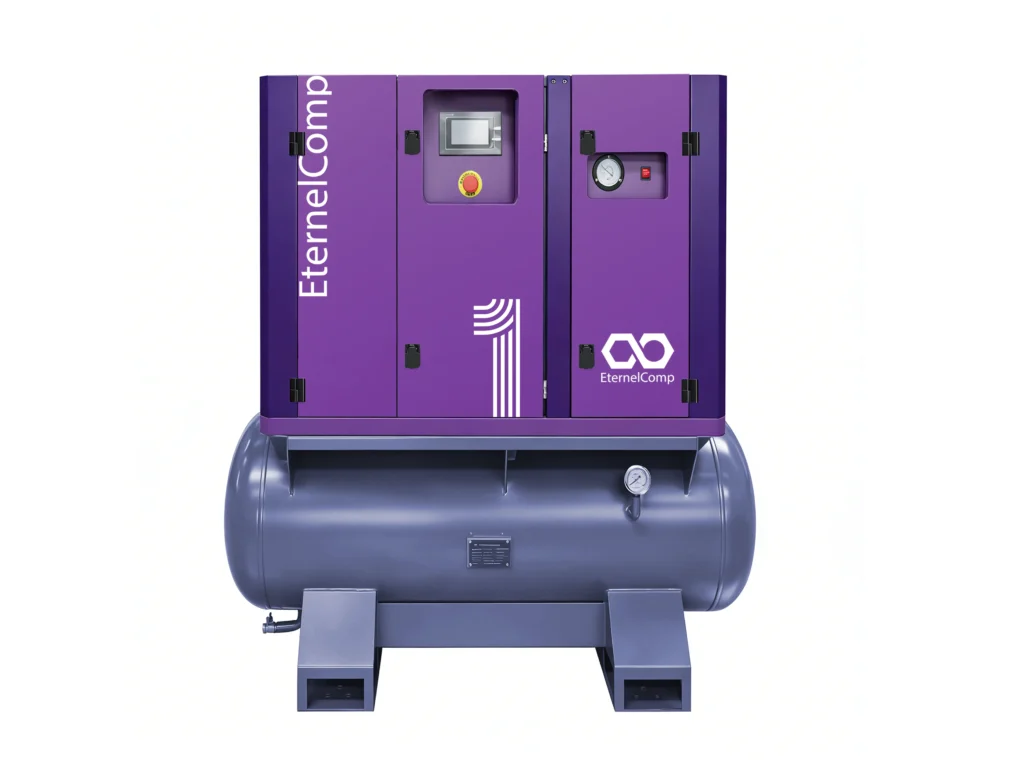
How to Read SCFM on a Compressor Nameplate
A nameplate SCFM figure is only meaningful when read with three companions: the declared reference conditions, the discharge pressure at which the figure applies, and the input power required to reach it. Reading airflow alone is how buyers end up with an undersized machine.
A short checklist covers most of the risk.
- Confirm the reference conditions. If SCFM is quoted without a stated pressure, temperature and humidity basis, treat the figure as provisional until the supplier confirms it.
- Check the discharge pressure attached to the flow figure. Flow ratings usually fall as discharge pressure rises, so a figure quoted at 100 PSI says nothing about performance at 150 PSI.
- Compare input power alongside airflow. Two machines with identical SCFM can differ substantially in kilowatts consumed, so specific power, expressed as kilowatts per 100 SCFM, is the fair comparison.
- Identify the test standard behind the numbers, since ISO 1217 and national test codes can report different values for the same machine.
- Look for independent verification. In North America the CAGI Performance Verification Program publishes third-party tested datasheets for rotary compressors and refrigerated dryers, making published figures checkable rather than merely claimed.
- Ask how the machine behaves at part load, because a unit sized to the last decimal of peak demand may spend most of its life cycling inefficiently.
Часто задаваемые вопросы
The three questions below cover what most often decides whether a compressor performs as promised after installation: gas composition, downstream sizing and the gap between horsepower and airflow.
Does SCFM Apply to Gases Other Than Air?
The concept carries over, but the numbers do not transfer directly. SCFM expresses a volumetric flow at a reference state, and the mass that flow represents depends on the molecular weight and compressibility of the gas. A reference flow of nitrogen or oxygen therefore corresponds to a different mass flow than the same SCFM figure for air. Sizing a compressor to feed an on-site generator means matching the generator’s stated gas demand at its required pressure rather than assuming an air figure applies unchanged.
Should Piping, Dryers and Receivers Be Sized in SCFM or ACFM?
Downstream components are sized on actual volumetric flow at their own operating point, which is ACFM. Pipe diameter, air velocity, dryer contact time and receiver volume all depend on how much space the air occupies inside the system, and that volume shrinks dramatically as pressure rises. Stating a pipe or dryer requirement in SCFM instead of ACFM can understate the physical volume a component must handle by a factor of several. Capacity is compared in SCFM; hardware is specified in ACFM.
Why Do Two Compressors With the Same Horsepower Show Different SCFM?
Horsepower describes the motor, not the airflow. The flow a machine produces depends on the compression element, its speed, the discharge pressure, the package design and drive train losses, so two machines of equal rated power can differ noticeably in delivered SCFM at the same pressure. They can also differ in the power consumed to deliver that flow, which is why specific power is the more useful efficiency comparison and why verified performance data matters more than a headline horsepower number.