Compressed air is one of the most expensive utilities in a plant, and almost every kilowatt drawn by the compressor leaves the package again as heat. How that heat is removed decides whether a machine holds a stable discharge temperature for a decade or trips every July, yet cooling configuration is often the last item on a specification sheet.
For most plants below roughly 75 kW, in a ventilated and reasonably clean room, an air-cooled unit is the lower-cost and lower-risk choice. Water cooling becomes the better answer once output passes about 200 kW, or when the room is enclosed, the ambient air is hot and dusty, or the plant runs continuously, provided treated cooling water is available or can be justified. The question is not which method cools better, because water always does, but whether the site can supply and maintain the water side at a lower total cost than the penalty of rejecting heat to air.
The sections below work through how each circuit removes heat, what it demands from the building, and where the cost curves cross.
How the Two Cooling Systems Remove Heat
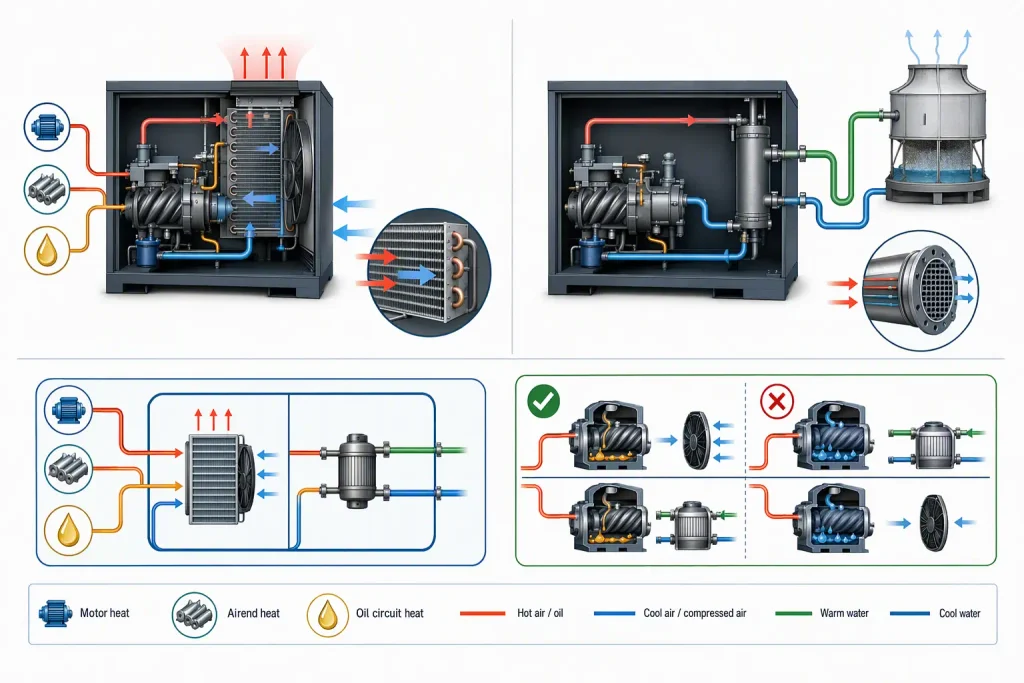
Both designs use the same compression element and the same internal cooling paths. The difference sits at the final heat sink: an air-cooled package rejects heat to the room through finned coils and a fan, while a water-cooled package rejects it to a water circuit through a shell-and-tube or plate exchanger, and from there to a cooling tower or dry cooler.
Inside an Винтовой воздушный компрессор с масляной смазкой, heat arrives from the motor, the airend and the oil circuit. Roughly 90 to 96 percent of electrical input becomes low-grade heat that has to be removed continuously.
The air-cooled cooling circuit
A fan pulls ambient air across a finned block containing the oil cooler and aftercooler and discharges it at the top of the canopy. The cooling limit is the room’s dry-bulb temperature. Aftercooler outlet air sits 10 to 16 K above ambient, and standard packages are rated for a 45 to 46 degrees C intake, with high-ambient versions reaching 50 degrees C.
The water-cooled cooling circuit
A shell-and-tube exchanger replaces the finned block, water on one side and compressed air on the other, normally in counterflow. Because the water comes from a tower, a chiller loop or a plant header, its temperature is largely independent of weather, and the air outlet stays close to 10 K above the water inlet. The package gets smaller and quieter, but the heat has only moved: tower, pump, piping and treatment now carry the burden.
Water-cooled is not water-lubricated
The two terms are routinely confused in procurement. Water-cooled describes the heat rejection medium. Water-lubricated describes what seals and lubricates the compression chamber in oil-free machines. A water-lubricated compressor can be air-cooled, and an oil-injected compressor can be water-cooled.
| Comparison item | Air-cooled | Water-cooled |
| Final heat sink | Room air | Cooling water loop |
| Heat exchanger | Finned coil block | Shell-and-tube or plate |
| Air outlet temperature | Ambient plus 10 to 16 K | Water inlet plus about 10 K |
| Weather sensitivity | Высокий | Очень низкий |
| Auxiliary equipment | Ducting, exhaust fan | Tower, pump, treatment |
What an Air-Cooled Compressor Requires from the Site
An air-cooled unit needs enough fresh air to absorb the heat, an unobstructed path for that air to leave the room, and an intake stream clean enough to keep the coils open. When any one fails, the package derates, alarms or trips on high discharge temperature no matter what the nameplate says.
The ventilation requirement can be estimated before equipment is ordered. A widely used field formula gives room airflow in cubic metres per second as Qv = 0.92 x N / dT, where N is shaft input in kW and dT is the permitted rise above outdoor conditions. For a 110 kW unit and an 8 K rise that is about 12.7 cubic metres per second, or 26,800 cfm. This is room ventilation, not the package fan.
Air velocity through inlet louvres should stay at or below 5 m/s, and openings must not let discharged hot air short-circuit back into the intake, the most common reason a room looks ventilated on paper but runs hot. Where the room cannot be opened, supply and discharge both need ducting within the fan’s available static pressure, a decision that belongs in the air compressor installation plan rather than in a retrofit after the first summer. Dust is the slow failure mode: a fouled coil loses capacity gradually, so the symptom is a rising temperature trend.
What a Water-Cooled Compressor Requires: Flow, Quality and Temperature
A water-cooled package needs three guaranteed inputs: a flow rate matched to the heat load, water chemistry inside the exchanger supplier’s limits, and a supply temperature low enough to hold the required approach. Any one failing shows up as scaling, corrosion or a climbing discharge temperature.
Sizing the cooling water flow
Since almost all shaft power becomes heat, required flow in cubic metres per hour is approximately Q = 0.86 x P / dT, with P as shaft power in kW and dT as the permitted water rise in K. A 200 kW unit designed for a 10 K rise needs about 17.2 cubic metres per hour; tighten the rise to 6 K and the demand jumps to 28.7.
| Shaft power | Rise 10 K | Rise 8 K | Rise 6 K |
| 75 кВт | 6.5 m3/h | 8.1 m3/h | 10.8 m3/h |
| 110 кВт | 9.5 m3/h | 11.8 m3/h | 15.8 m3/h |
| 200 kW | 17.2 m3/h | 21.5 m3/h | 28.7 m3/h |
A design rise of 5 to 10 K is normal; a larger rise saves water and pump energy but lifts the approach and loads the dryer.
Water quality limits
Scale is the dominant failure. A deposit of about 1 mm on the water side can cut exchanger performance enough to push discharge temperature out of range, and no machine adjustment recovers it.
| Параметр | Typical limit | Consequence if exceeded |
| pH | 7.0 to 9.0 | Acid corrosion or alkaline scale |
| Total hardness | below 100 mg/L as CaCO3 | Calcium carbonate scaling |
| Chloride | below 100 mg/L | Pitting of stainless tubes |
| Suspended solids | below 10 mg/L | Fouling and channel blockage |
| Iron and manganese | below 0.3 mg/L | Deposits and biofilm support |
Softening, dosing, side-stream filtration and electronic descaling are the usual countermeasures, and their cost belongs in the comparison.
Open loop, closed loop and towers
An open evaporative tower is the cheapest way to reject heat and the most demanding to keep clean. Make-up covers evaporation plus blowdown, roughly 1.3 to 1.5 times the evaporated volume, and the water needs biocide and scale control. A closed circuit using a dry cooler or an isolating plate exchanger keeps the machine side clean, and is usual where a tube leak would be a contamination event. In freezing climates the loop runs on glycol or drains at shutdown.

Capital Cost, Operating Cost and Ten-Year Cost of Ownership
Air cooling wins on first cost and maintenance simplicity. Water cooling wins on specific power and stability once a unit runs more than roughly 4,000 to 5,000 hours a year at high load. The crossover is set by running hours and by local prices for power, water and treatment.
| Cost item | Air-cooled | Water-cooled |
| Compressor package | Исходные данные | Typically 5 to 15 percent higher |
| Heat rejection equipment | Нет | Tower or dry cooler |
| Pump, piping, instruments | Нет | Pump skid, valves, gauges |
| Water treatment | Нет | Softener or dosing |
| Building works | Ducting, louvres, fan | Pipe penetrations, foundation |
Operating costs are closer than expected. An air-cooled package spends energy on a fan of roughly 2 to 4 percent of motor rating, and dumps its heat into the room, which ventilation or air conditioning must then remove. A water-cooled package spends comparable energy on a pump and tower fan, and adds make-up water, chemicals and blowdown charges. What it gains is a small reduction in specific power, because intake and intercooling temperatures stay low and constant. The honest comparison is a life-cycle assessment rather than a first-cost bid, the method advocated by the Институт сжатого воздуха и газа. Maintenance differs in rhythm rather than total: frequent low-cost coil cleaning against periodic testing, descaling and tower work.
Heat Recovery Changes the Economics
Because nearly all of the electrical input leaves the package as heat, recovery is a design input rather than a side benefit. An air-cooled unit can only offer warm air in winter, whereas a water-cooled unit can deliver 60 to 70 degrees C water all year round.
Air-side recovery is cheap: duct the discharge into the workshop in cold weather and divert it outdoors in summer with a damper, which cuts heating bills but delivers nothing for much of the year in a mild climate. Water-side recovery is continuous, with a plate exchanger on the oil circuit producing hot water at 60 to 70 degrees C for boiler make-up preheat, washdown or process heating; such systems commonly repay within one to three years where a steady hot water demand exists. Recovery only pays when the heat has a continuous destination, and a plant needing hot water around the clock will often justify water cooling on recovery alone.
Site and Environmental Factors That Decide the Case
Five conditions usually settle the argument before cost analysis begins: summer ambient temperature, airborne dust and corrosive gases, available floor and duct space, noise sensitivity, and whether the plant runs continuously. Any one outside the air-cooled envelope effectively makes the decision for you.
An enclosed compressor room with no external wall is the classic case for water cooling, because every pass of cooling air raises room temperature and the room drifts upward until the intake approaches its limit. The cost is not the repair bill but the unplanned stop, and one high-temperature trip on a three-shift line can exceed the entire first-cost difference. Where temperatures are already trending up, the diagnostics in this guide to rotary screw air compressor overheating are worth working through before blaming the cooling type.
The two methods also fail differently. Air-cooled coils foul on the outside, a reversible problem, but aluminium fins in a corrosive atmosphere pit and eventually crumble. Water-cooled exchangers foul on the inside, where deposits are harder to reach, yet the air side stays clean and a dusty room does not affect the package. In humid climates the air-side driving force shrinks as wet-bulb temperature rises, so tropical sites often need a larger coil. A water-cooled package is also more compact and typically a few dB(A) quieter.

Matching Cooling Type to Compressor Size and Application
Cooling type tracks package size. Air cooling dominates below about 75 kW, both options compete between 75 and 160 kW, and water cooling becomes the default above roughly 200 kW, or whenever high pressure and strict air purity push the package into high-heat territory.
| Size band | Usual choice | Причина |
| Up to 75 kW | Air-cooled | Small heat load, often not offered water-cooled |
| 75 to 160 kW | Either, decided by site | Heat load manageable, water availability decides |
| 200 kW and above | Water-cooled | Heat load too large for room air, stability matters |
| High pressure oil-free | Water-cooled | High discharge temperature, tight approach |
| Центробежный | Water-cooled | Large frame, integral intercoolers |
Roughly 80 percent of rotary screw packages in service are air-cooled, and the smallest sizes are frequently available only in that configuration. Variable speed drive and two-stage designs reduce specific power but do not remove the heat; a two-stage machine releases more of it at intercooler temperature, easier to reject but no smaller in total.
Downstream Air Quality and Treatment
Cooling method sets the aftercooler outlet temperature, and that temperature sets the pressure dew point entering the dryer. An air-cooled unit in a 40 degrees C room may deliver air at 52 to 56 degrees C, above the inlet rating of a standard refrigerated dryer, while a water-cooled unit on 30 degrees C water delivers around 38 to 40 degrees C.
The gap comes from approach temperature: air-cooled exchangers hold 8 to 11 K above ambient, water-cooled exchangers 5 to 8 K above the water inlet, with a standard dryer limited to a 45 degrees C inlet. Air cooling in a hot climate therefore shifts cost downstream, requiring a high-temperature dryer, an oversized dryer or a trim aftercooler. Water cooling keeps the dryer inside its envelope and holds a stable dew point, which matters for instrument air, coating, laser cutting and any process where moisture causes rejects. Where purity is contractual, specify it against the classes in ISO 8573-1 and confirm the selected осушитель воздуха для компрессора can hold that class at the actual aftercooler outlet temperature.
A Practical Selection Checklist
Score the site against weighted criteria rather than choosing on the reputation of one method, and verify the water side on site before the purchase order is issued instead of after the tower is delivered.
| Критерий | Вес | Air-cooled verdict |
| Ambient below 40 degrees C | Высокий | Pass |
| Room can be ducted or opened | Высокий | Обязательно |
| Dust or corrosive atmosphere | Высокий | Weak |
| Treated water available | Высокий | Не требуется |
| Annual hours above 5,000 | Средний | Weak |
| Continuous heat demand | Средний | Weak |
| First cost pressure | Средний | Strong |
The survey should record cooling water flow, pressure and inlet temperature; a water analysis covering hardness and chloride; room dimensions and opening area; power headroom for pump and tower fan; the noise limit at the nearest boundary; annual running hours; and whether a heat destination exists. Anything scored as blocking removes air cooling regardless of price, which is why the survey comes before the quotation.
Часто задаваемые вопросы
Can an air-cooled compressor be converted to water-cooled?
It is possible on many oil-injected screw packages, since the internal circuit is unchanged and only the secondary side is replaced, but it is rarely a bolt-on job. It needs a new exchanger or retrofit bundle, a pump, control interface and a revised warranty position. Above roughly 110 kW it is sometimes justified when a room cannot be ventilated; below that, the cost approaches the difference between two new packages.
Do water-cooled compressors consume more water than air-cooled ones?
Yes, but less than most operators expect. Air cooling consumes no water directly, though the ventilation air it needs may load the building cooling system. A unit on an open tower consumes make-up equal to evaporation plus blowdown, typically 1.3 to 1.5 times the evaporated volume, while a closed loop consumes almost nothing.
Which cooling type suits a containerized or outdoor installation?
Air cooling, provided the enclosure allows free airflow and protects drains from frost. Water cooling outdoors only makes sense when a plant loop is already at hand, because an exposed water circuit adds freeze risk, corrosion risk and maintenance that an outdoor air-cooled package avoids.