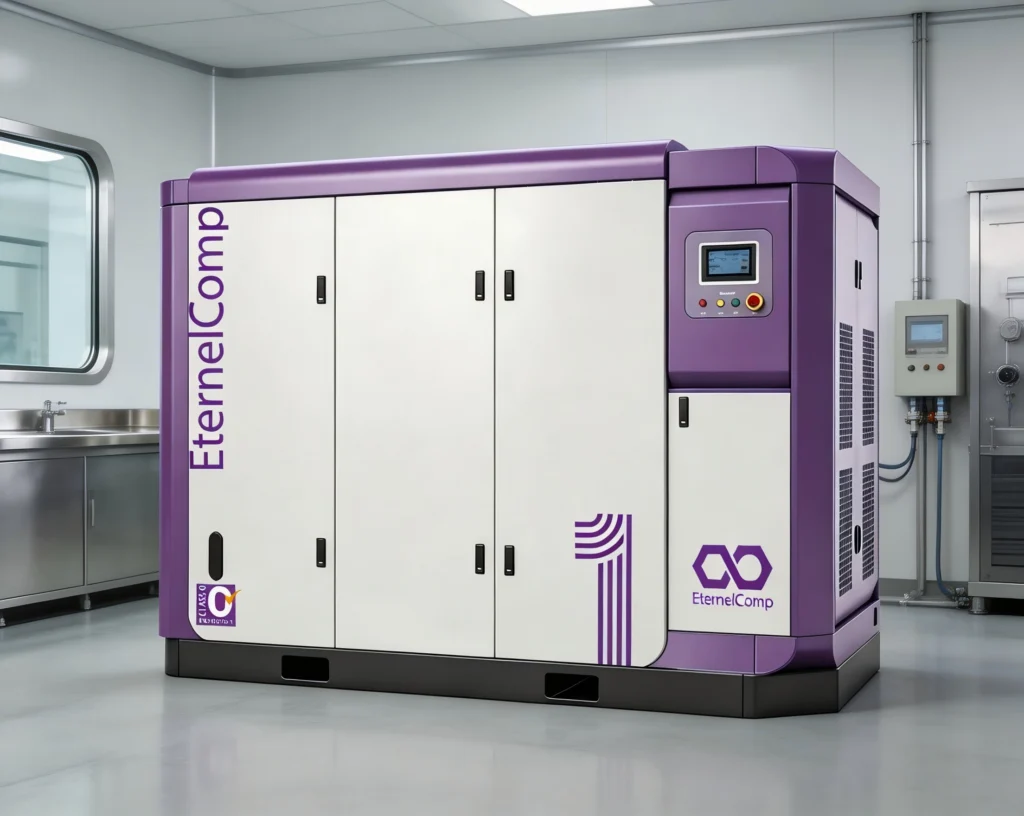
Compressed air reaches deeper into a production line than most plant managers realise. It blows across food before packaging, drives valves in sterile filling rooms, and cools components in electronics assembly. In those places the lubricating oil inside a conventional compressor is a contamination risk rather than a maintenance detail, yet machines are increasingly sold as oil-free and Class 0 without any explanation of what those terms guarantee.
A Class 0 oil-free air compressor is a compressor whose compression chamber contains no lubricating oil, and whose delivered air is verified against ISO 8573-1 Class 0, the strictest purity designation for total oil content. The limit is agreed in writing between the equipment user and the supplier and set tighter than Class 1.
Because the label carries more weight than the two words suggest, it helps to separate three things that are often blurred together: the oil-free design, the Class 0 requirement, and the testing that proves compliance.
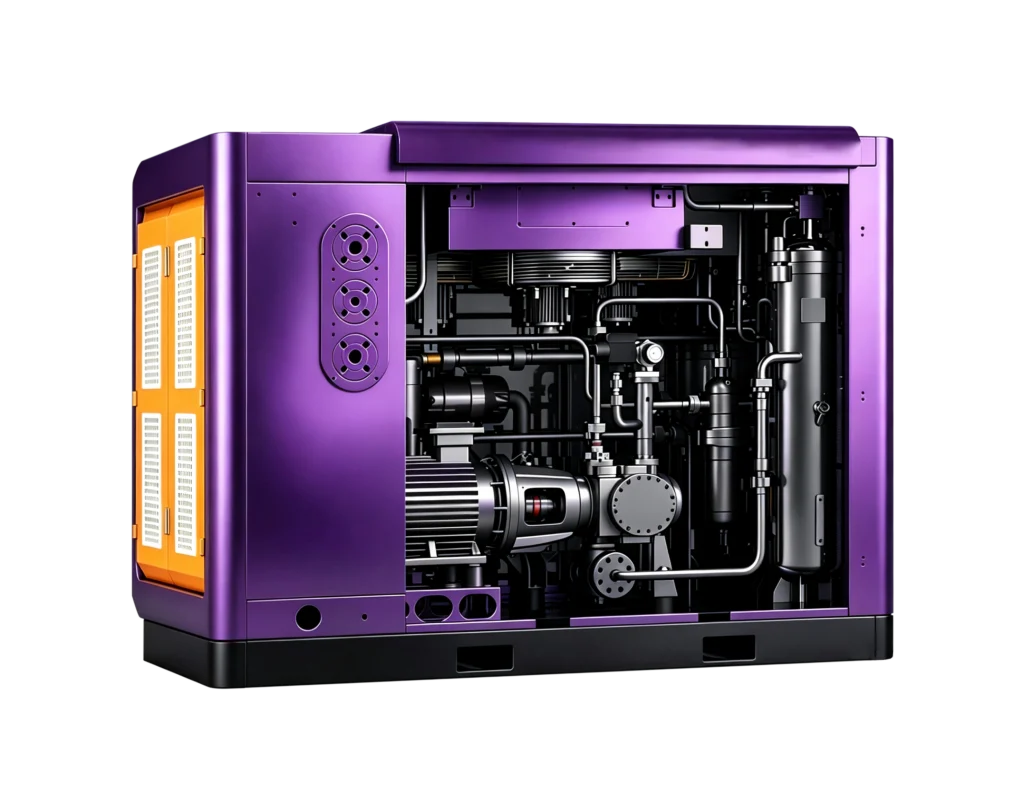
Что такое безмасляный воздушный компрессор класса 0?
A Class 0 oil-free air compressor pairs a compression chamber that never uses lubricating oil with a treatment train that holds measured oil content at or below the agreed Class 0 limit.
In an oil-flooded machine, oil lubricates, seals, and cools the compression elements at once, and a fraction always carries into the air stream however effective the separator is. An oil-free design removes that source. A water film, dry coatings, or precision dry running take over sealing and cooling, while bearings, gears, and the gearbox that still require lubrication are isolated from the air path by seals and controlled pressure. The Безмасляные компрессоры range shows how those designs are built.
How Oil-Free Design Differs From Class 0 Certification
Oil-free describes how a compressor is constructed, while Class 0 describes the measured purity of its delivered air. A machine tested as Class 0 in a clean plant room can drift out of specification once a seal wears or filtration is overdue, so the classification is neither automatic nor permanent.
What Is Class 0 Compressed Air Under ISO 8573-1?
Class 0 compressed air meets the highest purity designation in ISO 8573-1:2010, the international standard that classes compressed air by three contaminants: solid particles, water, and total oil. Class 0 is not a fixed figure and not literally zero contamination. The standard defines it as specified by the equipment user or supplier and more stringent than Class 1, so the exact value is agreed in writing for each installation.
Class 0 is therefore a placeholder for better than the best numbered class, not a measurement, which is why two Class 0 specifications can differ. In practice the value sits within the detection capability of the test methods described in the later parts of ISO 8573, and Class 1, the next grade down, allows up to 0.01 mg of total oil per cubic metre.
ISO 8573-1 Oil Purity Classes Compared
| Пункт | Explanation |
| Класс 0 | Limit agreed between user and supplier and more stringent than Class 1; commonly set at the detection limit of the applicable test method |
| Класс 1 | Total oil not more than 0.01 mg per cubic metre; pressure dew point -70 C; particle counts capped across the 0.1 to 5 micron range |
| 2-й класс | Total oil not more than 0.1 mg per cubic metre; pressure dew point -40 C |
| 3-й класс | Total oil not more than 1 mg per cubic metre; pressure dew point -20 C |
| 4-й класс | Total oil not more than 5 mg per cubic metre; pressure dew point +3 C, typical of general industrial air |
How Class 0 Is Specified and Verified
Air quality is written as a three-part code covering particles, water, and oil, so ISO 8573-1:2010 [1:2:0] means Class 1 for particles, Class 2 for water, and Class 0 for total oil. The official text of ISO 8573-1:2010 confirms that purity classes apply independently of where in the system the air is measured, which is exactly why the sampling location matters, and why verification is periodic rather than a one-off purchase document.
How Does a Class 0 Oil-Free Air Compressor Work?
It eliminates oil at its source rather than removing it after the fact, then protects that purity through isolation, filtration, and monitoring at the point of use.
Core Design Principles That Keep Oil Out
- Source elimination, because no lubricant enters the compression chamber and there is no oil aerosol to separate out.
- Physical isolation, with bearings, gears, and lubricated shafts sealed off from the air path by double seals and controlled crankcase pressure.
- Substituted sealing and cooling, using a water film, dry coatings, or close-tolerance dry running in place of oil.
- Continuous monitoring of temperature, dew point, and differential pressure to reveal drift before it becomes a compliance failure.
Why Downstream Treatment Still Matters
Removing oil from the machine leaves the other two categories unmanaged. Water is produced by compression itself and by humid intake air, while particles enter with the intake or form as corrosion and pipe scale. Dryers, coalescing elements, and activated carbon protect all three classes together, and activated carbon is the stage that adsorbs the oil vapour mechanical filtration cannot capture. The available Воздушные фильтры are rated by the class they support rather than by size alone.
Types of Oil-Free Compressors That Can Deliver Class 0 Air
Class 0 air can be produced by several compressor technologies, which differ mainly in how the compression chamber seals and cools itself without oil and in the airflow range each covers.
The Four Main Compressor Types Explained
Compressors are first divided by working principle. Positive displacement machines trap a fixed volume of air and reduce the space it occupies, while dynamic machines accelerate the air and convert velocity into pressure.
- Piston or reciprocating compressors use a piston inside a cylinder and suit intermittent demand, though oil-free versions are limited in size.
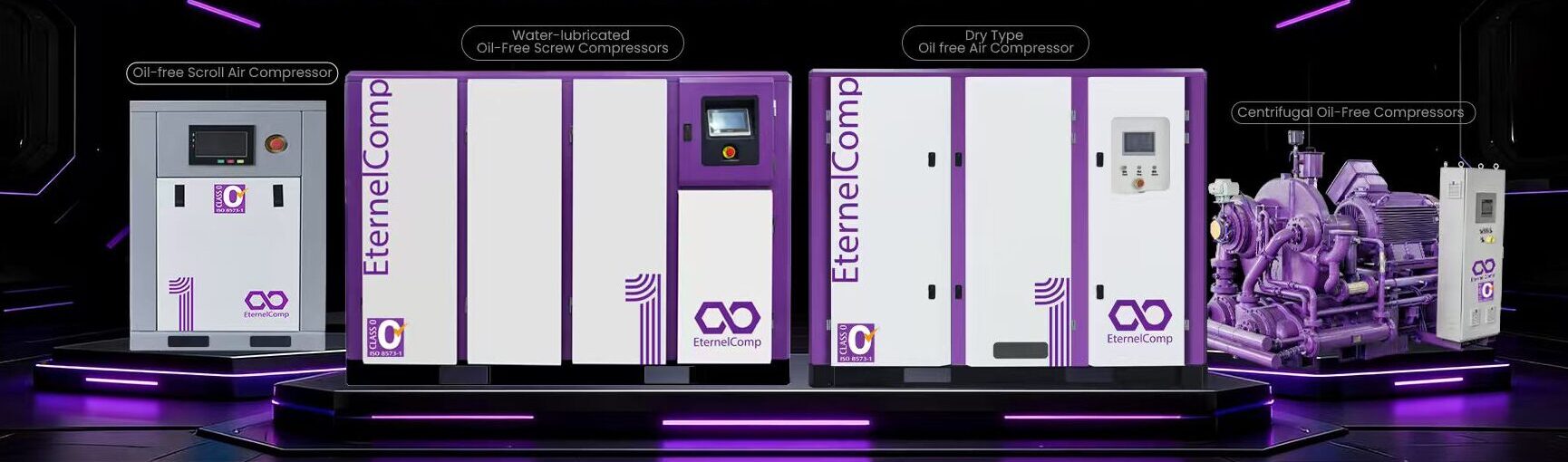
- Rotary screw compressors use two intermeshing rotors, deliver continuous flow, and are the standard choice for industrial duty.
- Scroll compressors trap air between a fixed and an orbiting spiral and suit small to medium oil-free flows.
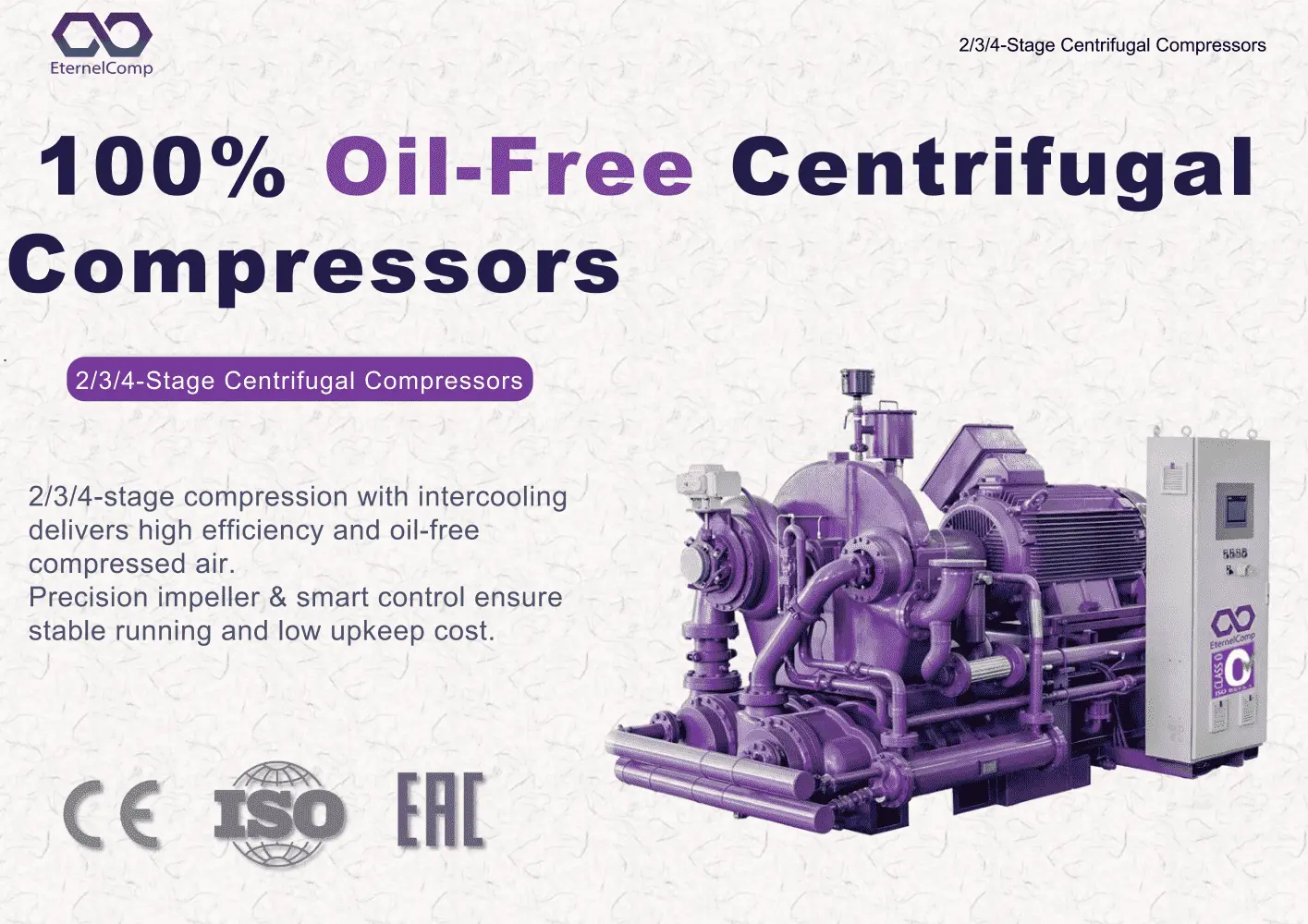
- Centrifugal compressors use a high-speed impeller, are inherently oil-free in the compression path, and serve very large steady flows.
This division into positive displacement and dynamic compression is described in the reference entry for an Воздушный компрессор.
Безмасляные ротационные винтовые компрессоры
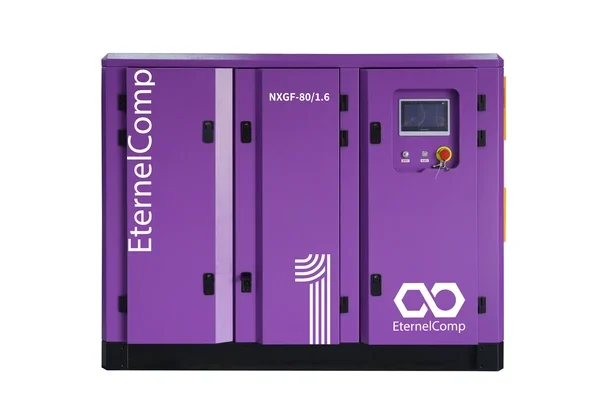
These dominate continuous industrial duty because they run without valves and cover large flow ranges. Oil-free versions seal by water injection or precision dry running, and the Безмасляный винтовой воздушный компрессор comparison shows how that approach stands against water-lubricated and centrifugal alternatives.
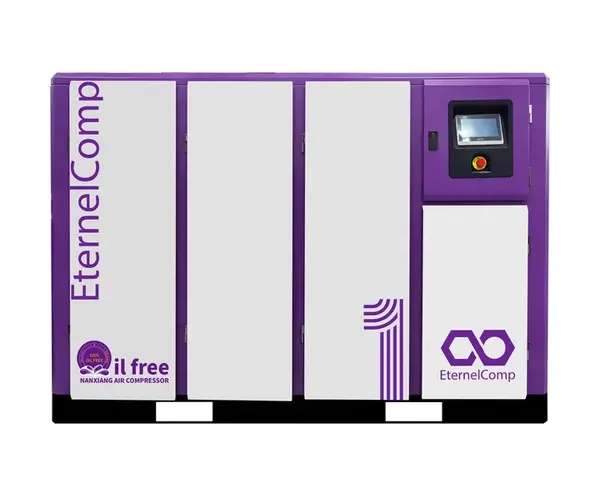
Безмасляные спиральные компрессоры
Scroll machines have few moving parts and low vibration, which makes them common in laboratories, dental and medical air systems, and small food applications. Their output is modest, so they are usually installed in modular banks.
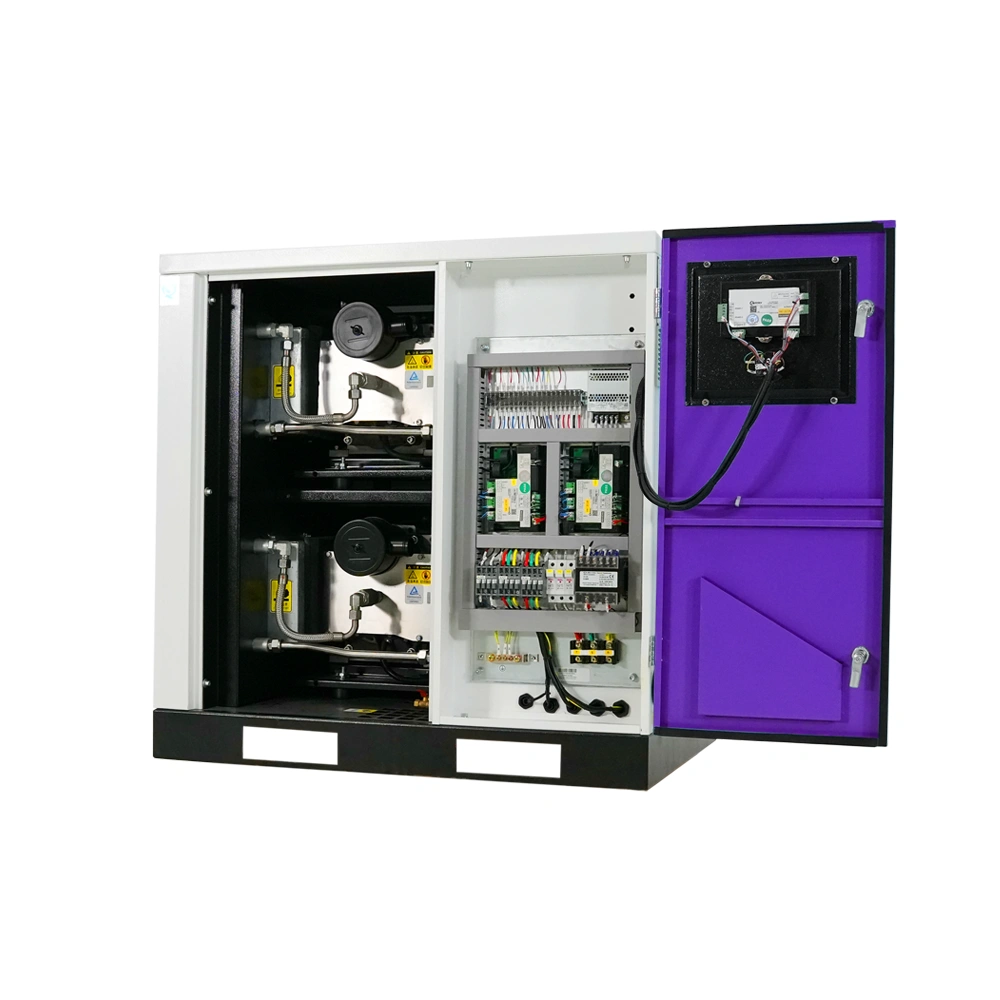
Oil-Free Centrifugal Compressors
Centrifugal machines are built for high volume and steady load, and their compression path contains no oil by design. They become inefficient when demand fluctuates widely, so they act as base-load machines in large plants.
Oil-Free vs Oil-Flooded Compressors: Which Is Better?
Neither is better in the abstract. An oil-free compressor is correct when compressed air contacts a product, a sterile surface, or a process in which trace oil would cause defects or regulatory failure, while an oil-flooded compressor stays the more economical option when the air never touches the product.
Side-by-Side Comparison
| Aspect | Oil-free versus oil-flooded |
| Oil in the compression chamber | None in an oil-free machine; continuously injected and circulated in an oil-flooded machine |
| Achievable air purity | Class 0 achievable and sustainable at the point of use; oil-flooded machines generally reach only Class 1 or lower even with heavy filtration |
| Первоначальная стоимость | Higher for oil-free, because of tighter tolerances, special materials, and larger cooling packages |
| Consumables and maintenance | No oil changes or oil filter disposal in the compression path, against regular oil, filter, and separator changes |
| Efficiency behaviour | Dry-running oil-free designs can lose efficiency at part load, while oil-flooded machines benefit from oil sealing and cooling |
| Типичные применения | Food and beverage, pharmaceutical, medical, electronics, semiconductor, cleanroom, lithium battery |
| Риск загрязнения | Concentrated in auxiliary lubricated parts and seal condition for oil-free, and in separator performance and maintenance discipline for oil-flooded |
When an Oil-Flooded Compressor Is Still the Right Choice
For non-contact duties, insisting on Class 0 adds capital cost without reducing real risk, since air that merely drives a cylinder or clears debris from a concrete floor does not need the tightest oil class. The decision should follow the process requirement rather than a default preference for the highest specification on the datasheet.
Are Oil-Free Compressors Really Oil-Free?
The compression chamber is genuinely oil-free, but the delivered air is not automatically oil-free. Residual hydrocarbons can still reach the air by three other routes, which is why Class 0 is verified by measurement at the point of use rather than assumed from the machine design.
The Three Sources of Residual Oil in Compressed Air
- Intake air, because ambient air in industrial areas already carries oil vapour and hydrocarbons from traffic and nearby processes, and compression concentrates whatever is drawn in.
- Internal isolation failure, because bearings, gears, and gearbox lubrication still exist, and a worn seal can let trace vapour migrate into the air path.
- The downstream system, because piping, receivers, and condensate traps can harbour oil from previous equipment, contaminating air that left the compressor clean.
Industries and Applications That Require Class 0 Air
Class 0 air is required wherever compressed air comes into direct contact with a sensitive product or a sterile surface, because oil contamination there is a product safety and regulatory matter rather than an equipment performance matter.
Переработка продуктов питания и напитков
Air used to blow off, convey, or package food, and air used to form packaging materials, can deposit oil directly onto the product. Contamination of this kind has triggered recalls and failed audits, and food safety schemes expect demonstrable control of oil, water, and microbiological quality in food contact air. The sector requirements are set out in the guide to an Air Compressor for Food Processing.
Pharmaceutical and Medical
Process air in pharmaceutical manufacturing, sterile filling, and medical device production is subject to validated specifications and audit scrutiny, and the acceptable oil level is effectively set by what testing can detect.
Electronics and Semiconductor
Fabrication and precision assembly are damaged by contamination far below the thresholds that matter elsewhere, so dry oil-free air with a tightly controlled dew point is standard.
Other Regulated Applications
Lithium battery material production, precision coating and painting, cleanroom processes, and some laser cutting operations also specify Class 0 air, because trace oil alters surface chemistry in ways that cannot be corrected afterwards.
Cost and Total Cost of Ownership Considerations
A Class 0 oil-free compressor costs more to buy than an equivalent oil-flooded machine and is often cheaper to run in the sectors that need it, because savings come from eliminated oil changes, reduced consumables, fewer stoppages, and avoided recall or compliance costs.
Cost Drivers Across the Lifecycle
| Cost area | What to examine |
| Капитальные затраты | Tighter tolerances, specialised coatings or water systems, and larger cooling packages raise the purchase price |
| Energy use | Specific power at the actual duty point, not at full load, determines running cost |
| Расходные материалы | Oil-free designs avoid oil, oil filters, and separator elements, but still consume air filters, dryer media, and wear parts |
| Maintenance labour | Fewer fluid changes, but more specialised service skills and potentially higher component costs |
| Compliance and risk | Documentation, periodic purity testing, and audit preparation recur, offset by a lower probability of rejection or recall |
| Время простоя | A contamination event can halt production for cleaning and requalification, and this usually outweighs every other line |
Where Overspecifying Class 0 Wastes Money
Specifying Class 0 for air that never contacts a product raises capital cost and can raise energy use through the pressure drop of unnecessary filtration, without any measurable reduction in risk. Industry bodies such as the Compressed Air and Gas Institute promote system-level assessment precisely because matching supply to genuine demand is where most of the savings lie.
How to Choose the Right Class 0 Oil-Free Air Compressor
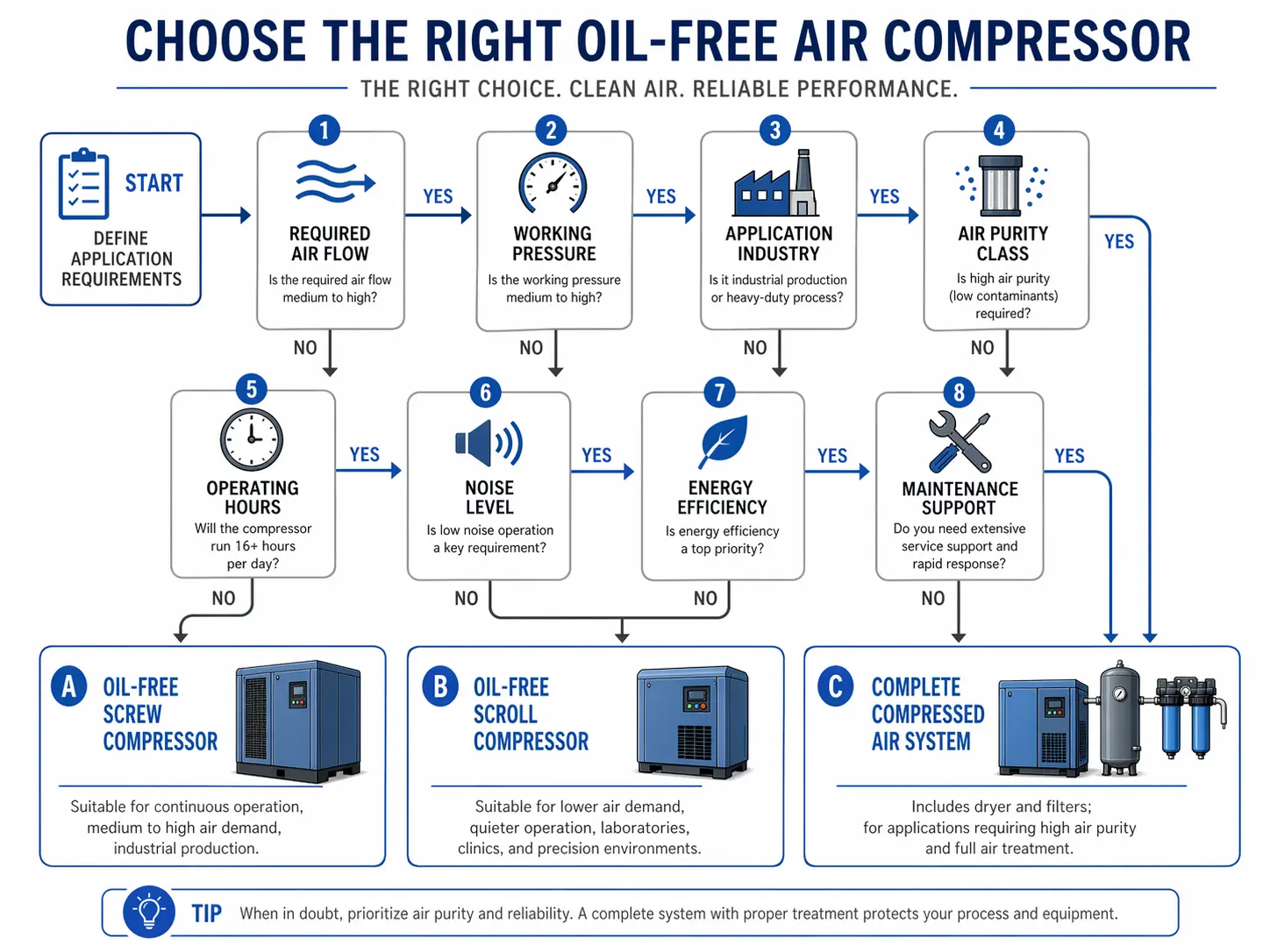
Choosing well means starting from the point of use rather than from the compressor, then confirming that the machine and its treatment hold the agreed purity under real operating conditions and that the supplier will document how it is verified.
Specification Checklist for Buyers
- Define the required air quality as a full three-part code, including the exact oil figure agreed for Class 0.
- Determine airflow and pressure at the point of use, including future expansion and pressure drop through treatment.
- Confirm the dew point requirement from the process, since the water class drives dryer selection and cost.
- Check how the oil-free design seals and cools, and how lubricated auxiliary components are isolated and monitored.
- Specify the treatment train and its maintenance intervals, including the activated carbon stage for oil vapour.
- Require documented test results, the sampling location, and the test method, and repeat the test on a defined schedule.
- Assess ambient intake conditions, because polluted intake air raises the load on every downstream stage.
- Review service capability and spare parts availability across the intended service life.
Общие ошибки, которых следует избегать
- Assuming an oil-free nameplate is the same as verified Class 0 air at the point of use.
- Sampling at the compressor outlet and ignoring the real distribution system.
- Omitting treatment because the machine is oil-free, leaving water and particle classes unmanaged.
- Leaving purity testing out of the maintenance plan until an audit forces the issue.
- Overspecifying Class 0 for non-contact duties and paying for purity the process does not need.
Часто задаваемые вопросы
These questions extend beyond the definitions above and address how a Class 0 oil-free compressor behaves in service, what still has to be maintained, and how often the classification must be re-proven.
Can Class 0 oil-free compressed air be used for breathing air?
Not on the basis of the oil class alone. Breathing air is governed by separate standards that set limits for oxygen, carbon monoxide, carbon dioxide, and moisture as well as oil, and they also require the air to be free of odour and taste. A Class 0 compressor can form part of a breathing air system, but that system must be built and tested specifically against the breathing air standard.
Do Class 0 oil-free compressors still need oil changes?
Usually yes. The compression chamber uses no oil, but bearings, gears, and the gearbox are still lubricated in many designs, and that oil has a defined service life. What disappears is the large volume of lubricant and the associated oil filter and separator changes that a flooded rotary screw machine requires, so maintenance planning should centre on the lubrication that remains.
How often should you test compressed air purity to maintain Class 0 compliance?
Annual testing is a common baseline for regulated food and pharmaceutical applications, with extra checks after major maintenance or system modification. Continuous monitoring of dew point, differential pressure, and temperature between formal tests detects drift early, since a compressor can move out of specification long before the next laboratory sample.