
Cuando se trata de sistemas industriales de aire comprimido, el compresor de aire de tornillo rotativo lubricado por aceite es probablemente uno de los más utilizados, y con razón. Es fiable, relativamente eficiente para aplicaciones de trabajo continuo y, sinceramente, ha sido la columna vertebral de las plantas de fabricación y procesamiento durante décadas. Pero, ¿qué es exactamente y cómo funciona? Vamos a explicarlo.
Lubricado por aceite, rotativo, de tornillo: ¿qué significan realmente estas palabras?
Antes de entrar en la mecánica, merece la pena detenerse en el propio nombre. Compresor de aire de tornillo rotativo lubricado por aceite” es un trabalenguas, pero cada palabra tiene un significado real.
Lubricado con aceite
Lubricado con aceite describe un método utilizado para lubricar. Se inyecta aceite continuamente en la cámara de compresión para lubricar las piezas móviles, sellar las holguras internas y absorber el calor. El compresor lubricado con aceite se diferencia de un compresor “sin aceite” en que los rotores funcionarán en seco (o con agua) y requieren tolerancias mecánicas para compensarlo.
Rotary
Rotary describe el tipo de movimiento. A diferencia de los compresores alternativos (de pistón), que se mueven hacia delante y hacia atrás en una carrera lineal, esta máquina comprime el aire mediante un movimiento de rotación continuo, sin puntos muertos ni inversiones de dirección. Esta es una de las razones por las que funciona tan bien en servicio continuo.
Tornillo
Tornillo se refiere a la geometría del rotor. Los dos rotores helicoidales entrelazados parecen, más o menos, un par de tornillos engranados. Al girar, los perfiles de las roscas atrapan y comprimen progresivamente el aire a lo largo del rotor hasta que sale por el orificio de descarga.
Si lo juntamos todo, el nombre es básicamente una descripción funcional de la máquina que, una vez que se sabe qué buscar, hace que sea mucho más fácil entender por qué se comporta como lo hace.
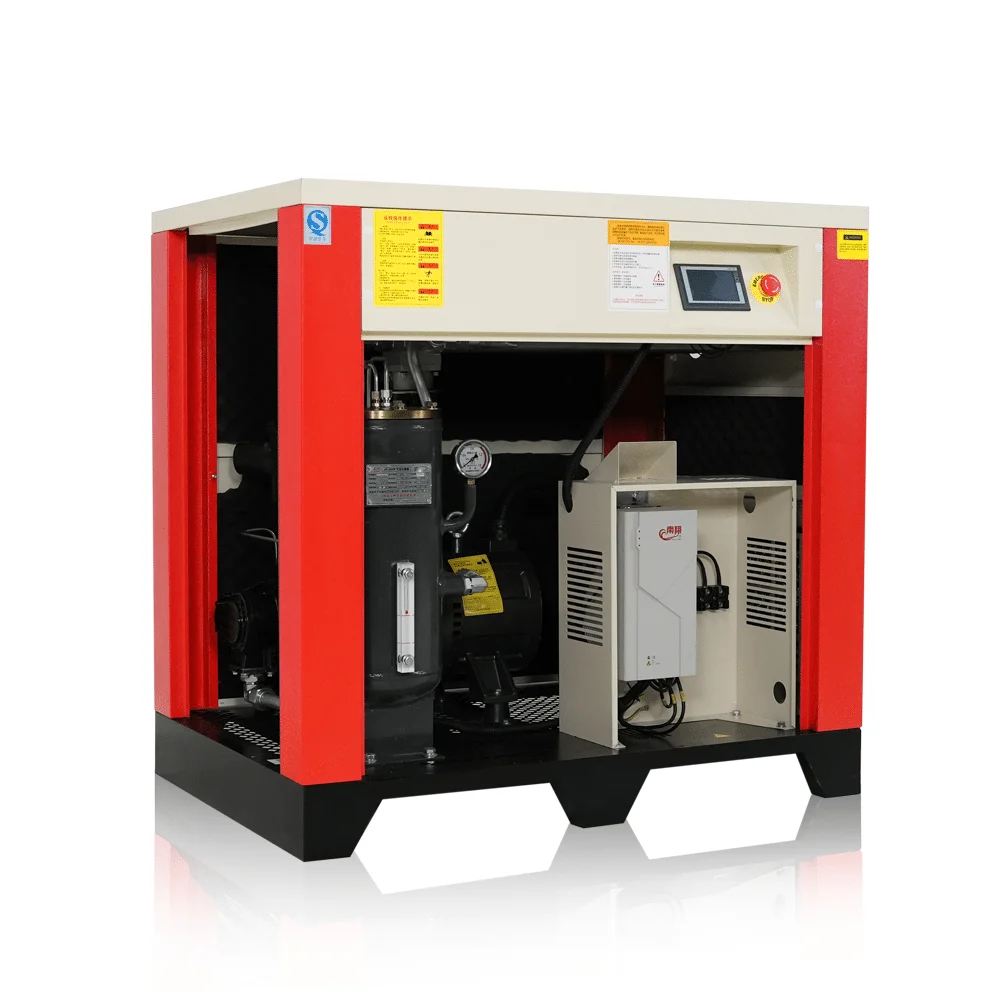
¿Cómo funciona un compresor de aire de tornillo rotativo lubricado por aceite?
En el centro de cada compresor de aire de tornillo rotativo lubricado por aceite son dos rotores helicoidales entrelazados -un rotor macho y un rotor hembra- que giran en sentidos opuestos dentro de una carcasa mecanizada con precisión. Cuando el aire entra por la válvula de admisión, queda atrapado entre los lóbulos del rotor. El volumen disminuye a medida que giran los rotores, lo que comprime el aire. Simple en principio, sorprendentemente elegante en su ejecución.
El petróleo desempeña aquí varios papeles fundamentales:
- Lubricación - reduce el desgaste entre los rotores y la carcasa
- Sellado - el aceite rellena los pequeños espacios entre rotores, mejorando la eficacia de la compresión
- Refrigeración - absorbe el calor generado durante la compresión, evitando el sobrecalentamiento
- Amortiguación acústica - ayuda a reducir el ruido de funcionamiento en comparación con las alternativas de funcionamiento en seco
Tras la compresión, la mezcla de aceite y aire pasa por un separador de aceite donde ambos se dividen. El aire comprimido va corriente abajo, y el aceite se enfría y recircula. Este diseño de circuito cerrado es lo que hace que estas máquinas sean duraderas durante largas horas de funcionamiento.
Componentes clave de un compresor de aire de tornillo rotativo lubricado por aceite
Entender lo que hay dentro puede ser sorprendentemente útil, sobre todo a la hora de solucionar problemas o evaluar una compra.
1. Unidad compresora (elemento roscado)
Es el corazón de la máquina. La etapa de compresión aloja los rotores macho y hembra y es donde se produce la compresión real. La calidad de la etapa de compresión determina en gran medida la vida útil y la eficiencia del compresor.
2. Tanque separador de aceite
Tras la compresión, el aire cargado de aceite entra en este depósito. Un elemento separador coalescente elimina la mayor parte del aceite, normalmente hasta 2-5 ppm (partes por millón) de contenido residual de aceite, aunque las unidades premium pueden llegar a menos.
3. Enfriador de aceite y postenfriador de aire
La gestión del calor es crucial. El refrigerador de aceite devuelve el aceite recirculante al rango de temperatura de funcionamiento, mientras que el postenfriador reduce la temperatura del aire comprimido antes de la impulsión.
4. Válvula de entrada y sistema de control
Las unidades modernas vienen con válvulas de entrada variables o modulantes emparejadas con controladores electrónicos. Estos regulan la capacidad, gestionan los ciclos de carga/descarga y proporcionan diagnósticos del sistema.
5. Sistema de accionamiento
La mayoría de los compresores de aire de tornillo rotativo lubricados con aceite utilizan uno u otro:
- Accionamiento directo (eje del motor acoplado directamente al bloque compresor)
- Transmisión por correa (más flexibilidad para ajustar la velocidad, más fácil de mantener)
- Transmisión por engranajes (común en grandes unidades industriales de alta velocidad)
Compresores de tornillo rotativo lubricados por aceite vs. sin aceite
Una pregunta que surge a menudo y que, sinceramente, merece la pena abordar directamente.
| Característica | Lubricado con aceite | Sin aceite |
|---|---|---|
| Pureza del aire | Clase 1-4 (ISO 8573-1) | Clase 0 (realmente sin aceite) |
| Coste inicial | Baja | Significativamente superior |
| Complejidad del mantenimiento | Moderado | Más alto |
| Nivel de ruido | Moderado | Normalmente más alto |
| Aplicaciones típicas | Industria general, automoción, alimentación y bebidas | Farmacia, electrónica, medicina |
| Vida útil | Larga duración (con un mantenimiento adecuado del aceite) | Larga, pero sensible a la contaminación |
| Eficiencia energética | Bien | Ligeramente inferior en muchos casos |
El compresor de aire de tornillo rotativo lubricado por aceite gana en coste y durabilidad en la mayoría de los entornos industriales generales. La versión exenta de aceite es necesaria cuando es inaceptable incluso la contaminación por trazas de aceite: fabricación de productos farmacéuticos, fabricación de semiconductores, etc.
Aplicaciones comunes
Compresores de tornillo lubricados por aceite son caballos de batalla en una amplia gama de industrias:
- Talleres de montaje y carrocería de automóviles
- Carpintería y fabricación de muebles
- Procesado de alimentos y bebidas (donde la filtración posterior se encarga del aceite)
- Talleres de soldadura y fabricación de metales
- Moldeo de plásticos
- MRO general (mantenimiento, reparación y operaciones) en grandes instalaciones
Son especialmente adecuados para aplicaciones que requieren funcionamiento continuo o casi continuo - digamos, un ciclo de trabajo de 60-100%. Los compresores alternativos (de pistón) tienden a tener problemas con ese tipo de demanda, mientras que las unidades de tornillo rotativo la soportan sin sudar.
Ventajas y limitaciones
Ventajas
- Funcionamiento continuo sin sobrecalentamiento
- Tamaño compacto en relación con la capacidad
- Menos ruido y vibraciones que los compresores de pistón
- Largos intervalos de servicio (algunos modelos hasta 4.000-8.000 horas entre cambios de aceite)
- Amplia gama de capacidades: desde 5 CV hasta más de 500 CV.
Limitaciones
- Arrastre de aceite residual en el aire comprimido (requiere filtración posterior para aplicaciones sensibles)
- Mayor coste inicial que los compresores alternativos comparables
- Requiere el tipo de aceite adecuado y el cumplimiento de los intervalos: el uso de un lubricante incorrecto es una causa sorprendentemente común de fallo prematuro.
- No es ideal para aplicaciones muy intermitentes y de bajo ciclo de trabajo, en las que un compresor de pistón podría resultar más económico.
Cómo elegir el compresor de aire de tornillo rotativo lubricado con aceite adecuado
Algunas cosas que vale la pena considerar antes de comprar:
- Caudal requerido (CFM/m³/min) - El error más común es no dimensionar correctamente. Calcule su demanda máxima real y añada 20-25% de amortiguación.
- Presión de funcionamiento (PSI/bar) - La mayoría de las unidades industriales funcionan a 100-125 PSI. Existen modelos de mayor presión, pero consumen más energía.
- Velocidad fija frente a variador de velocidad (VSD) — Los VSD funcionan a velocidad variable, aproximadamente 30-40% más eficientes que los motores tradicionales de velocidad fija para aplicaciones de carga variable. Además, el sistema de refrigeración que elija dependerá de las necesidades de su aplicación;
- Método de refrigeración — Las unidades refrigeradas por aire suelen ser más fáciles de utilizar que los sistemas refrigerados por agua. Sin embargo, también se recomiendan para su uso en temperaturas ambiente de 40 °C o superiores o con un gran número de unidades de refrigeración.
- Compatibilidad con el tipo de aceite — Muchos fabricantes especifican lubricantes patentados o sintéticos. Tenga esto en cuenta en los costes de explotación a largo plazo.
Preguntas frecuentes
¿Con qué frecuencia debe cambiarse el aceite de un compresor de tornillo rotativo lubricado por aceite?
La respuesta depende del fabricante, el tipo de aceite y las condiciones de funcionamiento. Los aceites minerales deben cambiarse cada 2.000 a 4.000 horas, mientras que los lubricantes totalmente sintéticos pueden contribuir a ampliar el intervalo de cambio de aceite a 6.000 a 8.000 horas o más en muchos casos. Si trabaja en entornos polvorientos o con altas temperaturas, prevea que los periodos de cambio de aceite se reduzcan considerablemente. Siga el programa de mantenimiento de su OEM en lugar de las estimaciones generales.
¿Puede utilizarse un compresor de tornillo rotativo lubricado por aceite para aplicaciones de aire respirable o en contacto con alimentos?
No, no directamente. Los aceites residuales en la salida de aceites sin procesar hacen que no sea seguro suministrar salidas sin procesar para inhalación, así como para contacto directo con alimentos dentro del rango de 2-3 ppm. Para obtener un aire de calidad que cumpla esas especificaciones, es necesario utilizar filtros multietapa aguas abajo (por ejemplo, filtros coalescentes de dos etapas y varios pares de torres de filtros de carbón activado) junto con una supervisión continua de los vapores de aceite. No obstante, en muchas instalaciones alimentarias se utilizan piezas lubricadas con aceite; sin embargo, el método de filtración debe diseñarse correctamente y verificarse de forma periódica.
¿Cuál es la causa del consumo excesivo de aceite en un compresor de tornillo rotativo y es siempre señal de un problema grave?
No siempre, pero merece la pena investigarlo. Los culpables más comunes son un elemento separador de aceite saturado o dañado, el llenado excesivo del depósito de aceite, el funcionamiento a baja presión o con tiempos de ciclo cortos que impiden una separación adecuada del aceite, o un retén del eje defectuoso. En muchos casos se trata de un problema de mantenimiento más que de un fallo mecánico. Dicho esto, ignorar el elevado arrastre de aceite puede contaminar los equipos y herramientas posteriores, por lo que merece la pena diagnosticarlo cuanto antes.