
Rotary screw compressors have become the default choice for industrial compressed air because they deliver high flow from a compact package with few wearing parts. As more plants specify them for assembly lines, packaging, and laser cutting, one question keeps coming up during layout and budgeting: the compressor is the expensive item, so is a receiver tank still necessary? Floor space is tight and many units ship as all in one packages, so the answer deserves more than a plain yes.
For nearly every industrial, commercial, or workshop installation the answer is yes: a compressore rotativo a vite needs an air receiver tank, and the tank volume should be sized to the demand pattern rather than chosen by habit. A screw compressor can physically run with no storage at all, but it will cycle more often, hold pressure less steadily, run hotter, and consume more energy per cubic meter of air delivered. The only cases where a receiver can be honestly omitted involve demand that is continuous, steady, and closely matched to compressor output.
The sections below explain what each component does, how control strategy changes the storage requirement, and how to size a receiver without guesswork.
What Is the Purpose of a Rotary Screw Air Compressor?
Its purpose is to produce a continuous, high volume supply of compressed air at a stable pressure over long duty cycles. Unlike a piston compressor that fills a tank in bursts, a screw compressor is designed to run loaded for hours and to act as the backbone of a plant wide air system.
Two meshing helical rotors trap air in a decreasing cavity and squeeze it toward the discharge. In an oil-lubricated rotary screw air compressor, oil seals the clearances, absorbs heat, and carries it to a cooler, which allows high flow from a small frame. Oil-free designs time the rotors with gears and seal with water or coated surfaces, which matters for food, medical, and electronics duty. Either way the machine is a flow device, rated in CFM at a stated pressure, whose efficiency depends on running near its design point for long periods. Plant demand is rarely that steady, so the gap between supply and draw must be absorbed somewhere.
Is a Rotary Compressor the Same as a Screw Compressor?
Rotary is a family name covering screw, vane, scroll, and centrifugal designs. Screw dominates in industrial sizes, so the terms are often used interchangeably, but they are not identical. A centrifugal machine has a different part load curve, surge behavior, and storage requirement, and performance figures cannot be transferred between them. Rotary screw means a twin rotor positive displacement compressor with a fixed volume ratio.
What Is the Difference Between an Air Receiver Tank and an Air Compressor?
The compressor converts electrical or fuel energy into compressed air flow, while the receiver is a passive pressure vessel that stores that air. The compressor decides how much air the system can produce per minute; the receiver decides how much is available instantly, before the compressor has time to react.
| Aspetto | Compressore d'aria | Air Receiver Tank |
| Primary function | Generates compressed air flow | Stores compressed air volume |
| Energy input | Electric motor or engine | None, passive vessel |
| Capacity rating | CFM at a stated pressure | Volume in liters or gallons, plus design pressure |
| Position in system | Supply side, upstream | Between supply and demand |
| Attenzione alla manutenzione | Oil, filters, coolers, valves | Drain, inspection, relief valve testing |
A larger receiver does not increase compressor output, which is the most common misunderstanding in system design. If a plant needs 120 CFM and the compressor delivers 100 CFM, no tank size closes that gap for more than a short burst. A receiver only shifts air through time, accepting flow when demand is below supply and returning it when demand spikes.
Do Rotary Screw Compressors Run Constantly, and Why Does That Decide the Tank?
Fixed speed rotary screw compressors do run constantly while the system is pressurized, because the motor keeps turning when the inlet valve closes and the machine is unloaded. Variable speed units reduce speed instead of stopping, and both strategies rely on stored air to avoid short, wasteful cycles.
In load and unload operation the compressor runs loaded until pressure reaches the upper set point, then closes its inlet valve until pressure falls to the lower set point. An unloaded screw compressor still spins at full speed and typically draws 20 to 35 percent of full load power while producing no useful air, so unloaded time is a direct energy loss. With a small receiver, pressure collapses quickly, the machine reloads almost immediately, and a full cycle may take only 20 or 30 seconds. With adequate storage the same machine stays unloaded longer and delivers the same air with fewer transitions. Many manufacturers also specify a minimum of about 30 seconds per cycle, with one cycle per minute preferred, to protect the motor and let the airend stabilize thermally.
Load and Unload, Modulation, and Variable Speed Compared
| Control type | Running behavior | Typical pressure band | Storage dependence |
| Fixed speed load and unload | Motor runs continuously, inlet valve opens and closes | Wide, often 1 to 2 bar | High, roughly 3 to 5 gallons per CFM |
| Modulation | Flow reduced by throttling the inlet | Moderato | Moderate, efficiency falls at part load |
| Variable speed drive | Speed follows demand | Narrow, often 0.2 to 0.5 bar | Lower, roughly 1 to 3 gallons per CFM |
Variable speed is often marketed as removing the need for storage, which is misleading. A drive follows average demand closely, but it cannot answer a step change such as three tools starting at once, and it cannot help when demand briefly exceeds maximum speed. For a closer comparison, see this guide to VSD vs fixed-speed control.

What an Air Receiver Actually Does in a Rotary Screw System
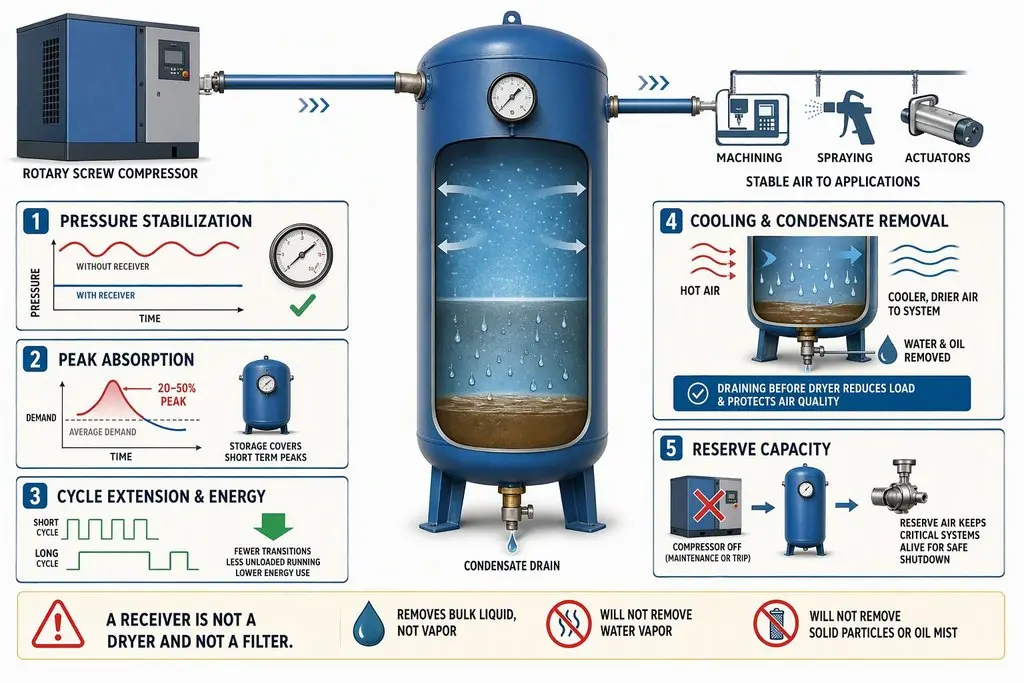
It performs five jobs: stabilizing system pressure, absorbing short term peaks, extending the compressor cycle, cooling air and dropping out bulk condensate, and holding a reserve of air when the compressor stops. Each affects reliability or energy cost, and most affect both.
- Pressure stabilization. Every valve opening and blow off event creates a disturbance. A receiver gives it somewhere to go, so pressure at the point of use holds steady. Machining, cutting, and spraying are sensitive to dips a compressor gauge never shows.
- Peak absorption. Peaks often exceed average demand by 20 to 50 percent for a few seconds. Storage covers that gap without buying a larger compressor, which is why a smaller machine with correct storage can be cheaper than a larger machine alone.
- Cycle extension and energy. Longer load and unload periods mean fewer transitions, less unloaded running, and lower specific power. U.S. Department of Energy guidance treats storage as part of the control strategy, since it lets a system meet peaks without starting extra compressors.
- Cooling and condensate removal. Hot air slows down in the vessel, loses heat to the wall, and releases water and oil aerosol as liquid that collects at the bottom. Draining it before the dryer cuts dryer load and protects air quality. Our air receivers are built for this wet side duty.
- Reserve capacity. When the compressor stops for maintenance or trips, the receiver keeps critical actuators alive long enough for a controlled shutdown.
A receiver is not a dryer and not a filter. It removes bulk liquid, not vapor, and it will not fix excessive leakage or undersized piping.
When a Rotary Screw Compressor Can Run Without a Receiver
It can run without one only when demand is continuous and steady, the process tolerates the resulting pressure band, the compressor responds fast enough, and no local pressure vessel rule requires storage. All conditions must hold at once, which in practice is rare.
- Average and peak demand both stay inside the controllable range, with no step changes larger than a few percent of output.
- The process tolerates swings across the full load and unload band without scrap or actuator faults.
- Piping volume between compressor and use points is large enough to act as buffer volume on its own.
- Downstream dryers and filters are rated for the actual inlet temperature and flow they will see continuously.
- Local regulations do not require a receiver, relief valve, and inspection scheme.
Compact packages with an integrated tank sit in a grey zone. They suit intermittent low duty tasks, but the tank is sized for portability, not plant demand, so it is not a substitute for a system receiver. Where these conditions fail and storage is omitted anyway, expect short cycling, higher discharge temperature, and wet air downstream.
How to Size an Air Receiver for a Rotary Screw Compressor
A receiver is sized from the demand event it must cover: the volume of air released, the time it is released over, and the pressure drop the process can tolerate. Rules of thumb are only a cross check after that calculation.
The standard relationship used in Department of Energy training material is:
V = T x C x 14.7 / (P1 – P2)
V is volume in cubic feet, T is event duration in minutes, C is the flow that must come from storage in CFM, 14.7 is atmospheric pressure in psi, and P1 minus P2 is the allowable pressure drop. If the compressor keeps producing during the event, use the deficit, meaning demand minus output. Multiply cubic feet by 7.48 for US gallons.
| Scenario | Event to cover | Calculation | Volume |
| Workshop peak | 90 CFM for 20 seconds, 110 to 100 psi allowed | (0.33 x 90 x 14.7) / 10 | 44 ft3, about 330 gallons |
| Fixed speed unit | 100 CFM, minimum 30 second cycle | 3 to 5 gallons per CFM | 300 to 500 gallons |
| Variable speed unit | 100 CFM, smooth profile, narrow band | 1 to 3 gallons per CFM | 100 to 300 gallons |
The 1 to 3 gallons per CFM figure in older literature came from the reciprocating era and no longer suits load and unload screw compressors. Current guidance is closer to 3 to 5 gallons per CFM, with the higher end for wide pressure bands and frequent peaks, as summarized in Department of Energy training material. Measure before sizing, because logged flow beats a count of tools. Without measurements, an Calcolatore di CFM per compressori d'aria based on tool consumption and duty factor gives a reasonable starting point.
Volume is only one specification. The vessel must be rated above maximum system pressure, its connections must not be smaller than the main header, the coating must suit the condensate, an automatic drain should be fitted, and the pressure boundary needs certification such as an ASME stamp or PED marking. In the United States, OSHA 29 CFR 1910.169 also requires a visible gauge, relief valves sized to limit overpressure, an accessible drain, and accessible inspection openings.
Wet Receiver or Dry Receiver: Where the Tank Belongs
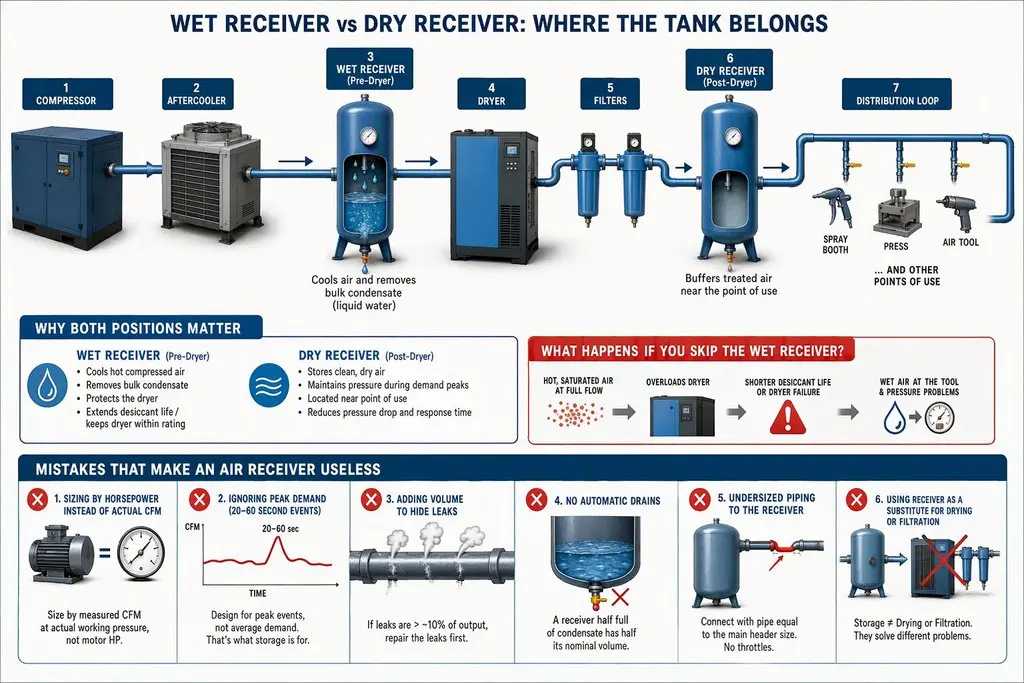
A wet receiver sits between the compressor and the dryer to cool air and remove bulk condensate, while a dry receiver sits after the dryer and filters to buffer treated air near the point of use. Larger systems often need both, because the positions solve different problems.
| Tipo | Position | Main function | Note |
| Wet receiver | After compressor and aftercooler, before dryer | Slows airflow, drops temperature, separates bulk water and oil | Protects the dryer from liquid slugs, needs automatic draining |
| Dry receiver | After dryer and filters, near the loop or a large intermittent user | Supplies clean stored air, stabilizes local pressure | Pairs well with a pressure and flow controller |
A typical rotary screw compressor layout runs compressor, aftercooler, wet receiver, dryer, filters, dry receiver, then the distribution loop. Omitting the wet receiver forces the dryer to handle saturated air at full temperature and flow, which shortens desiccant life and pushes refrigerated dryers past their rating. One receiver placed far from an intermittent user causes the opposite problem: pipe friction separates the stored volume from the event, so pressure at the tool still dips. When a single press or blast cabinet dominates the peak, local storage at that machine is often the cheapest fix in the plant.
Mistakes That Make an Air Receiver Useless
Most rotary screw compressor installations that underperform have specification errors rather than equipment faults, and they reproduce exactly the symptoms the tank was meant to prevent: pressure swings, short cycling, and wet air at the tool.
- Sizing by motor horsepower instead of measured CFM at actual working pressure.
- Designing for average demand and ignoring 20 to 60 second peaks, the events storage exists to cover.
- Adding volume to hide leakage. Above roughly 10 percent of output, repair the leaks first.
- Leaving out automatic drains. A receiver half full of condensate has half its nominal volume.
- Connecting the vessel through pipe smaller than the main header, adding a throttle where flow should be free.
- Treating the receiver as a substitute for drying or filtration.
Domande frequenti
These questions come up after the sizing decision, and each one changes the specification rather than the principle behind it.
Can an Air Receiver Be Added to an Existing Rotary Screw System Later?
Yes, and it is one of the more cost effective upgrades available. Check floor space and foundation loading, tie in through a connection at least the size of the main header, confirm relief valve capacity for the new volume, and retune adjustable load and unload timers. Retrofit is worth evaluating whenever a plant sees pressure dips at shift start or cycles shorter than 30 seconds.
Does an Oil-Free Screw Compressor Need Different Storage Volume?
Usually more, for the same flow. An oil-lubricated machine has a sump of pressurized oil and air that keeps feeding the system briefly after unloading, which stretches the effective cycle. An oil-free machine has no such blowdown reserve, so cycle time depends almost entirely on receiver volume. These systems also tend to serve tighter pressure tolerances, such as electronics production, which argues for the upper end of the range.
Does Altitude Change How a Receiver Should Be Sized?
Yes. The formula uses absolute atmospheric pressure, which falls with elevation, so the same volume holds less free air. At 1,500 meters, atmospheric pressure is about 12.5 psi rather than 14.7 psi, which raises the required volume for a given standard CFM event by roughly 18 percent. Compressor free air delivery also declines with altitude, so size with local absolute pressure and site rated flow rather than sea level catalog figures.