Rotary screw compressors are bought against a pressure class, typically 7, 8, 10 or 13 bar, chosen to cover the hungriest tool on the floor. After installation that number tends to drift upward: a header that sags during the busiest shift gets fixed by turning the setpoint up, and nobody turns it back down. Within a year the plant runs a bar or two above what any process needs.
Yes, in two ways that need different diagnoses. A compresor de tornillo rotativo can deliver more pressure than the process requires, a setpoint and system design problem driven by pressure drop and leakage elsewhere in the plant. It can also build pressure beyond its own rated discharge pressure, a control fault or air path restriction that the safety layer must catch. The first wastes energy every hour; the second is an equipment risk.
Both begin with a misunderstanding of how the machine decides how much pressure to make.

Three Different Pressures People Confuse
A screw compressor has no single pressure. It has a rated pressure, a control setpoint, a discharge pressure, and a different pressure at every point downstream, so the reading depends on where the gauge sits.
An operator reading 8 bar on the package gauge may see a full bar less at the header, because the dryer, filters and piping each remove pressure without removing flow.
Rated Pressure, Setpoint, and Actual Discharge Pressure
| Presión | What it describes | Where it comes from |
| Rated discharge pressure | Maximum continuous pressure the airend and vessel are designed for | Nameplate |
| Control setpoint | Pressure the controller tries to hold | Load and unload settings |
| Actual discharge pressure | Real time reading at the outlet | Package gauge |
| Point-of-use pressure | Pressure at the tool after regulator and hose drop | Regulator gauge |
Rated capacity is measured under reference conditions. Acceptance testing of flow and power on displacement compressors follows ISO 1217, which defines those conditions and corrections, which is why a datasheet figure and a hot August reading never match.
Where the Gauge Sits Changes the Answer
A machine discharging at 7.5 bar can deliver 6.6 bar at the header: a loaded dryer costs 0.2 to 0.3 bar, each dirty filter 0.1 to 0.3 bar, a convoluted piping run another half bar. Facing that gap, an operator can fix the restriction or raise the setpoint. The second works immediately, needs no diagnosis, and is almost always the one taken.
How a Rotary Screw Compressor Regulates Its Own Pressure
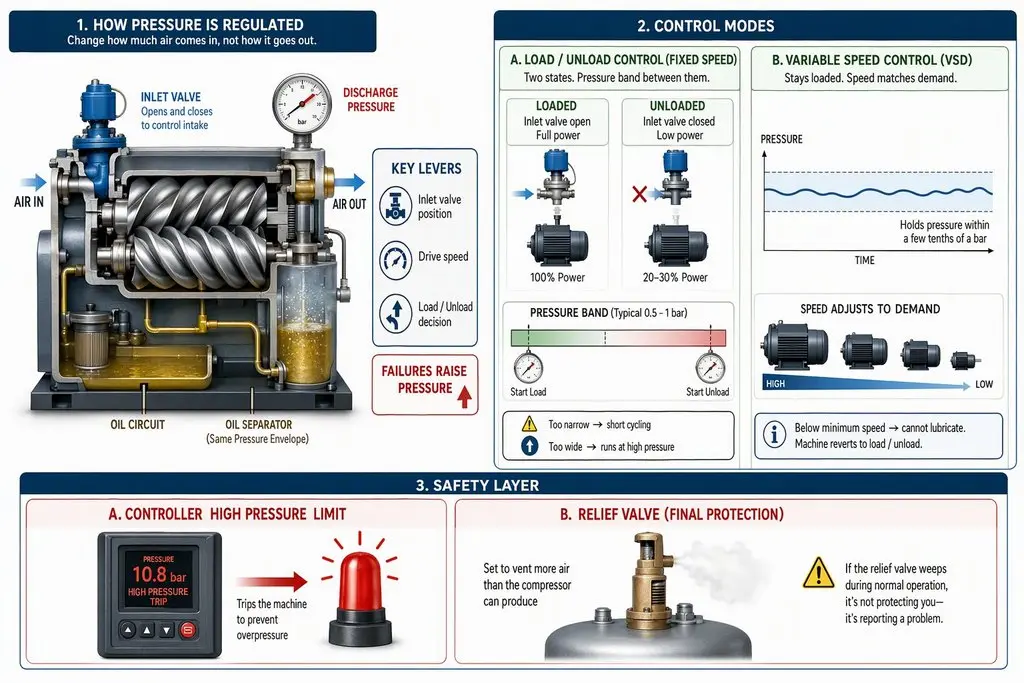
The compressor regulates pressure by changing how much air it admits, not by throttling the air it discharges. Inlet valve position, drive speed and the load or unload decision are the levers, and each can fail in a direction that raises pressure.
Two intermeshing rotors trap a fixed volume of air and squeeze it against the discharge port, so pressure rises when more air is forced into a system that is already full. On an oil-lubricated rotary screw air compressor, the airend, oil circuit and separator share one pressure envelope.
Load and Unload Control and the Pressure Band
A fixed speed machine holds constant rotor speed and switches between two states. Loaded, the inlet valve is open and the separator sits at discharge pressure. Unloaded, the valve closes and the motor draws a fraction of full power. The gap between the two is the band, typically 0.5 to 1 bar. Too narrow causes short cycling; too wide forces the system to run at the top of the range.
Variable Speed Control and Setpoint Tracking
A variable speed drive slows the motor as demand falls, staying loaded across a wide flow range instead of switching states. Well tuned units hold pressure within a few tenths of a bar, which allows a narrower band and lower average pressure. Below minimum speed the airend cannot lubricate itself, so the machine reverts to load and unload.
The Safety Layer: Controller Limits and the Relief Valve
The controller trips on high discharge pressure, and the vessel carries a relief valve sized to vent more air than the compressor can produce. A relief valve that weeps during a normal shift is not protecting against a fault; it is reporting one.
What Causes Excess Pressure in a Screw Compressor
Excess pressure rarely means the compressor is making too much air. It means a control element is failing to reduce output, a restriction is trapping pressure upstream of the process, or a setpoint was raised to compensate for a problem elsewhere.
Control and Instrumentation Faults
The inlet valve is a mechanical assembly with a diaphragm, a loading solenoid and a return spring, and any of them can fail in the open direction. A ruptured diaphragm or leaking solenoid leaves the rotors ingesting air after the controller has decided to unload. Sensing fails the other way: a transducer drifting low reports less pressure than exists, so the controller keeps loading to close a gap that is not there.
Air Path Restrictions Inside and After the Compressor
Anything obstructing flow downstream of the airend raises the pressure needed to push the same volume through. The separator element is the usual example: as it loads with oil aerosol its differential rises, and past roughly 1 bar it is due for replacement regardless of the hour meter. A blocked scavenge line or a partly closed valve does the same, and these faults hide well because pressure is the only abnormal reading.
Setpoint Errors and Poor Multi-Compressor Sequencing
Two compressors with overlapping bands will fight. One loads, pushes the header above the other’s unload point, the second unloads, the header falls, and the cycle repeats. The visible result is unstable pressure; the hidden result is that both machines run above the necessary pressure to stay coordinated.
| Cause | What the readings show | First thing to check |
| Inlet valve stuck open | Pressure rises when unloaded | Valve stem and diaphragm |
| Loading solenoid leaking | Slow creep during unload | Solenoid seat |
| Transducer drift | Display lower than gauge | Calibrated gauge |
| Separator element loaded | High differential | Differential reading |
| Competing setpoints | Rapid cycling | Band settings |
Signs Your System Is Running Above the Pressure It Needs
The clearest sign is rarely a gauge reading. It is a pattern: relief valves that weep, compressors that cycle faster than production justifies, and energy consumption that climbs while output stays flat.
- Compressors cycle between load and unload more often than the schedule justifies.
- Header pressure swings by more than about half a bar during a shift.
- The relief valve weeps or fails to seat after a pressure peak.
- Air tools and actuators wear out faster than their rated service life.
- Drains discharge more condensate, because more air is being compressed and cooled.
Any one of these has an innocent explanation. Three or more together point to a system running above the pressure it needs.

What Excess Pressure Actually Costs
Every bar above the true requirement is paid for twice: once at the compressor shaft, where the extra pressure ratio consumes extra power, and again at every leak and unregulated end use that the higher pressure feeds.
The Energy Penalty of Every Extra Bar
The relationship is close to linear across the range most plants use. According to the U.S. Department of Energy and the Compressed Air Challenge, every 2 psi of additional discharge pressure raises energy consumption by roughly 1 percent, about 7 percent per bar. The DOE compressed air sourcebook sets out the system level basis for that figure.
| Discharge setpoint | Relative shaft power | Annual energy at a 100 kW baseline |
| 6.5 bar | 96 percent | 841,000 kWh |
| 8 bar | 107 percent | 937,000 kWh |
| 10 bar | 121 percent | 1,060,000 kWh |
The figures assume continuous full load, so read them as an illustration of the trend.
Artificial Demand and Leakage
Higher pressure increases flow through every unregulated opening. A leak is a fixed orifice, and mass flow rises with the absolute pressure ratio, so a header raised from 6.5 to 8 bar leaks more air without a new hole appearing. The DOE calls the result artificial demand. Receptores de aire buffer demand spikes and reduce cycling, but they cannot remove artificial demand, because the pressure driving the leakage is unchanged.

How Much Pressure Is Too Much
Too much has a hard limit and a soft limit. The hard limit is the lowest of the vessel rating, the airend rating and the relief valve setting. The soft limit is what the most demanding end use requires, and it is almost always the lower and more expensive one.
Working Pressure Ratings and Relief Settings
Standard screw compressors are built around a few classes: 3 to 5 bar for conveying, 7 to 8 bar for general workshop air, 10 to 13 bar for laser assist gas and moulding, and 25 to 40 bar for bottle blowing. The class fixes airend geometry, motor sizing and vessel thickness, so it is not a margin to be spent.
The relief valve is set at or below the maximum allowable working pressure of the protected vessel. Under OSHA 29 CFR 1910.169, the relieving capacity of safety valves on an air receiver must prevent pressure from exceeding that maximum by more than 10 percent.
When the Application Genuinely Needs Higher Pressure
Some processes really do need pressure above the standard class. The correct response is a machine designed for it, such as a medium-pressure oil-injected screw air compressor, not a standard 8 bar unit with the setpoint pushed upward. Running a standard machine above its class loses capacity, raises discharge temperature and shortens airend life.
How to Bring Pressure Back Under Control
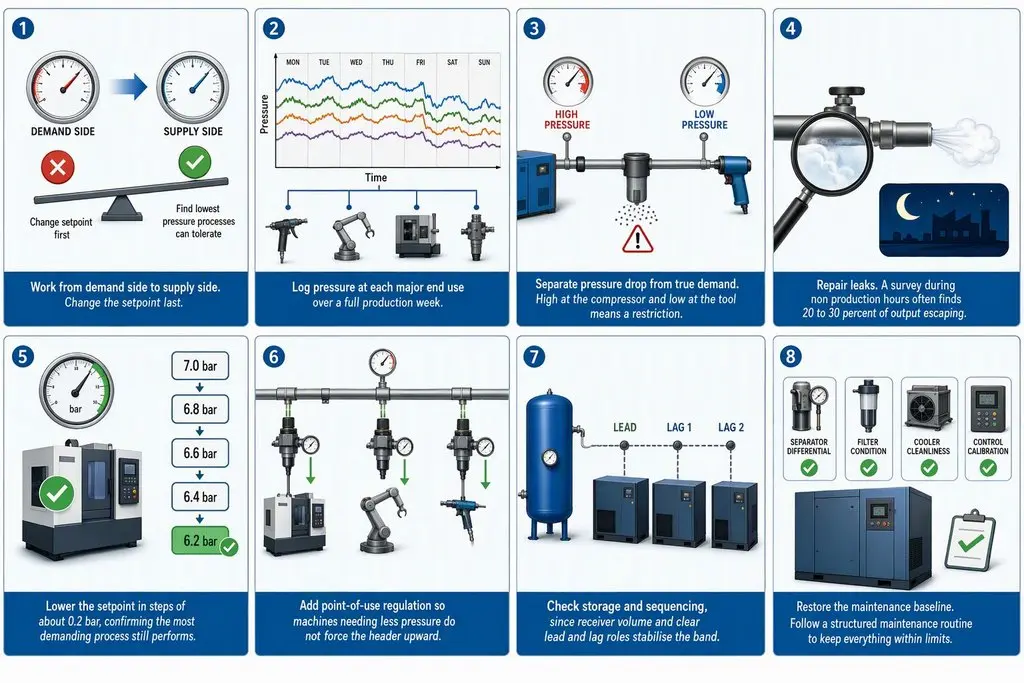
Work from the demand side back to the supply side, and change the setpoint only after establishing the lowest pressure the processes can tolerate. Adjusting the setpoint first hides the problem and makes diagnosis harder.
- Log pressure at each major end use over a full production week, not a single spot reading.
- Separate pressure drop from true demand. High at the compressor and low at the tool means a restriction.
- Repair leaks. A survey during non production hours often finds 20 to 30 percent of output escaping.
- Lower the setpoint in steps of about 0.2 bar, confirming the most demanding process still performs.
- Add point-of-use regulation so machines needing less pressure do not force the header upward.
- Check storage and sequencing, since receiver volume and clear lead and lag roles stabilise the band.
- Restore the maintenance baseline. Separator differential, filter condition, cooler cleanliness and control calibration all drift between services. A structured oil-lubricated rotary screw air compressor maintenance routine keeps them inside their limits.
Common Screw Compressor Problems That Push Pressure Up
Most routine faults appear as a pressure symptom before they appear as a failure, which makes the pressure trend one of the most useful records a maintenance team can keep.
| Problem | Pressure symptom | Mecanismo |
| Loaded separator element | Rising differential | Restricted path after the airend |
| Clogged intake filter | Longer loaded run | Starved inlet lowers flow |
| Fouled oil cooler | High temperature, derating | Falling cooling capacity |
| Worn inlet valve | Creep during unload | Valve no longer seals |
| Blocked scavenge line | Elevated separator pressure | Trapped oil adds volume |
Recording discharge pressure, separator differential and motor current at the same time each day turns a vague complaint into a trend line.
Do Rotary Screw Compressors Run Constantly?
Many do, but running constantly is not the same as producing air constantly. A fixed speed machine keeps its motor turning while the inlet valve closes, so for part of every cycle it spins without adding air to the system.
Continuous rotation is normal. Screw compressors are built for continuous duty, motor starts are limited, and steady rotation holds oil temperature stable. A machine pinned at full load and never unloading shows either that demand exceeds capacity, in which case pressure falls, or that the controls prevent unloading, in which case pressure rises.
Are Rotary Screw Compressors Better at Holding Pressure?
For most industrial loads, yes. A screw compressor holds steadier pressure than a reciprocating machine of similar size, because delivery is continuous rather than pulsed and the controls respond faster to demand changes.
A reciprocating machine delivers air in discrete pulses and, in smaller sizes, cycles on a pressure switch with a wide band. The comparison is not unconditional. A poorly sequenced screw system can hold worse pressure than a single well controlled reciprocating unit, and a screw compressor idling at low load all year will cost more to run than the piston machine it replaced.
A screw compressor can indeed produce too much pressure, and usually does so gradually, through a setpoint raised to cover a restriction, a valve that no longer closes, or a leak survey never carried out.

Preguntas frecuentes
Can I lower the setpoint to save energy without changing anything else?
Sometimes, but the reduction is limited by the weakest point in the system. Lowering the setpoint without repairing leaks moves the shortfall to the tool that was already marginal. Reduce in steps of about 0.2 bar and stop where performance begins to suffer.
Why does my compressor only reach relief pressure in hot weather?
Hot ambient air reduces the cooling margin of the oil cooler and lowers the density of air entering the intake, so the machine works harder for the same delivered flow. The usual causes are a partly fouled cooler, a separator element near the end of its life, or a setpoint that was always slightly too high.
Will a bigger air receiver stop the pressure from climbing?
No. A receiver buffers demand spikes and reduces cycling, which improves stability, but it cannot lower the pressure the system settles at. Additional storage only delays the rise caused by a stuck inlet valve or a drifting transducer.