
El aire comprimido es una de las fuentes de energía más utilizadas en la industria manufacturera, los talleres de automoción, la fabricación de metales, el embalaje, la carpintería, la industria alimentaria y muchos otros entornos industriales. Sin embargo, no todas las Compresor de aire está diseñado para la misma demanda de presión, el mismo ciclo de trabajo o los mismos requisitos de calidad del aire. Cuando una instalación necesita una presión más alta, una mayor eficiencia y un funcionamiento continuo más fiable, a menudo se opta por un compresor de aire de dos etapas.
A compresor de aire de dos etapas Es un compresor de aire que comprime el aire en dos etapas independientes, en lugar de una sola. En la primera etapa, el aire se comprime hasta alcanzar una presión intermedia, se enfría y, a continuación, se vuelve a comprimir en la segunda etapa para alcanzar una presión final más elevada. Este diseño mejora la eficiencia, reduce la carga térmica y hace que el compresor sea adecuado para aplicaciones industriales exigentes.
Para saber si un compresor de aire de dos etapas es adecuado para su actividad, es importante analizar cómo funciona, en qué se diferencia de una unidad de una sola etapa y qué características técnicas son las más importantes a la hora de elegir uno.
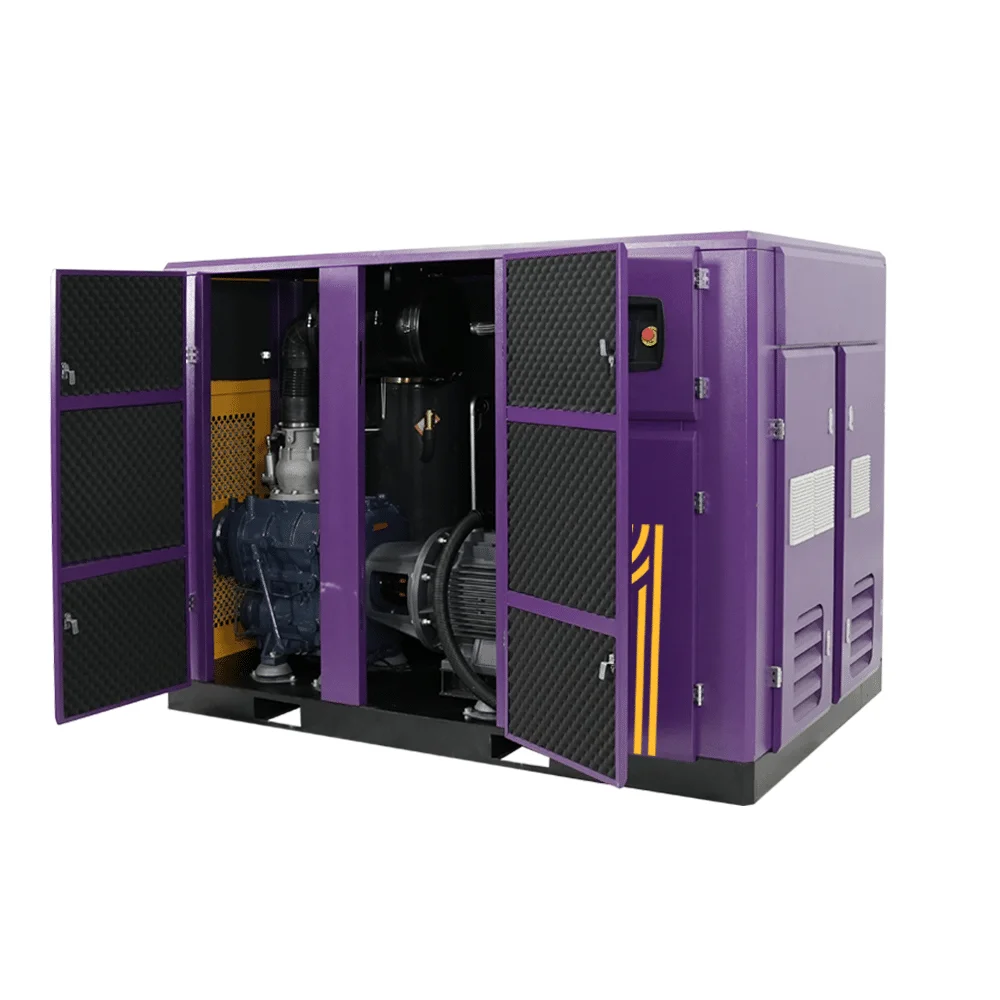
¿Qué es un compresor de aire de dos etapas?
Un compresor de aire de dos etapas es un sistema de aire comprimido que utiliza dos ciclos de compresión para aumentar la presión del aire de forma más eficiente que un compresor de una sola etapa. Se utiliza habitualmente cuando las aplicaciones requieren una presión más alta, un caudal estable y largas horas de funcionamiento.
En un compresor de aire alternativo típico de dos etapas, el aire atmosférico entra en el primer cilindro, donde se comprime hasta alcanzar una presión intermedia. A continuación, el aire comprimido caliente pasa por un intercooler, que reduce su temperatura antes de que entre en el segundo cilindro. En la segunda etapa, el aire se comprime de nuevo hasta alcanzar la presión final requerida y, a continuación, se envía a un depósito receptor o a los equipos situados aguas abajo.
Este proceso de compresión en dos etapas resulta especialmente útil porque la compresión del aire genera calor. Si el aire se comprime a alta presión en una sola etapa, la temperatura aumenta considerablemente, lo que puede reducir la eficiencia y aumentar el desgaste mecánico. Al enfriar el aire entre etapas, un compresor de dos etapas reduce la carga de trabajo de la segunda etapa y mejora el rendimiento general.
Definición básica
Un compresor de aire de dos etapas puede definirse como:
Un compresor que aumenta la presión del aire en dos etapas de compresión secuenciales, con refrigeración entre etapas, para alcanzar una mayor presión de descarga y una mejor eficiencia térmica.
Los compresores de dos etapas están disponibles en diferentes configuraciones, entre las que se incluyen:
- Compresores de pistón alternativo
- Compresores de tornillo rotativo con bloques compresores de dos etapas
- Compresor de aire lubricado con aceite
- Compresor de aire sin aceite
- Sistemas industriales fijos
- Unidades portátiles de alta presión
Aunque el diseño mecánico pueda variar, el principio básico sigue siendo el mismo: el aire se comprime, se enfría y se vuelve a comprimir.
Rango de presión habitual
Los compresores de aire de dos etapas suelen elegirse para aplicaciones que requieren niveles de presión superiores a los que muchos compresores de una sola etapa pueden proporcionar de forma eficiente.
| Tipo de compresor | Rango de presión habitual | Caso de uso habitual |
| Compresor de aire de una etapa | 90–125 PSI | Herramientas para trabajos ligeros, pequeños talleres |
| Compresor de aire de dos etapas | 125–175 PSI o más | Herramientas industriales, fabricación, talleres de servicio |
| Compresor especializado de alta presión | 200 PSI+ | Procesos industriales especializados |
El rango de presión real depende del diseño del compresor, la potencia del motor, el sistema de refrigeración y los requisitos de la aplicación.
¿Cómo funciona un compresor de aire de dos etapas?
Un compresor de aire de dos etapas funciona aspirando aire atmosférico, comprimiéndolo en un cilindro o bloque compresor de primera etapa, enfriándolo mediante un intercooler y, a continuación, comprimiéndolo de nuevo en un cilindro o bloque compresor de segunda etapa antes de enviarlo a un depósito o a un sistema de distribución de aire.
El proceso está diseñado para que la compresión sea más eficiente y controlada. En lugar de obligar a la máquina a alcanzar la presión final en un solo paso, el compresor divide el aumento de presión en dos etapas. Esto reduce la temperatura de descarga y mejora la durabilidad.
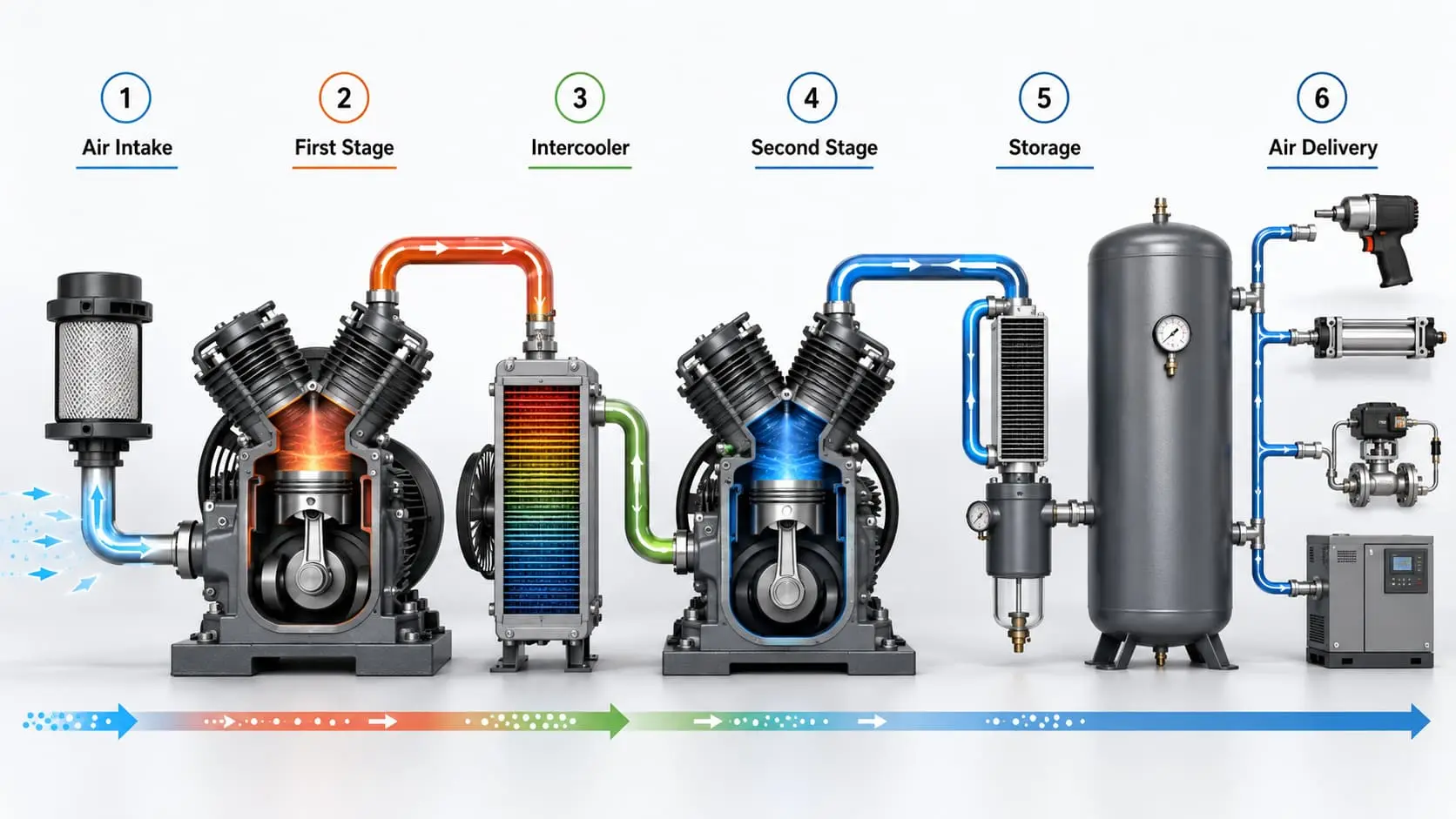
Proceso de compresión paso a paso
El ciclo de trabajo suele seguir estos pasos:
- Toma de aire
El aire ambiente entra en el compresor a través de un filtro de admisión. El filtro ayuda a eliminar el polvo, las partículas y los contaminantes antes de que comience la compresión. - Compresión en la primera etapa
El cilindro de la primera etapa, o elemento de compresión, comprime el aire hasta una presión intermedia. En este punto, el aire se calienta debido al proceso de compresión. - Intercooler
El aire comprimido caliente pasa por un intercooler. Esta etapa de enfriamiento reduce la temperatura del aire antes de que entre en la segunda etapa. - Compresión de segunda etapa
El aire enfriado a presión intermedia se comprime de nuevo hasta alcanzar la presión de descarga final. - Enfriamiento posterior y almacenamiento
El aire comprimido puede pasar por un posenfriador y un separador de humedad antes de entrar en un depósito de almacenamiento o en un sistema de tuberías. - Entrega aérea
El aire comprimido almacenado se suministra a herramientas neumáticas, equipos de producción, válvulas, cilindros u otras aplicaciones finales.
Por qué es importante la refrigeración intermedia
La refrigeración intermedia es una de las características más importantes de un sistema de dos etapas. Cuando el aire se enfría entre etapas, su densidad aumenta y la segunda etapa de compresión necesita menos energía para llevarlo a la presión final.
Entre las ventajas del intercooler se incluyen:
- Temperatura de salida más baja
- Reducción de la tensión térmica en los componentes
- Mayor eficiencia en la compresión
- Menor carga de humedad en los sistemas posteriores
- Mejor rendimiento de lubricación en unidades lubricadas con aceite
- Mayor vida útil de las válvulas, los anillos, las juntas y los cojinetes
Según el Departamento de Energía de EE. UU., los sistemas de aire comprimido pueden representar una parte significativa del consumo eléctrico industrial, por lo que las mejoras en la eficiencia son importantes para el control de los costes operativos. Para obtener más información, consulte la Recursos sobre sistemas de aire comprimido del Departamento de Energía de EE. UU..
Compresores de aire de dos etapas frente a los de una sola etapa: ¿cuál es la diferencia?
La principal diferencia es que un compresor de aire de una sola etapa comprime el aire una vez, mientras que un compresor de aire de dos etapas lo comprime dos veces, con un proceso de enfriamiento entre ambas etapas. Esto permite que una unidad de dos etapas alcance una presión más alta de forma más eficiente y sea capaz de hacer frente a aplicaciones más exigentes.
Un compresor de una sola etapa suele ser suficiente para una demanda de aire de ligera a moderada. Se utiliza habitualmente en pequeños talleres, garajes y aplicaciones en las que las herramientas funcionan de forma intermitente. Un compresor de dos etapas, por el contrario, resulta más adecuado para entornos industriales en los que se requiere una presión más alta, un tiempo de funcionamiento más prolongado y un suministro de aire constante.
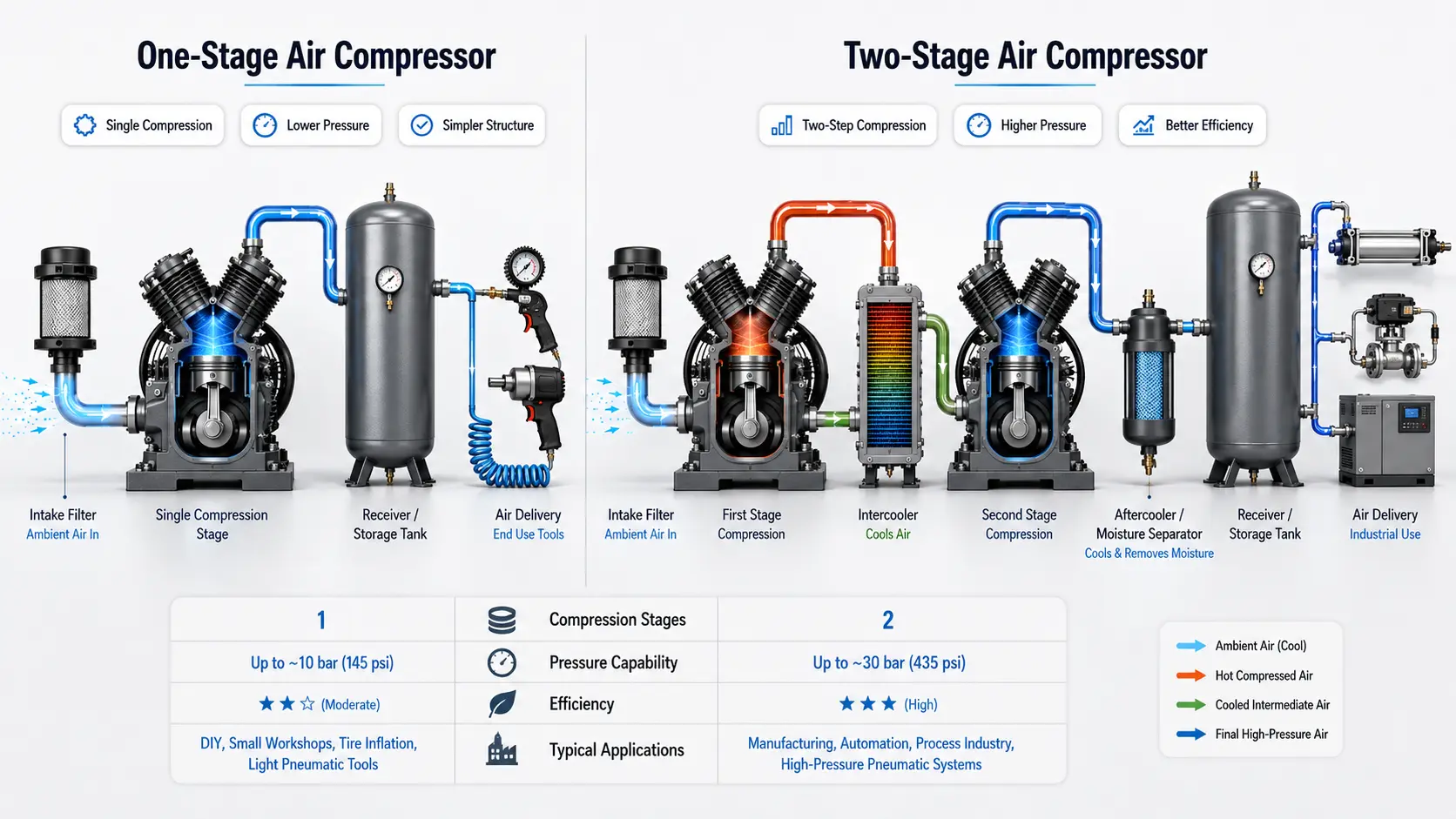
Tabla comparativa
| Característica | Compresor de aire de una etapa | Compresor de aire de dos etapas |
| Proceso de compresión | Un paso de compresión | Dos etapas de compresión |
| Enfriamiento entre etapas | No | Sí |
| Presión típica | Hasta unos 125 PSI | A menudo, entre 125 y 175 PSI o más |
| Eficiencia a alta presión | Baja | Más alto |
| Generación de calor | Más alta a la presión final | Mejor controlado |
| Idoneidad del ciclo de trabajo | Uso ligero a moderado | De uso medio a intensivo |
| Coste inicial | Baja | Más alto |
| Complejidad del mantenimiento | Más sencillo | Más componentes |
| Usuarios habituales | Pequeñas tiendas, uso aficionado | Instalaciones industriales y comerciales |
Cuándo puede bastar con un compresor de una sola etapa
Un compresor de aire de una sola etapa puede ser adecuado si tu actividad:
- Utiliza herramientas neumáticas de vez en cuando
- Requiere una presión inferior a 125 PSI
- Tiene una demanda de CFM baja a moderada
- Corre durante intervalos cortos
- Dispone de un espacio de instalación limitado
- Da prioridad a un menor coste inicial
Cuándo un compresor de dos etapas es la mejor opción
Un compresor de dos etapas suele ser una mejor opción si tu instalación:
- Requiere una presión superior a 125 PSI
- Permite utilizar varias herramientas neumáticas al mismo tiempo
- Funciona de forma continua o durante turnos largos
- Se necesita una presión estable para los equipos de producción
- Quiere una mayor eficiencia a mayor presión
- Utiliza el aire comprimido como servicio esencial
En entornos B2B, la decisión no debe basarse únicamente en el precio de compra. También deben tenerse en cuenta el consumo energético, los costes de mantenimiento, el riesgo de paradas y el aumento de la demanda de aire.
¿Cuáles son los componentes principales de un compresor de aire de dos etapas?
Los componentes principales de un compresor de aire de dos etapas son el filtro de admisión, la cámara de compresión de la primera etapa, el intercooler, la cámara de compresión de la segunda etapa, las válvulas, el motor, el sistema de lubricación, el sistema de refrigeración, el depósito receptor y el sistema de control.
Cada componente desempeña un papel fundamental a la hora de mantener la presión, controlar el calor, mejorar la eficiencia y proteger la máquina del desgaste prematuro. Conocer estas piezas ayuda a los compradores a evaluar la calidad del producto y los requisitos de mantenimiento.
Componentes principales y sus funciones
| Componente | Función |
| Filtro de aspiración | Elimina las partículas en suspensión antes de la compresión |
| Cilindro de primera etapa o bloque compresor | Realiza la compresión inicial |
| Intercooler | Enfría el aire entre las etapas de compresión |
| Cilindro o bloque compresor de segunda etapa | Comprime el aire hasta alcanzar la presión final |
| Válvulas de retención | Evitar el flujo de aire inverso |
| Presostato o regulador de presión | Inicia, detiene o modula el funcionamiento del compresor |
| Depósito colector | Almacena aire comprimido y estabiliza la presión |
| Válvula de seguridad | Libera la presión si el sistema supera los límites de seguridad |
| Válvula de drenaje | Elimina el condensado del depósito o del separador |
| Motor | Proporciona potencia mecánica |
| Sistema de lubricación | Reduce la fricción y el desgaste de los componentes |
| Enfriador posterior | Enfría el aire de salida antes de su tratamiento posterior |
Parámetros técnicos importantes
A la hora de comparar compresores de aire de dos etapas, presta atención a estas especificaciones:
Presión nominal
La presión se mide normalmente en PSI, bar o MPa. El compresor debe alcanzar la presión mínima que requiere tu equipo, teniendo en cuenta la caída de presión en las tuberías, los filtros, los secadores y los reguladores.
Capacidad de suministro de aire
La capacidad de aire se mide habitualmente en CFM o m³/min. Indica la cantidad de aire comprimido que la unidad puede suministrar a una presión determinada.
Entre los términos importantes se incluyen:
- Caudal en CFM: Caudal de aire teórico en función del tamaño de la bomba
- CFM suministrados: Caudal de aire útil real
- SCFM: Pies cúbicos estándar por minuto en condiciones estándar definidas
Potencia del motor
La potencia del motor suele expresarse en caballos de vapor o kilovatios. Sin embargo, una potencia nominal más alta no implica automáticamente un mejor rendimiento. La capacidad de suministro de aire a presión de trabajo es un criterio de comparación más útil.
Ciclo de trabajo
El ciclo de trabajo se refiere al tiempo que un compresor puede funcionar dentro de un periodo determinado. Los compresores de aire industriales de dos etapas suelen estar diseñados para ciclos de trabajo más elevados que las máquinas de uso ligero.
Tamaño del depósito
El depósito acumulador almacena aire comprimido y ayuda a reducir los ciclos frecuentes de arranque y parada. Los depósitos de mayor capacidad pueden hacer frente a picos breves de alta demanda, pero no sustituyen la necesidad de contar con una capacidad adecuada del compresor.

¿Cuáles son las ventajas y las limitaciones de un compresor de aire de dos etapas?
Un compresor de aire de dos etapas ofrece una mayor capacidad de presión, una mayor eficiencia a presiones elevadas, una temperatura de funcionamiento más baja y una mayor durabilidad, pero suele tener un coste inicial más elevado y unos requisitos de mantenimiento más complejos que un modelo de una sola etapa.
Para muchos usuarios industriales, las ventajas en cuanto al rendimiento justifican la inversión. Sin embargo, la mejor opción depende de la demanda real de aire, las horas de funcionamiento, el coste energético y los recursos de mantenimiento.
Principales ventajas
Mayor presión de salida
La compresión en dos etapas permite que el sistema alcance presiones más altas de forma más eficaz. Esto es importante para aplicaciones como:
- Herramientas neumáticas de alta resistencia
- Prensas industriales
- Equipos de chorro de arena
- Servicios relacionados con los neumáticos
- Maquinaria industrial
- Sistemas de control de procesos
Mayor eficiencia energética a alta presión
La compresión de aire en dos etapas reduce la energía necesaria para alcanzar una mayor presión de descarga. A largo plazo, esto puede reducir los costes de electricidad, especialmente en instalaciones donde se utiliza aire comprimido a diario.
Menor carga térmica
Dado que el aire se enfría entre etapas, el compresor funciona con una menor carga térmica. Una temperatura más baja ayuda a proteger:
- Pistones
- Anillos
- Válvulas
- Rodamientos
- Aceite lubricante
- Juntas y empaquetaduras
Mayor vida útil de los equipos
Un proceso de compresión más frío y equilibrado puede contribuir a prolongar la vida útil del compresor, siempre que este reciba un mantenimiento adecuado.
Un suministro de aire más estable
Los compresores de dos etapas suelen diseñarse para ciclos de funcionamiento exigentes y pueden proporcionar una presión de salida más constante en entornos de producción.
Posibles limitaciones
A pesar de sus ventajas, los compresores de dos etapas no siempre son necesarios.
Entre las limitaciones más habituales se encuentran:
- Mayor coste de compra
- Más componentes que hay que revisar y mantener
- Mayor espacio ocupado en algunas configuraciones
- Mayores requisitos de instalación
- Posible necesidad de mejorar la ventilación
- Conocimientos más avanzados sobre el servicio
Si tu aplicación solo requiere aire a baja presión de forma intermitente, una unidad de dos etapas podría resultar sobredimensionada e innecesariamente cara.
¿Dónde se suelen utilizar los compresores de aire de dos etapas?
Aplicaciones industriales habituales
| Industria | Usos habituales |
| Servicio de automoción | Inflado de neumáticos, elevadores, herramientas de impacto, sistemas de pulverización |
| Fabricación de metales | Esmerilado, corte, abrazaderas neumáticas, granallado |
| Fabricación | Herramientas de montaje, actuadores, líneas de envasado |
| Carpintería | Clavadoras, lijadoras, soporte para CNC, controles del sistema de aspiración de polvo |
| Alimentación y bebidas | Equipos de envasado, transporte neumático, sistemas de control |
| Plásticos | Soporte para moldeo, recorte, automatización |
| Producción textil | Telares, chorros de aire, válvulas de control |
| Apoyo a la construcción | Herramientas de alta presión y equipamiento para obras |
¿Cómo elegir el compresor de aire de dos etapas adecuado?
Para elegir el compresor de aire de dos etapas adecuado, calcula la capacidad de aire necesaria, comprueba la presión de trabajo, evalúa el ciclo de trabajo, ten en cuenta las necesidades en cuanto a la calidad del aire, analiza las condiciones de instalación y compara el coste del ciclo de vida, en lugar de fijarte únicamente en el precio de compra.
Paso 1: Calcular la demanda de aire
Empieza por hacer una lista de todos los equipos que consumen aire y sus requisitos de CFM.
Ejemplo de cálculo:
| Equipamiento | CFM requerido | Cantidad | CFM total |
| Llave de impacto | 6 | 2 | 12 |
| Pistola pulverizadora | 10 | 1 | 10 |
| Lijadora neumática | 8 | 2 | 16 |
| Boquilla de soplado de aire | 5 | 1 | 5 |
| Total estimado | 43 CFM |
Una vez calculada la demanda total, hay que añadir un margen de seguridad para tener en cuenta las fugas, la expansión futura y el uso simultáneo. En muchas instalaciones se añaden entre 20% y 30%, dependiendo de la aplicación.
Paso 2: Confirmar la presión necesaria
Identifica cuál es el requisito de presión más elevado entre tus herramientas o máquinas. A continuación, ten en cuenta las pérdidas de presión provocadas por:
- Longitud de la tubería
- Filtros
- Secadoras
- Organismos reguladores
- Mangueras
- Acopladores rápidos
- Desniveles
- Accesorios de tamaño inferior al normal
Si tu herramienta requiere 120 PSI en el punto de uso, es posible que el compresor tenga que descargar a una presión más alta para compensar las pérdidas del sistema.
Paso 3: Evaluar el ciclo de trabajo
Para una producción continua, elige un compresor diseñado para un gran número de horas de funcionamiento. Un ciclo de trabajo elevado reduce el riesgo de sobrecalentamiento y de un desgaste excesivo.
Paso 4: Ten en cuenta la calidad del aire
Algunas aplicaciones requieren un aire más limpio y seco que otras. Por ejemplo:
- La pintura requiere un control de la humedad y del aceite
- El envasado de alimentos puede requerir aire sin aceite o altamente filtrado
- Las herramientas neumáticas suelen soportar una calidad del aire inferior
- El aire para instrumentos requiere un aire estable, limpio y seco
Dependiendo de la aplicación, es posible que necesites:
- Secador de aire refrigerado
- Secador desecante
- Filtro de coalescencia
- Filtro de partículas
- Filtro de carbón activado
- Purgador automático de condensados
Paso 5: Revisar las condiciones de instalación
Antes de comprar, ten en cuenta lo siguiente:
- Superficie útil
- Ventilación
- Temperatura ambiente
- Suministro eléctrico
- Nivel de ruido
- Drenaje de condensados
- Acceso al servicio
- Requisitos de la fundación
Una instalación deficiente puede reducir la eficiencia del compresor y acortar la vida útil del equipo.
¿Cómo se debe realizar el mantenimiento de un compresor de aire de dos etapas de forma segura?
El mantenimiento de un compresor de aire de dos etapas debe consistir en inspecciones periódicas, una lubricación adecuada, la sustitución de los filtros, el drenaje del condensado, la comprobación de las correas o acoplamientos, la inspección de las válvulas, la limpieza del sistema de refrigeración y la comprobación de los dispositivos de seguridad.
El mantenimiento es esencial, ya que los sistemas de aire comprimido funcionan a presión y generan calor. Un mantenimiento deficiente puede provocar una disminución de la eficiencia, daños en los equipos, un funcionamiento inseguro y paradas imprevistas.
Lista de comprobación para el mantenimiento rutinario
| Tarea de mantenimiento | Frecuencia recomendada | Objetivo |
| Comprobar el nivel de aceite | Diariamente o antes de su uso | Evitar fallos en la lubricación |
| Depósito colector de drenaje | Diariamente o según sea necesario | Eliminar el condensado y reducir la corrosión |
| Revisar el filtro de admisión | Semanal | Mantener el flujo de aire y la eficiencia |
| Comprueba las correas o el acoplamiento | Mensualmente | Asegúrate de que la transmisión de potencia sea la adecuada |
| Limpia el intercooler y el posenfriador | Mensual o trimestral | Mejorar la transferencia de calor |
| Revisa las mangueras y los racores | Mensualmente | Reducir las fugas y la pérdida de presión |
| Comprobar la válvula de seguridad | De vez en cuando | Confirmar la protección contra sobrepresión |
| Cambiar el aceite | Según las recomendaciones del fabricante | Proteger los componentes internos |
| Cambiar el filtro de aire | Según sea necesario | Evitar la contaminación |
| Revisar las válvulas y los anillos | Intervalo de mantenimiento programado | Mantener el rendimiento de la compresión |
Buenas prácticas en materia de seguridad
El aire comprimido puede ser peligroso si no se maneja correctamente. Los operarios deben seguir los procedimientos de seguridad en el trabajo y la normativa vigente. Para obtener orientación general sobre seguridad, consulte los recursos de la Administración de Seguridad y Salud en el Trabajo.
Entre las medidas de seguridad importantes se incluyen:
- Nunca se deben puentear las válvulas de seguridad de presión
- No se debe superar la presión nominal.
- Desconecta la alimentación eléctrica antes de realizar el mantenimiento
- Despresurice el sistema antes de realizar cualquier operación de mantenimiento
- Mantén las protecciones en su sitio alrededor de las correas y las piezas giratorias
- Utiliza mangueras y racores con la capacidad nominal adecuada
- Asegúrate de que haya una ventilación adecuada
- Utiliza protección ocular y auditiva cuando sea necesario
- No utilices aire comprimido para limpiar la piel o la ropa
Gestión de fugas
Las fugas de aire son una de las causas más habituales de desperdicio de energía en los sistemas de aire comprimido. Incluso las fugas más pequeñas pueden aumentar el tiempo de funcionamiento del compresor y los costes de explotación.
Entre los puntos habituales de fugas se incluyen:
- Acopladores
- Accesorios roscados
- Mangueras
- Organismos reguladores
- Válvulas de purga
- Uniones de tuberías
- Juntas desgastadas
- Conectores de desconexión rápida
Un programa de detección de fugas puede ayudar a reducir el desperdicio de energía y a mejorar la fiabilidad del sistema.
Preguntas frecuentes
¿Puede un compresor de aire de dos etapas ser sin aceite?
Sí. Los compresores de dos etapas pueden ser lubricados con aceite o sin aceite, dependiendo del diseño. Los modelos sin aceite se utilizan a menudo cuando la pureza del aire es fundamental, como en la industria alimentaria, farmacéutica, electrónica y en determinados entornos de laboratorio. Sin embargo, los sistemas sin aceite pueden tener requisitos de mantenimiento y consideraciones económicas diferentes.
¿Un depósito receptor más grande aumenta el caudal (CFM) del compresor?
No. Un depósito receptor más grande no aumenta el caudal real en CFM del compresor. Solo almacena más aire comprimido y puede ayudar a gestionar breves periodos de picos de demanda. Si tu equipo necesita más aire del que puede producir el compresor, la presión acabará bajando independientemente del tamaño del depósito.
¿Por qué se forma humedad en un sistema de compresor de aire de dos etapas?
La humedad se forma porque el aire contiene vapor de agua y la compresión eleva la temperatura del aire. A medida que el aire comprimido se enfría, el vapor de agua se condensa y se convierte en líquido. Por eso se suelen utilizar purgadores, posenfriadores, separadores de humedad y secadores de aire para proteger las herramientas, las tuberías, las válvulas y los equipos de producción.