Low-pressure air drives aeration basins, conveying lines and flotation cells, and it is rarely cheap. A 90 kW blower uses more electricity in a year than the equipment it serves, so choosing between a rotary lobe machine and a high-speed centrifugal one is a financial decision first.
A Roots blower is safer when back pressure moves, airflow demand swings widely, or maintenance must stay in-house. A turbo blower wins when pressure is stable, hours are long, and part-load efficiency holds near the design point. The question is not which machine is more efficient, but which spends more hours near its best efficiency point at the lowest verified wire-to-air power.
The turbo blower vs. Roots blower comparison below runs from principle to ten-year cost, in the order that decides a specification.
What Is the Difference Between a Roots Blower and a Turbo Blower?
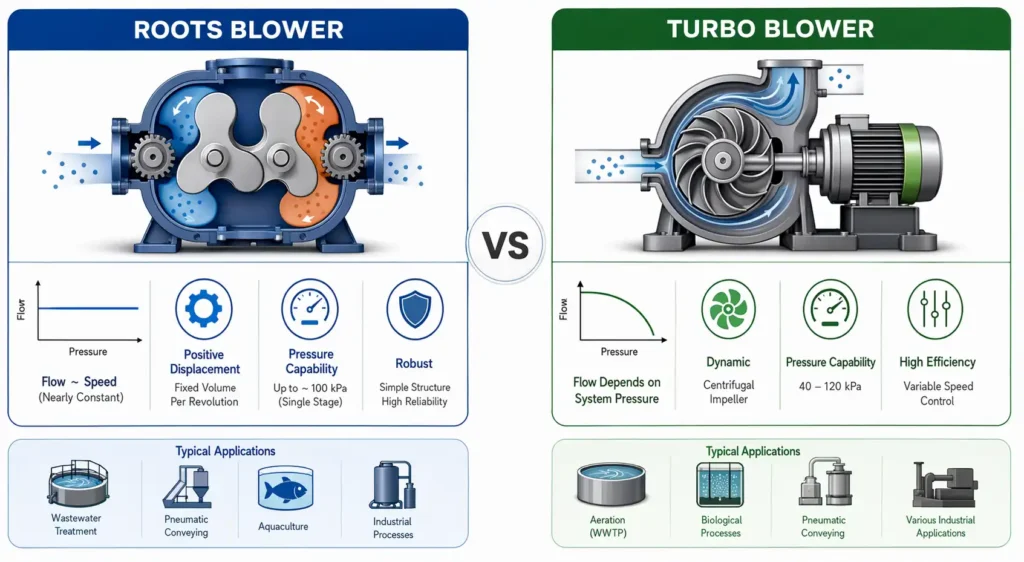
A Roots blower traps a fixed volume of air and pushes it into the discharge line, so flow follows shaft speed and pressure is whatever the system demands. A turbo blower, or high-speed centrifugal blower, accelerates air with an impeller and converts velocity into pressure, so flow and efficiency depend on where it sits on its curve.
How a Roots Blower Moves Air
Two or three lobes rotate in opposite directions inside a close-fitting casing, phased by timing gears so the rotors never touch. Each pair traps a crescent pocket at the inlet and carries it to the discharge port without changing its volume, so the machine displaces air rather than compressing it. Compression happens only when the pocket opens and higher-pressure air flows back in.
That backflow sets both the robustness and the ceiling. With no internal compression, power rises almost linearly with pressure rise, and single-stage isentropic efficiency sits between 50 and 70 percent. Ratios cluster around 2, so higher duties use two stages, while flow stays proportional to speed.
How a Turbo Blower Moves Air
A single impeller on a permanent magnet motor spinning at tens of thousands of revolutions per minute adds kinetic energy; a diffuser converts it into static pressure. Air foil or magnetic bearings carry the shaft without contact, keeping the air path oil-free, and an integral drive modulates speed.
This inverts the behaviour. Flow depends on the pressure the system presents, efficiency peaks in one narrow region, and at low flow the impeller approaches surge, so the controller recirculates or blows off air. Packages span 40 to 120 kPa and arrive as skids with drive, filtration and controls fitted, which is how an air bearing turbo blower is normally supplied.
Comparison Table: Principle and Consequences
| Criterio | Roots blower | Turbo blower |
| Displacement | Positive, no internal compression | Dynamic, single-stage centrifugal |
| Flow versus pressure | Set by speed, independent of pressure | Follows system pressure |
| Pressure rise | 30 to 100 kPa per stage | 40 to 120 kPa |
| Eficacia | Flat, 50 to 70 percent | Peaks at the design point |
| Noise and bearings | Oil or grease, 85 to 105 dB(A) | Air foil or magnetic, below 80 dB(A) |
Field experience follows from those five lines, but the table alone cannot settle a selection.
Pressure, Flow and Boost: Reading the Operating Envelope
Roots blowers cover roughly 30 to 100 kPa per stage and tolerate a drifting back pressure. Turbo blowers are efficient between 40 and 120 kPa on stable duty. A screw blower extends positive displacement operation to about 200 kPa through internal compression. Compare pressure rise, not discharge pressure alone.
Typical Envelope and Boost Range
Package ranges below are indicative for the rotary lobe and turbo blowers usually quoted for these duties; replace them with the supplier’s curve at your site conditions.
| Tecnología | Pressure rise | Unit flow | Potencia del motor |
| Three-lobe Roots | 40 to 100 kPa | 3 to 120 m³/min | 7.5 to 160 kW |
| Screw blower | 40 to 200 kPa | 2 to 200 m³/min | 5.5 to 250 kW |
| Turbo blower | 40 to 120 kPa | 5 to 45 m³/min per unit | 5.5 to 600 kW |
A single-stage Roots blower produces about 0.3 to 0.9 bar of pressure rise, or 30 to 90 kPa, with roughly 1 bar as the practical ceiling before efficiency and discharge temperature suffer. In forced-induction units that is 5 to 13 psi, and a pressure ratio of 2 is about 15 psi of boost; higher duties need two stages.
Energy Efficiency and Part-Load Behavior
On a stable high-flow duty the turbo blower is usually the lower-energy machine, with reported savings of 30 to 45 percent. Where demand collapses for long periods the Roots machine often wins, because it holds usable efficiency across the whole band and has no surge limit.
The Design-Point Trap
An impeller is efficient over a narrow slice of its map. A plant that specifies full flow and then runs at 55 percent for most of the year buys an efficiency figure it will rarely see, and the controller will blow off air part of the time to stay clear of surge. Roots equipment is the mirror image: unremarkable efficiency everywhere, stable everywhere, with power falling as speed falls.
Dissolved oxygen control belongs to the same argument. A loop that trims airflow to the biological load only saves energy if the machine can follow the trim without hunting.
What Retrofits Actually Deliver
Aeration is the largest single electrical load in a wastewater plant, typically about half of total consumption, according to U.S. EPA guidance on wastewater energy efficiency. Published results sit in a consistent range of 20 to 45 percent lower consumption for a well-matched turbo installation, with payback of one to three years. A documented plant retrofit study replacing Roots blowers with a high-speed turbo machine recorded a 42 percent reduction and payback inside 1.5 years.
Those figures do not transfer: load profile, water depth and tariff decide the outcome. For a 60 m³/min duty at 70 kPa over 8,000 hours, a 27 kW gap is 216,000 kWh, or 21,600 dollars at 0.10 dollars per kWh.
Maintenance, Reliability and Air Quality
A Roots blower is maintained by plant fitters with bearings, seals, belts and oil. A turbo blower is maintained by changing filters and monitoring bearings, with factory support for anything deeper. Neither is maintenance-free, and oil-free air only becomes decisive when the process air touches the product.
Two Maintenance Models
| Artículo | Roots blower | Turbo blower |
| Routine work | Oil changes, belts, filter cleaning | Filters, cooling path, vibration monitoring |
| Intervalo | 3 to 6 months | 6 to 12 months, filter-led |
| Annual cost, share of equipment value | Around 3 percent | Around 1 to 2 percent |
| Main risk | Bearing wear, seal leakage | Bearing air contamination, cooling loss |
Bearings and Air Quality
Air foil bearings need a minimum speed to generate their film and dislike start-stop cycling, dust and high ambient temperature. Magnetic bearings tolerate more cycling but add electronics to maintain. Both keep oil out of the air path, and where air touches food, pharmaceutical product, electronics or breathing air, that matters: oil content classes are defined in ISO 8573-1, and a Class 0 or Class 1 claim should be backed by a package test report.
Footprint, Installation and Site Conditions
A turbo package needs a fraction of the floor space and no inertia foundation, which matters in a retrofit. A Roots installation needs more room, acoustic treatment and alignment care, but tolerates a dirtier and hotter plant room. Turbo discharge is also pulse-free, so existing silencers may be redundant.
Site Conditions That Shift the Sizing
- Altitude: at 1,500 m, ambient pressure is about 15 percent lower, so the same volumetric duty moves about 15 percent less oxygen by mass.
- Inlet temperature: air at 40 degrees Celsius is about 6 percent less dense than at 20.
- Humidity: water vapour displaces air, cutting oxygen delivery further in hot climates.
- Dust: intake filtration and bearing protection become the limiting factor for foil bearings.
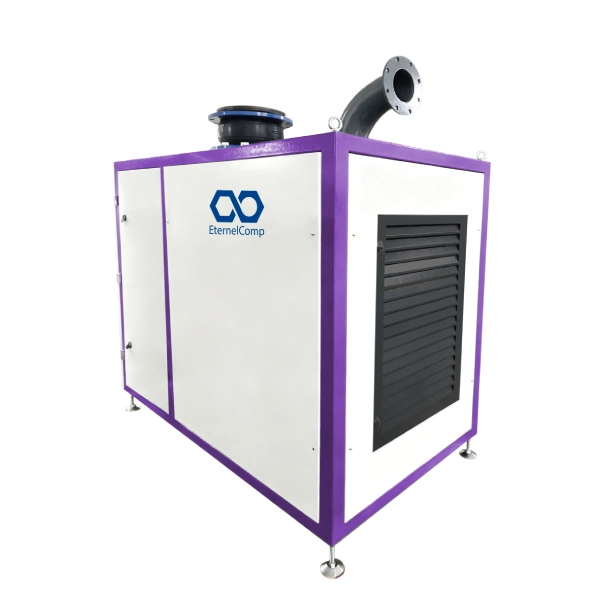
Specify at the worst realistic summer condition. A packaged unit with air or water cooling, such as a maglev turbo blower, can be configured for a hot plant room, but the derating still applies.
Matching the Blower to the Duty
Match on the shape of the load curve and the stability of the back pressure first, then compare efficiency at the weighted average duty rather than at peak. The machine that fits the middle of your operating range beats the one that only fits its own design point.
A Five-Step Selection Sequence
- Define the duty: flow at the injection point, pressure rise including pipe and diffuser losses, and the air quality class.
- Plot the annual load duration curve. The area under it, not the peak, is what you pay for.
- Compute the turndown. Below about 3:1, staging smaller units is cheaper than one wide-range machine.
- Check back pressure: a steady head favours a dynamic machine, variable level or filter loading favours positive displacement.
- Compare wire power at peak, average and minimum, then convert the difference into ten-year cost.
Application Fit by Duty
| Duty | Pressure rise | Load pattern | Usual fit |
| Municipal aeration, fixed depth | 50 to 80 kPa | Daily curve | Turbo, or staged units |
| Small industrial aeration | 40 to 70 kPa | Wide swings, idle periods | Roots or screw |
| Aquaculture pond aeration | 20 to 40 kPa | Continuous, low pressure | Roots |
| Pneumatic conveying | 50 to 100 kPa | Varies with line loading | Roots or screw |
| Flotation and mixing air | 40 to 70 kPa | Steady | Turbo |
Where a Screw Blower Fits
The screw blower sits between the two. Intermeshing rotors compress air progressively from the moment the inlet port closes, so the machine performs real internal compression instead of relying on backflow. It draws 15 to 30 percent less power than a Roots unit at the same duty, has no surge limit and reaches about 200 kPa, at a higher price and with more seal attention. Where a duty needs pressure headroom and efficiency together, an oil-free screw blower is often the compromise that holds.
Total Cost of Ownership and How to Specify
Over ten years, energy dominates the cost of any blower running more than 4,000 hours a year. The cheaper quotation is usually the more expensive machine, and the gap turns on how well the package matches the load curve.
A Ten-Year Cost Model
Assumptions: 60 m³/min at 70 kPa, 8,000 hours a year, 0.10 dollars per kWh, no tariff escalation.
| Elemento de coste | Roots blower | Turbo blower |
| Installed capital cost | 55,000 | 115,000 |
| Wire power at duty | 90 kW | 63 kW |
| Consumo energético anual | 720,000 kWh, 72,000 in cost | 504,000 kWh, 50,400 in cost |
| Mantenimiento anual | 1,650 | 1,700 |
| Ten-year total | 791,500 | 636,000 |
Simple payback on the 60,000 capital difference is under three years. Change an input and the answer moves: at 2,000 hours a year the comparison favours the Roots machine, and at 0.06 dollars per kWh payback stretches past five years.
Specifying for Verification
Write the guarantee in the units you will measure. Specify wire power at the duty point, tested to the ASME PTC 13 wire-to-air performance test code, with inlet condition and pressure rise on the test sheet. Require the full performance curve rather than a single point, plus the turndown limit and anti-surge strategy. A supplier who puts those numbers in writing offers an engineering comparison; one who offers a headline percentage does not.
Preguntas frecuentes
These three questions usually arrive after a first comparison, and each turns on one variable rather than on the technology as a whole.
Which is better, a turbo or a blower?
The question mixes a category with a type. Blower is the general term for a machine moving air at a pressure ratio of about 3 or less, and turbo is one way of building one. Between a Roots blower and a turbo blower, neither is better in isolation: Roots suits shifting back pressure, turbo suits steady pressure and long high-load hours.
Is a screw or roots supercharger better?
In forced induction, a screw supercharger usually wins at higher boost because it compresses internally, while a Roots unit is simpler and cheaper at low boost. The industrial version of the argument is identical. A screw blower beats a Roots blower by 15 to 30 percent in power at the same duty, especially above 80 kPa. Below about 50 kPa on intermittent duty, Roots cost and simplicity often outweigh the gap.
What plant size justifies a turbo blower?
There is no fixed flow threshold; running hours and load stability matter more than size. A small plant running 7,000 hours a year at a steady dissolved oxygen setpoint can justify a turbo package, while a large plant with seasonal shutdowns may not. As a rule, if a machine will exceed 4,000 hours a year at more than 60 percent of rated flow, model a turbo option.