Tanto los compresores de pistón lubricados con aceite como los compresores de tornillo rotativo lubricados con aceite producen aire comprimido. Eso es obvio. Pero la forma en que lo consiguen —y cómo se comportan día tras día en una planta de producción— no podría ser más diferente. Es una diferencia que tiene mucha más importancia de lo que muchos compradores primerizos esperan.
Esta comparación se centra específicamente en las máquinas de tornillo rotativo lubricadas con aceite, ya que son el tipo de compresor de tornillo más utilizado en aplicaciones industriales generales. No son los compresores sin aceite ni los de espiral. El compresor de tornillo con inyección de aceite: el que la mayoría de las empresas acaban valorando cuando su sistema de pistón se queda pequeño.
Cómo funciona realmente cada tipo
Compresores de pistón: el incansable caballo de batalla de siempre
La mayoría de la gente ha visto al menos una vez un compresor de pistón. Un cigüeñal acciona uno o varios pistones dentro de los cilindros. El aire entra durante la carrera descendente, se comprime durante la carrera ascendente y se expulsa a través de una válvula de descarga. El concepto es sencillo, y esa sencillez forma parte de su atractivo.
Sin embargo, el flujo de salida es intrínsecamente pulsante. Cada carrera del pistón genera una ráfaga de aire comprimido, por lo que los compresores de pistón casi siempre van acompañados de un depósito de almacenamiento para suavizar el flujo. Los modelos de una sola etapa admiten presiones moderadas; las versiones de dos etapas comprimen el aire dos veces para obtener una salida de mayor presión en PSI.
Son ruidosos, de funcionamiento sencillo y se pueden encontrar en cualquier sitio.
Tornillo rotativo lubricado con aceite: diseñado para un funcionamiento continuo
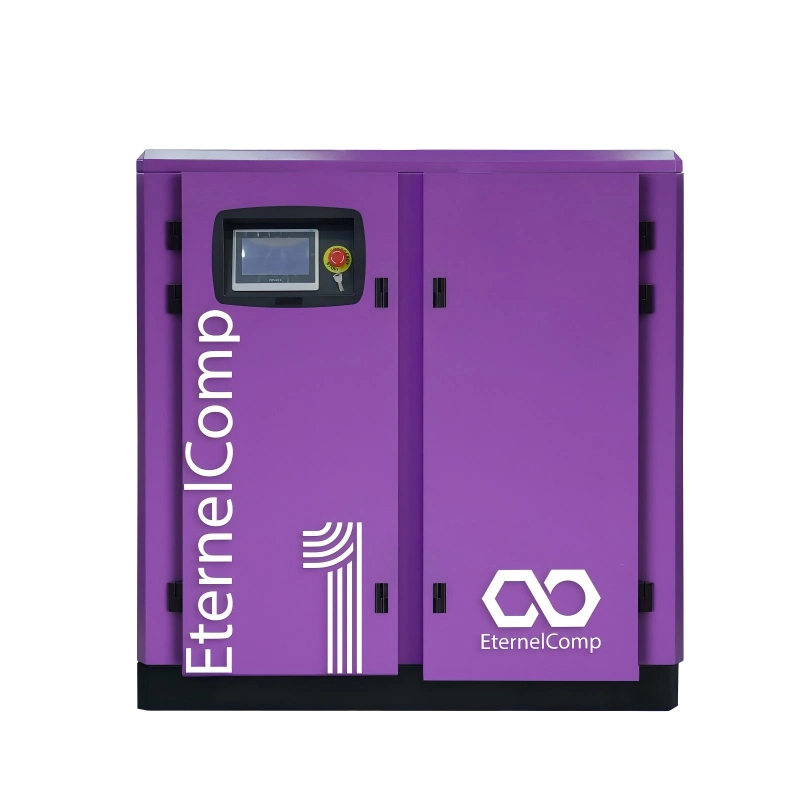
Los compresores de tornillo funcionan de manera diferente en un nivel fundamental. Dos rotores helicoidales —un par formado por uno macho y otro hembra— se engranan dentro de una carcasa sellada. A medida que giran, el aire queda atrapado entre los lóbulos y la pared de la carcasa, y luego se comprime progresivamente a medida que se desplaza desde el extremo de admisión hasta el de descarga.
¿Qué es lo que hace que compresores de aire de tornillo rotativo lubricados con aceite Una característica distintiva es la inyección de aceite. El aceite inunda la cámara de compresión durante el funcionamiento. Sella los minúsculos huecos entre los rotores, absorbe el calor de la compresión y lubrica las piezas móviles. A continuación, un separador de aceite elimina el aceite del aire antes de que llegue al sistema de distribución.
El resultado es un flujo de aire suave y continuo, sin pulsaciones ni ciclos. Estas máquinas están diseñadas para funcionar todo el día, todos los días, sin períodos de descanso.
Las diferencias clave: comparación lado a lado
Aquí es donde las cosas se concretan. La tabla siguiente recoge las diferencias más relevantes a la hora de tomar una decisión entre los compresores de pistón y los compresores de tornillo con inyección de aceite:
| Factor | Compresor de pistón | Tornillo rotativo lubricado con aceite |
|---|---|---|
| Ciclo de trabajo | 50–70% (requiere periodos de enfriamiento) | 100% continuo |
| Entrega aérea | Pulsante | Suave, uniforme |
| Nivel de ruido | 80–95 dB (alto) | 65–80 dB (notablemente más silencioso) |
| Vida útil habitual | 10-15 años (unidad de bombeo) | 20–30+ años (grupo compresor) |
| Mantenimiento | Más frecuentes: válvulas, anillos, juntas | Con menor frecuencia: aceite, filtros, separador |
| Eficiencia energética | Aceptable a plena carga; deficiente a carga parcial | Los modelos VSD destacan en situaciones de demanda variable |
| Coste inicial | Baja | Mayor (a menudo entre 2 y 5 veces más para un CFM similar) |
| Presión máxima | Más de 300 PSI (multietapa) | Normalmente, entre 100 y 225 PSI |
| Ideal para | Uso intermitente y poco intensivo | Funcionamiento industrial continuo |
Algunas de estas diferencias parecen insignificantes sobre el papel. En la práctica, algunas de ellas —especialmente el ciclo de trabajo y la eficiencia energética— son factores determinantes a la hora de tomar la decisión de compra en operaciones de gran envergadura.
Ciclo de trabajo: la diferencia que pilla a la gente por sorpresa
Probablemente este sea el factor más importante de todos y el que más se suele pasar por alto.
Los compresores de pistón no están diseñados para funcionar sin interrupción. La mayoría tiene un ciclo de trabajo nominal de 50–70%, lo que significa que necesitan un tiempo de inactividad para enfriarse entre ciclos de compresión. Si se fuerza una máquina de pistón más allá de su ciclo de trabajo nominal —haciendo que funcione de forma continua para trabajos de CNC, chorro de arena o en un taller con mucha actividad—, se producirán sobrecalentamiento, un desgaste acelerado de los anillos y fallos prematuros. A veces, en cuestión de meses.
Los compresores de tornillo, por el contrario, están diseñados para un funcionamiento continuo (100%). Hacerlos funcionar las 24 horas del día, los 7 días de la semana, no supone un uso indebido, sino que es precisamente para lo que están pensados. En cualquier operación en la que la demanda de aire comprimido sea constante, en lugar de intermitente, esta diferencia por sí sola suele zanjar el debate.
Coste total de propiedad: más allá del precio de venta
Los costes energéticos son el tema principal
He aquí una cifra que suele sorprender a la gente: la electricidad suele representar 70–80% del coste total de un compresor a lo largo de su vida útil. ¿El precio de compra? Una fracción de lo que gastarás en su consumo eléctrico.
Aquí es donde los compresores de tornillo con variador de velocidad (VSD) realmente destacan. Una unidad VSD ajusta la velocidad del motor al alza o a la baja para adaptarse a la demanda real de aire en tiempo real. Durante los periodos de baja demanda, reduce la velocidad y consume menos energía. Las máquinas de pistón, por el contrario, funcionan con carga o sin ella —o se encienden y apagan cíclicamente—, lo que supone un desperdicio de energía en condiciones de carga parcial.
En un periodo de funcionamiento de 10 años, el ahorro energético que supone un compresor de tornillo correctamente dimensionado y equipado con un variador de velocidad (VSD) puede ser considerable. En muchos casos, suficiente para compensar por completo el mayor coste inicial.
Mantenimiento y tiempo de inactividad
Los compresores de pistón tienen más componentes sujetos a desgaste —anillos de pistón, válvulas, juntas, cojinetes de biela—. Con un uso diario intensivo, estas piezas requieren atención con mayor frecuencia. Los compresores de tornillo tienen menos puntos de desgaste mecánico, y el mantenimiento es principalmente rutinario: cambios de aceite, sustitución de filtros y cambio de elementos separadores. Es más predecible, más fácil de programar y, en general, menos disruptivo.
El coste del tiempo de inactividad no planificado —pedidos perdidos, trabajadores inactivos, líneas de producción paralizadas— es algo que rara vez aparece en las comparativas de fichas técnicas, pero que sin duda se refleja en los presupuestos operativos reales.
Cuándo sigue siendo recomendable optar por un compresor de pistón
Sería injusto afirmar que los compresores de pistón están obsoletos. No lo están. En determinados casos, siguen siendo la opción más acertada:
- Aplicaciones intermitentes y de baja intensidad — un pequeño taller de carpintería en el que se utiliza una pistola de clavos y una boquilla de purga.
- Requisitos de presión muy elevados — Las máquinas de pistón de varias etapas alcanzan presiones que los compresores de tornillo estándar no pueden igualar.
- Presupuestos ajustados y una demanda realmente baja — Si el compresor solo funciona unas pocas horas a la semana, la rentabilidad de una máquina de tornillo no justifica la inversión.
- Portabilidad — La gran mayoría de los compresores de obra y móviles funcionan con pistones.
El error no es elegir un compresor de pistón. El error es elegir uno cuando la aplicación exige, en realidad, un funcionamiento continuo, y luego preguntarse por qué falla constantemente.
Si quieres saber más sobre los compresores de aire de tornillo rotativo lubricados con aceite, lee ¿Qué es un compresor de aire de tornillo rotativo lubricado con aceite?.
Preguntas frecuentes
¿«Lubricado con aceite» significa que el aire comprimido contendrá aceite?
Sí, hasta cierto punto. Todos los compresores de tornillo con inyección de aceite producen aire con trazas de aceite, normalmente en el rango de 2 a 5 ppm tras pasar por el separador de aceite integrado. Para la mayoría de los usos industriales generales (herramientas neumáticas, cilindros neumáticos, soplado), esto es perfectamente aceptable. Para aplicaciones que requieren aire más limpio —envasado de alimentos, procesos farmacéuticos, pintura—, se pueden instalar filtros coalescentes o de carbón activo adicionales que reduzcan el contenido de aceite hasta casi cero. Las aplicaciones verdaderamente libres de aceite pueden requerir una clase de compresores totalmente libres de aceite.
¿Es más difícil mantener un compresor de tornillo que uno de pistón?
En realidad no; es diferente, más que más difícil. El mantenimiento de los compresores de tornillo gira en torno a los cambios de fluido, la sustitución de filtros y la renovación de los elementos separadores a intervalos de horas definidos. Es predecible y se puede programar. El mantenimiento de los compresores de pistón puede parecer más reactivo: sustituciones de válvulas provocadas por la pérdida de rendimiento, desgaste de los anillos detectado por un aumento de las fugas de escape o fallos en las juntas que provocan fugas. Las máquinas de tornillo suelen premiar la rutina; las de pistón, en cambio, suelen exigir vigilancia.
¿A partir de qué volumen de producción empieza a ser rentable pasar de un compresor de pistón a uno de tornillo?
No existe un umbral único de CFM, pero sí un límite aproximado que se observa en muchas instalaciones: cuando se necesita aire comprimido de forma constante durante más de 6-8 horas al día, las limitaciones del ciclo de trabajo y la ineficiencia energética de un compresor de pistón empiezan a suponer un coste superior al sobreprecio de una máquina de tornillo. Los talleres que funcionan en dos turnos o más casi siempre comprueban que una unidad de tornillo rotativo con inyección de aceite, correctamente dimensionada, se amortiza en pocos años gracias al ahorro en las facturas de energía y a la reducción de los gastos de mantenimiento.