Oxygen is everywhere — literally about 21% of the air around us — yet getting a reliable, concentrated supply of it for medical wards, industrial plants, or aquaculture farms is a whole different story. That’s where a PSA Oxygen Generator comes in. It’s not a new invention exactly, but the technology has quietly matured into one of the most dependable methods for on-site oxygen production available today.
So what exactly is it, and why are so many industries switching away from traditional oxygen cylinders and cryogenic systems in favor of PSA technology? Let’s break it down.
What Does PSA Stand For?
PSA stands for Pressure Swing Adsorption. The name actually describes the process pretty well once you know what adsorption means — it’s the process by which gas molecules stick to the surface of a solid material (rather than being absorbed into it). The “pressure swing” part refers to the fact that the system alternates between high and low pressure to keep the process running continuously.
Ambient air contains roughly 21% oxygen, 78% nitrogen, 0.9% argon, and a small fraction of trace gases. A PSA Oxygen Generator exploits the difference in how these gases behave under pressure — specifically, how nitrogen can be selectively trapped, leaving concentrated oxygen to flow through.
How a PSA Oxygen Generator Works
The Role of Zeolite Molecular Sieves
At the heart of every PSA Oxygen Generator is a material called zeolite — a highly porous crystalline substance that has a remarkable ability to adsorb nitrogen molecules preferentially under pressure. While nitrogen concentrates in the pore system of the zeolite, oxygen gas is produced as a product gas.
Zeolite can be found naturally, though most industrial generators use a synthetic version engineered for optimal performance. Think of it like a molecular sponge — one that has an unusual appetite specifically for nitrogen.
The Two-Tower Cycle
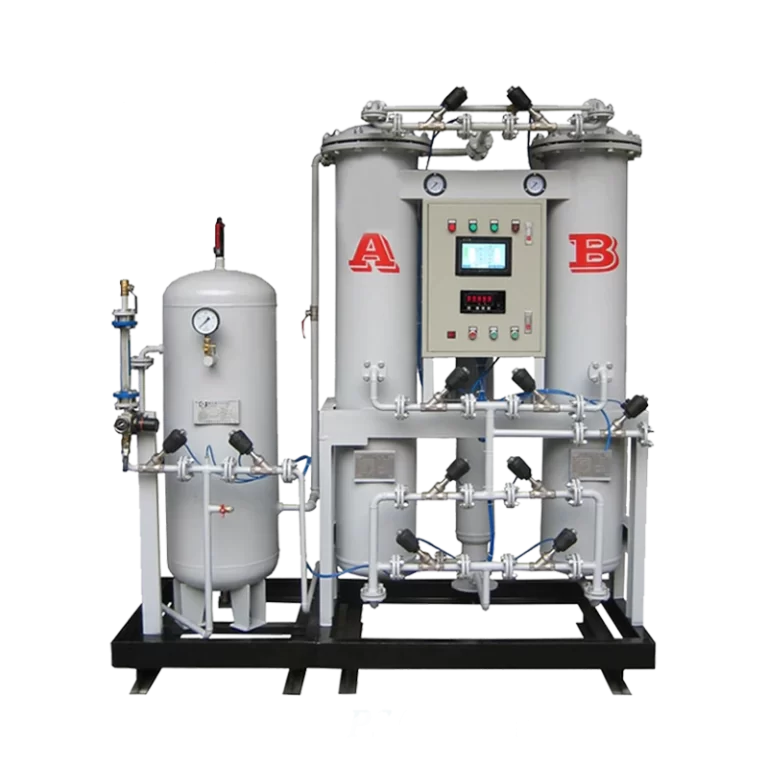
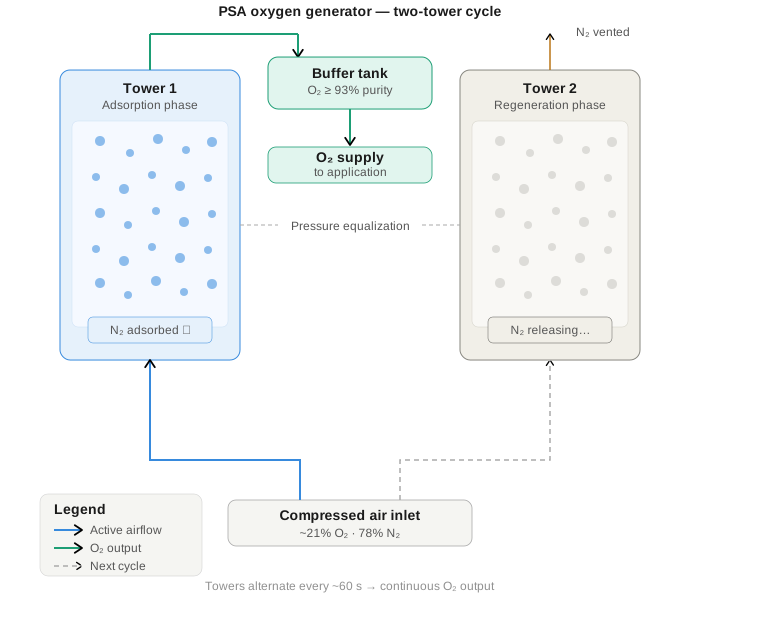
Most PSA oxygen systems use two pressurized vessels filled with zeolite to ensure continuous oxygen production. Here’s what happens step by step:
- Compressed air is filtered, dried, and fed into the first adsorption tower
- Nitrogen is selectively adsorbed by the zeolite under high pressure (typically 4–8 bar)
- Oxygen passes through and collects in a buffer tank
- When the zeolite in Tower 1 reaches saturation, the system switches to Tower 2
- Tower 1 depressurizes — the nitrogen is released and vented out
- The cycle repeats, continuously
Because the system swings back and forth between two vessels — one pressurizing while the other depressurizes — it maintains a steady, uninterrupted flow of oxygen.
Output Purity
Most PSA generators produce oxygen with a purity of 90–95%, which is suitable for the majority of medical and industrial applications. For contexts requiring ultra-high purity above that range, additional purification steps may be needed — but for most use cases, 93%+ is more than adequate.
PSA vs. Other Oxygen Production Methods
It helps to understand how PSA stacks up against older approaches:
| Feature | PSA Oxygen Generator | Oxygen Cylinders | Cryogenic System |
|---|---|---|---|
| Raw Material | Ambient air | Pre-filled gas | Liquefied air |
| On-site Production | Yes | No | Partial |
| Operating Cost | Low | High (recurring) | Very High |
| Infrastructure Needed | Minimal | Storage space | Complex cooling systems |
| Safety Risk | Low | Fire/explosion risk | Cryogenic hazard |
| Oxygen Purity | 90–95% | 99%+ | 99%+ |
Unlike cryogenic distillation, PSA technology operates under normal temperature and pressure conditions — no complex cooling systems, no large-scale infrastructure. For most facilities, that simplicity is genuinely appealing.
Key Advantages of PSA Oxygen Generators
There are a few reasons this technology keeps gaining ground:
- Cost efficiency — Once installed, operating costs are low since the raw material is just air
- Safety — No large volumes of pressurized oxygen stored on-site, reducing fire and explosion risk significantly
- Environmental friendliness — No harmful byproducts; air is the only input
- Low maintenance — Under normal operating conditions with proper maintenance, the zeolite molecular sieve has an almost indefinite lifespan
- Automation — Modern units can be monitored remotely via computer or smartphone
- Scalability — Modular systems can be expanded as oxygen demand grows
Where Are PSA Oxygen Generators Used?
The applications are broader than most people expect. It’s not just hospitals. Industries ranging from fish farming to glass manufacturing rely on this technology daily.
Medical and Healthcare
Hospitals, clinics, and even home-care setups use PSA Oxygen Generators to maintain a continuous oxygen supply for patients. During the COVID-19 pandemic, the technology proved its worth when governments worldwide fast-tracked PSA plant installations in public health facilities to combat oxygen shortages. The reliability factor matters enormously in these settings — a supply interruption is simply not an option.
Industrial Applications
- Metal cutting and welding (oxygen-enriched flames burn hotter and cleaner)
- Wastewater treatment (oxygen boosts aerobic biological processes)
- Glass manufacturing (improves combustion efficiency in furnaces)
- Paper and pulp industry
- Aquaculture and fish farming (dissolved oxygen in tanks supports fish survival)
Other Uses
- Natural gas processing
- Chemical production
- Laboratory environments requiring controlled atmospheres

Things Worth Knowing Before Buying
A PSA Oxygen Generator is not universally the right answer for every situation. There are a few practical considerations:
Purity Ceiling
As noted, most PSA systems top out around 93–95% purity. For applications like semiconductor manufacturing or certain research environments demanding 99.5%+ purity, a PSA system alone won’t cut it without additional processing.
Compressed Air Quality
The system depends entirely on clean, dry, oil-free compressed air as its input. If the upstream compressor isn’t properly maintained — or if the air has too much humidity or contamination — the zeolite sieves can degrade faster and oxygen output quality drops.
Power Dependency
Unlike cylinders that just sit there, a PSA system needs electricity to run compressors and control valves. In locations with unstable power supply, this requires a backup solution.
Final Thoughts
A PSA Oxygen Generator represents a genuinely practical shift in how oxygen is produced and supplied — particularly for facilities that need reliable, continuous oxygen without the logistical headache of refilling cylinders or managing cryogenic storage. The technology isn’t flashy, but it works. The two-tower pressure swing cycle, the zeolite molecular sieves, the automatic valve switching — it all adds up to something surprisingly elegant in its simplicity.
For hospitals, industrial plants, fish farms, and countless other operations, on-site PSA oxygen generation has moved from an interesting alternative to something closer to the obvious choice. And given ongoing improvements in zeolite materials and energy efficiency, the technology is only going to get better from here.