Hay una razón por la que el compresor de aire exento de aceite ha pasado de ser una opción de nicho a convertirse en un estándar generalizado en numerosos sectores. No se trata solo de una ventaja, sino de varias que se complementan entre sí y se acumulan a lo largo de la vida útil de la máquina.
Y aunque el coste inicial sigue haciendo que algunos compradores se lo piensen dos veces, el debate ha cambiado notablemente en los últimos años. Las instalaciones que antes consideraban la tecnología sin aceite un lujo ahora la ven como la opción por defecto. Vale la pena analizar con cierto detalle las razones que lo explican, ya que van mucho más allá del argumento obvio del “aire más limpio”.
Ventaja 1: Riesgo nulo de contaminación por aceite en el flujo de aire
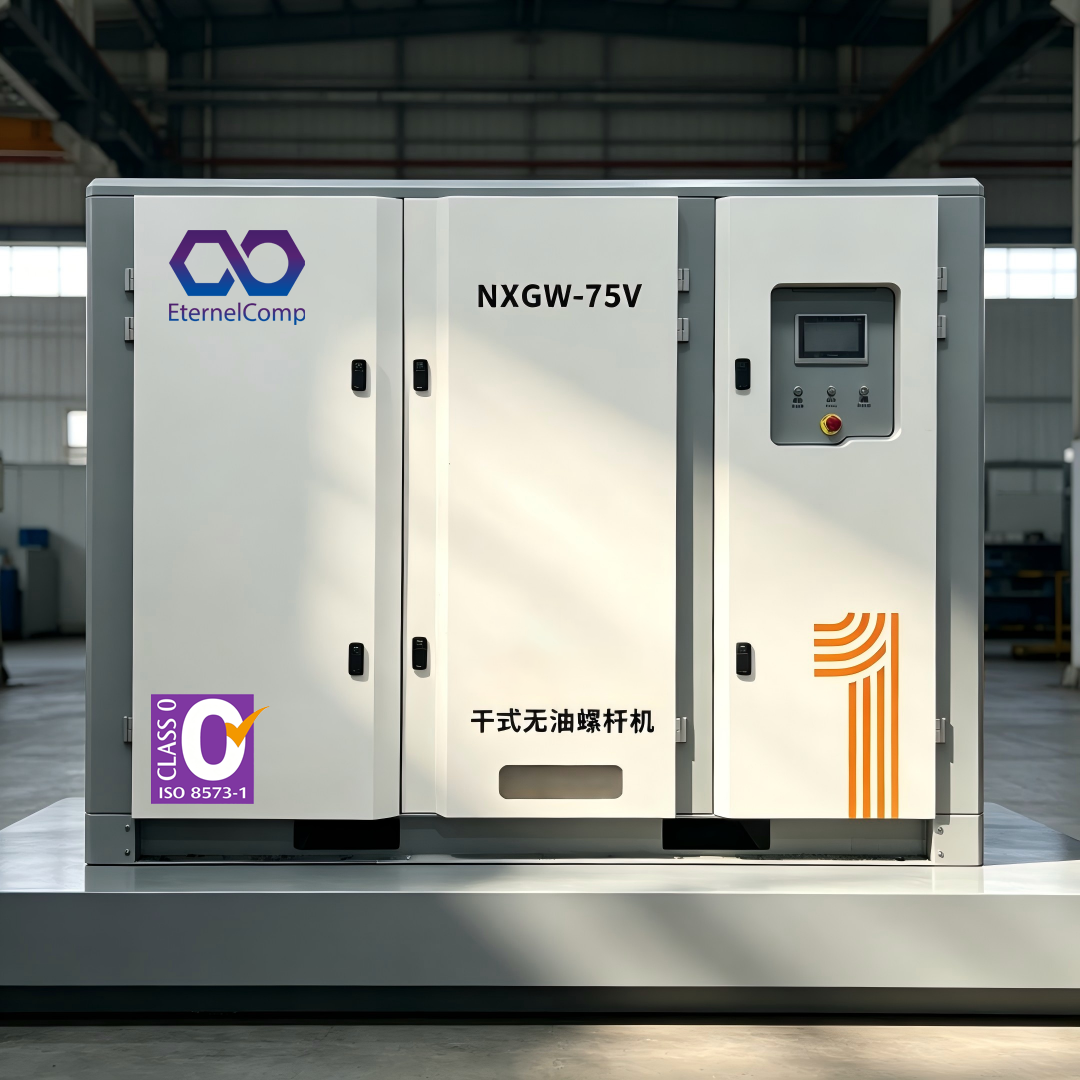
Esta es la ventaja fundamental y, sinceramente, la que determina la mayoría de las decisiones de compra en los sectores regulados. Un compresor sin aceite no utiliza aceite lubricante en la cámara de compresión. La ausencia de aceite en el proceso implica que no puede pasar aceite al aire comprimido resultante. Suena sencillo —y lo es—, pero las repercusiones en las fases posteriores son significativas.
En la producción de alimentos y bebidas, la fabricación de productos farmacéuticos, el montaje de componentes electrónicos y los sistemas de aire médico, incluso la más mínima cantidad de vapor de aceite en el flujo de aire puede causar graves problemas:
- Contaminación del producto y rechazo de lotes
- Daños en instrumentos neumáticos delicados
- Infracciones en materia de salud y seguridad
- Auditorías de calidad fallidas
El estándar de referencia que buscan la mayoría de los compradores es la norma ISO 8573-1 Clase 0, que, en esencia, certifica que el compresor no presenta ningún riesgo de contaminación por aceite. Las unidades con inyección de aceite pueden lograr un aire de salida relativamente limpio mediante una filtración en varias etapas, pero siempre existe un riesgo residual. Los filtros se degradan. El mantenimiento se retrasa. Un solo cambio de aceite omitido o un filtro coalescente saturado pueden enviar aceite a la red antes de que nadie se dé cuenta.
Con la tecnología sin aceite, esa categoría de riesgo simplemente no existe. En operaciones en las que la contaminación no solo supone un inconveniente, sino que resulta realmente costosa —o peligrosa—, esa seguridad es más importante que casi cualquier otra especificación de la ficha técnica.
Ventaja 2: menores necesidades de mantenimiento a largo plazo
Una de las ventajas más prácticas y cotidianas de utilizar sistemas de aire comprimido sin aceite es que el programa de mantenimiento resulta mucho más sencillo. No hay que cambiar el aceite. No hay que sustituir filtros de aceite. No hay que supervisar ni realizar el mantenimiento del separador de aceite y agua.
Puede que sobre el papel parezca una cuestión sin importancia, pero en la práctica tiene su importancia, sobre todo en instalaciones que cuentan con equipos de mantenimiento reducidos o que operan en lugares remotos donde el acceso de los técnicos es limitado.
Para que quede claro, “sin aceite” no significa “sin mantenimiento”. Estas máquinas siguen teniendo componentes que se desgastan y requieren atención:
- Filtros de aire de admisión
- Juntas y válvulas
- Rodamientos
- Correas de transmisión (en algunos modelos)
Sin embargo, al eliminar el circuito de aceite del sistema, se suprime toda una categoría de tareas programadas y los consumibles asociados a ellas. Además, se elimina una de las causas más habituales de paradas imprevistas: las averías relacionadas con el aceite. Menos posibilidades de avería, menos cosas que se pueden olvidar y menos piezas que almacenar.
En el caso de instalaciones con múltiples unidades o sistemas distribuidos, esa reducción de las necesidades de mantenimiento se amplía rápidamente.
Ventaja 3 — Cumplimiento normativo y medioambiental simplificado
No se habla lo suficiente de esta ventaja, probablemente porque resulta menos llamativa que la calidad del aire o el ahorro de costes. Pero tiene un impacto realmente significativo.
Los compresores lubricados con aceite producen condensado que contiene aceite. En la mayoría de los países —en toda la UE, EE. UU. y gran parte de Asia— ese condensado se clasifica como residuo peligroso. No se puede verter legalmente por el desagüe. Debe recogerse, tratarse con equipos de separación de aceite y agua, y eliminarse a través de empresas autorizadas de gestión de residuos. Esto implica costes continuos de equipamiento, tasas de eliminación y trámites burocráticos.
Los compresores sin aceite producen condensado limpio. En la mayoría de los casos, este se puede verter directamente en las redes de alcantarillado sin necesidad de tratamiento previo. La carga administrativa se reduce drásticamente. No hay que mantener unidades de separación, no hay que presentar documentos de residuos peligrosos y no hay riesgo de multas por una eliminación inadecuada.
Es una de esas ventajas ocultas que no aparecen en el folleto del producto, pero que sí se reflejan claramente en el presupuesto operativo.
Ventaja 4 — Menor coste total de propiedad
El precio de venta de un compresor de aire sin aceite suele ser más elevado que el de un modelo equivalente con inyección de aceite. Esa es la realidad, y es la razón principal por la que algunos compradores se lo piensan dos veces. Sin embargo, el coste total de propiedad cuenta una historia diferente.
A continuación se presentan, en una comparación, los factores de los costes recurrentes:
| Factor de coste | Compresor con lubricación por aceite | Compresor sin aceite |
|---|---|---|
| Compras de aceite lubricante | Periódico (cada 1 000-3 000 horas) | Ninguno |
| Sustitución del filtro de aceite | Habitual | Ninguno |
| Mantenimiento del separador de aceite y agua | Obligatorio | No es necesario |
| Eliminación de condensados | Gestión de residuos peligrosos | Desagüe estándar (condensado limpio) |
| Tiempo de inactividad por mantenimiento del sistema de combustible | Periódico | Eliminado |
| Filtración de aire en varias etapas | A menudo se necesita en las fases posteriores | Mínimo o nulo |
| Eficiencia energética (aparatos modernos) | Moderado | Igual o mejor |
El umbral de rentabilidad varía en función del ciclo de trabajo, los costes energéticos y la normativa local en materia de eliminación de residuos. Sin embargo, en el caso de operaciones continuas o casi continuas, es habitual que el mayor precio de compra se amortice en un plazo de dos a cuatro años, a veces incluso antes en entornos muy regulados donde los costes de eliminación y cumplimiento normativo son elevados.
Los diseños modernos sin aceite —entre los que se incluyen los de espiral, de dientes y los de pistón avanzado— también han subsanado el déficit de eficiencia energética por el que se criticaba a las generaciones anteriores. Los costes de funcionamiento ya no suponen la desventaja que representaban en el pasado.
Ventaja 5: Versatilidad en todo tipo de aplicaciones y entornos
Dado que el aire de salida es intrínsecamente limpio, los compresores sin aceite pueden utilizarse en una gama mucho más amplia de aplicaciones sin necesidad de un tratamiento posterior exhaustivo. Esa flexibilidad resulta muy valiosa, especialmente para las instalaciones que abastecen a múltiples procesos con distintos requisitos de calidad del aire a partir de un único sistema de aire comprimido.
También está la cuestión del ruido. Las unidades sin aceite más antiguas tenían fama de ser ruidosas, notablemente más que sus homólogas con inyección de aceite. Eso ha cambiado considerablemente. Los diseños modernos, entre los que se incluyen los silenciosos compresores de pistón Diseñados para funcionar sin aceite, ahora suelen operar por debajo de los 60 dB. Esto los hace idóneos para su instalación en talleres, laboratorios, consultas dentales y otros espacios en los que el ruido de un compresor en una esquina simplemente no sería aceptable.
La variedad de entornos en los que estas máquinas se adaptan perfectamente hoy en día es amplia:
- Entornos hospitalarios y clínicos
- Universidades y laboratorios de investigación
- Líneas de producción alimentaria
- Pequeños talleres de fabricación
- Salas blancas e instalaciones electrónicas
No se trata tanto de encontrar la aplicación adecuada para el compresor, sino más bien de que el compresor se adapte con naturalidad a casi cualquier aplicación.
Si quieres saber más sobre los compresores de aire sin aceite, lee ¿Qué es un compresor de aire sin aceite?
Preguntas frecuentes
¿Son los compresores de aire sin aceite menos duraderos que los modelos lubricados con aceite?
Esta crítica era válida hace una o dos décadas, cuando los elementos de compresión sin aceite se desgastaban más rápidamente debido a la falta de lubricación entre las superficies móviles. La ingeniería moderna ha resuelto en gran medida este problema. Los recubrimientos avanzados (PTFE, aluminio anodizado), las tolerancias más estrictas y los diseños mejorados de los cojinetes han prolongado significativamente la vida útil de los elementos. Aunque los tornillos rotativos con inyección de aceite pueden seguir superando a las unidades sin aceite en cuanto a la longevidad absoluta de los elementos, la diferencia es tan pequeña que rara vez influye en el análisis global de la relación coste-beneficio, especialmente si se tienen en cuenta el menor mantenimiento y el ahorro en consumibles.
¿Puede un compresor sin aceite soportar aplicaciones industriales pesadas, como el chorro de arena o el martillo neumático?
Para tareas industriales de gran volumen y alta presión, los compresores de tornillo rotativo con inyección de aceite siguen siendo los más habituales, en parte debido a los ciclos de trabajo extremos que implican y en parte por el enorme volumen de aire que se requiere. Dicho esto, los compresores de tornillo rotativo y centrífugos sin aceite son absolutamente adecuados para la industria pesada, especialmente cuando las normas de pureza del aire así lo exigen (procesamiento de alimentos a gran escala, líneas de pintura de automóviles, aire para instrumentación petroquímica). No es tanto una cuestión de capacidad como de adaptar el tipo de compresor a los requisitos específicos de presión, caudal y pureza del trabajo.
¿El aire de un compresor sin aceite está realmente libre de cualquier contenido de aceite?
El proceso de compresión en sí mismo no introduce aceite. Sin embargo, el aire ambiente que aspira cualquier compresor —sea sin aceite o no— puede contener trazas de hidrocarburos procedentes del entorno (gases de escape de vehículos, humos industriales, etc.). Un compresor sin aceite garantiza que no añadir aceite al aire, pero no puede filtrar los contaminantes que ya están presentes en el aire de admisión. Para aplicaciones que requieran una pureza absoluta, puede seguir siendo recomendable instalar filtros de admisión o adsorbedores de carbón activo en las fases posteriores del proceso, aunque los niveles de contaminación en cuestión son varios órdenes de magnitud inferiores a los que introduciría una unidad con inyección de aceite.