
Air Compressor Energy Cost Calculator
Estimate annual electricity costs and potential savings from upgrading to a VSD air compressor.
Why Purchase Price Is the Wrong Number to Focus On
According to data from the Natural Resources Canada, the typical lifetime cost breakdown for an industrial compressed air system over 10 years looks something like this:
- Energy consumption: ~76%
- Maintenance and repairs: ~12%
- Initial equipment purchase: ~12%
Read that again. The purchase price — the number that dominates most buying conversations — represents barely one-tenth of total ownership cost. Two compressors with identical price tags can differ by tens of thousands of dollars in energy consumption over a decade. The “cheaper” option on paper is frequently the most expensive one to operate.
This is not a theoretical problem. It plays out constantly in facilities running outdated, oversized, or poorly matched equipment.
The Core Components of Air Compressor ROI
Energy Costs — The Dominant Factor
Energy is where the money goes, so it’s where the ROI calculation has to start. The basic formula is straightforward:
Annual Energy Cost = HP × 0.746 × Annual Operating Hours × Electricity Rate ÷ Motor Efficiency
Here’s a worked example. Consider a 50 HP Air Compressor running two shifts — roughly 6,000 hours per year — at an electricity rate of $0.10/kWh with 95% motor efficiency:
50 × 0.746 × 6,000 × 0.10 ÷ 0.95 = $23,558 per year
Over 10 years, that’s
€235,580 in energy alone—for a machine that may have cost €235,580.
15,000 to $30,000 to buy. The compressor pays for itself in electricity many times over.
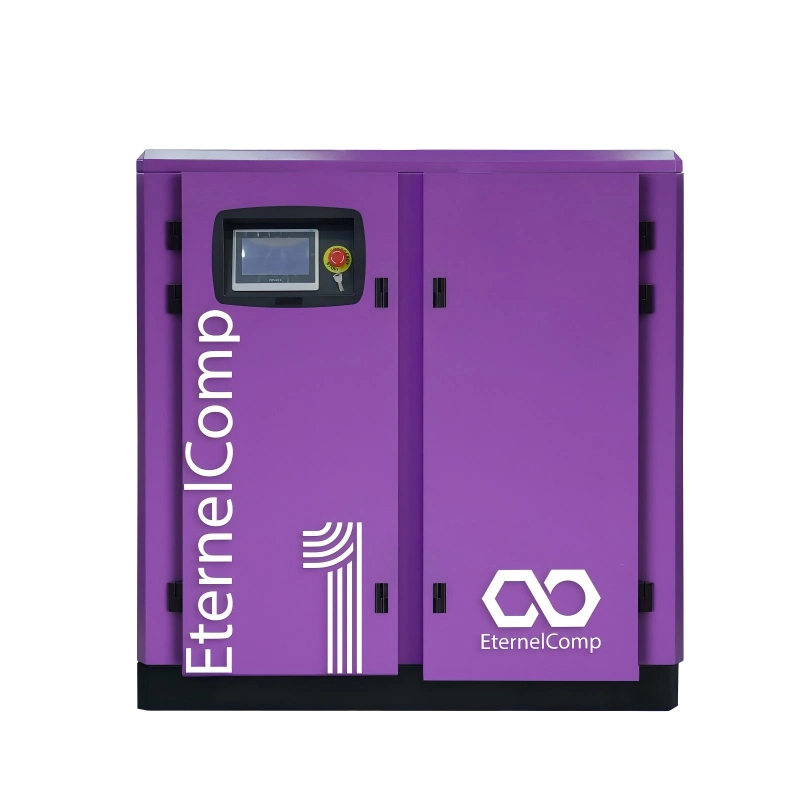
Now consider the savings potential. Upgrading from a fixed-speed compressor to a variable speed drive (VSD) model in a facility with fluctuating demand can reduce energy consumption by 20–50%. On the numbers above, that’s 4,700→11,700 saved every single year. The efficiency advantage of modern oil lubricated rotary screw air compressors with VSD capability is one of the main reasons they’ve become the default choice in continuous manufacturing settings.
Maintenance and Consumables
Maintenance costs vary significantly by compressor type and operating conditions. Screw compressors generally require scheduled service — oil changes, air and oil filter replacements, separator element swaps — at predictable intervals. Piston compressors involve more wear-prone components like valves, rings, and gaskets that tend to need attention more reactively.
The real cost here isn’t just parts and labor. It’s unscheduled downtime. A compressor failure on an active production line can easily cost thousands of dollars per hour in lost output, depending on the operation. Factoring even a conservative estimate for downtime risk into the ROI model often tips the math decisively toward higher-reliability equipment.
Downtime and Productivity Impact
This is the hardest piece to quantify — and it’s tempting to leave it out of the calculation entirely. That would be a mistake.
Stable, consistent air pressure directly affects production quality. Pressure drops cause defects, slow cycle times, and trigger nuisance shutdowns on automated lines. A compressor that delivers reliable output day after day doesn’t just save on energy — it protects throughput. The value is real, even if it doesn’t fit neatly into a spreadsheet cell.

A Simple ROI Calculation Framework
Here’s a practical step-by-step approach:
- Establish baseline costs — What does the current system cost annually in energy, maintenance, and estimated downtime?
- Model the new system — Using manufacturer specs and the energy formula above, project annual operating costs.
- Calculate annual savings — Baseline minus projected costs.
- Determine payback period — Capital investment divided by annual savings.
- Project cumulative savings — Extend the savings over 5, 7, or 10 years.
Here’s what that looks like in a simplified real-world comparison:
| Cost Category | Old System (Fixed-Speed Piston) | New System (VSD Rotary Screw) |
|---|---|---|
| Purchase / installation | $0 (already owned) | $35,000 |
| Annual energy cost | $28,000 | $16,800 |
| Annual maintenance | $3,500 | $1,800 |
| Estimated annual downtime cost | $4,000 | $500 |
| Total annual operating cost | $35,500 | $19,100 |
| Annual savings | — | $16,400 |
| Payback period | — | ~2.1 years |
| 10-year cumulative savings | — | $129,000 |
After roughly two years, the new system has paid for itself. Every year beyond that is pure savings — money that drops straight to the bottom line or gets reinvested elsewhere.
Hidden Factors That Shift the ROI
A few variables don’t always make it into the initial calculation but can meaningfully change the outcome:
- Air leaks. Industry estimates suggest 20–30% of compressed air in poorly maintained distribution systems is lost through leaks. Fixing leaks is often the single highest-ROI action a plant can take — sometimes before any equipment change at all.
- Oversizing or undersizing. A compressor that’s too large wastes energy cycling inefficiently. One that’s too small runs at full load constantly and wears out faster. Proper sizing is foundational to ROI.
- Heat recovery. Compressors convert roughly 80–90% of electrical input into heat. Heat recovery units can redirect that thermal energy to space heating or process water heating, effectively turning waste into value.
- Air quality requirements. Industries like food processing, pharmaceuticals, and electronics may need an Oil-Free Air Compressor to avoid contamination risks. The higher upfront cost of oil-free equipment is often offset by eliminating product rejection events, filtration costs, and regulatory compliance headaches — all of which factor into ROI.
FAQ
Can compressed air system ROI be improved without buying a new compressor?
Absolutely. In many facilities, the fastest ROI improvements come from operational changes rather than equipment replacement. Leak detection and repair programs alone can reduce energy waste by 20–30%. Adjusting system pressure to the actual minimum required — rather than running at an arbitrarily high setpoint — saves roughly 1% in energy for every 2 PSI reduction. Adding proper storage (receiver tanks) to buffer demand spikes, installing sequencing controllers for multi-compressor systems, and performing routine maintenance on schedule all improve ROI without a single capital equipment purchase.
Is it worth hiring a professional compressed air audit before making a purchase decision?
For any facility spending more than 30,000–50,000 annually on compressed air energy, a professional audit is almost always worth the investment. Auditors use data logging equipment to map actual demand profiles over days or weeks — not just peak loads, but the full range of fluctuations. This data reveals whether VSD makes sense, whether the system is oversized, where the biggest leaks are, and what realistic savings projections look like. Many compressor distributors offer audits, though independent third-party audits tend to produce less biased recommendations. The cost of an audit — typically 2,000→10,000 depending on system complexity — is usually recovered many times over through better-informed decisions.