Industrial plants rely on an air compressor to keep tools, automation, and process equipment running, yet few machines are watched as closely as they should be. An aging unit rarely fails without warning, but the early signals — slower pressure recovery, creeping energy bills, and more frequent service visits — are easy to mistake for normal operating costs. When a compressor finally stops, the plant faces not only a large repair bill but also unplanned downtime that can cost far more than the repair itself. Compressed air is also one of the most expensive forms of energy in a factory, and as Wikipedia’s overview of air compressors notes, electricity can account for the majority of a compressor’s lifetime cost.
If your compressor is more than a decade old, cannot hold rated pressure, needs repairs more than once or twice a year, consumes noticeably more power than it used to, or shows visible oil leaks, heat, and noise, it is time to start planning a replacement. These five warning signs — performance loss, frequent breakdowns, rising energy use, age, and physical wear — give you a practical checklist for deciding when an old air compressor should be retired.
Work through each sign and compare the total cost of keeping your current machine with the cost of a newer, more efficient one.
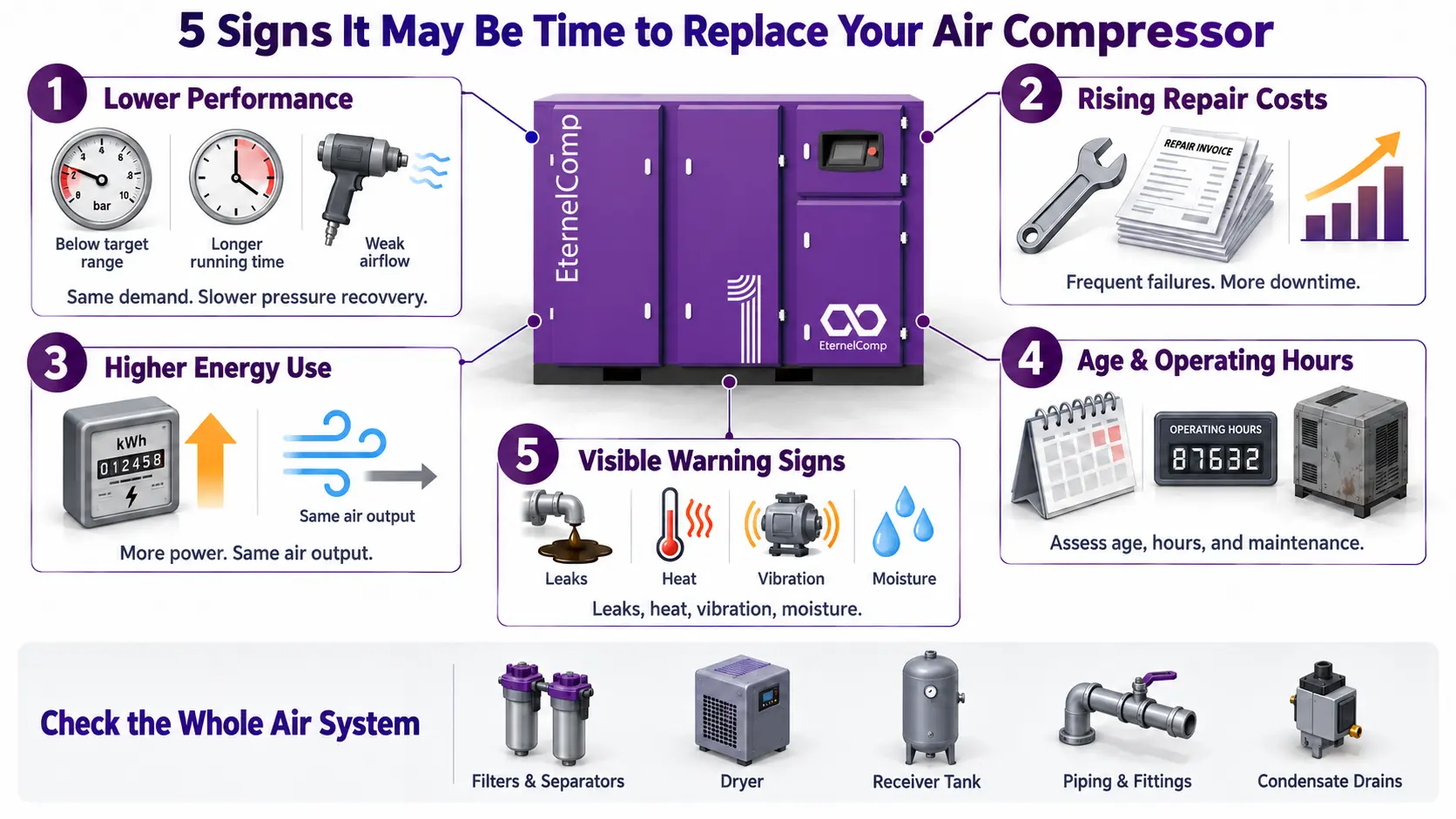
Sign 1: Performance Drops Even When Demand Hasn’t Changed
If the compressor struggles to reach its normal cut-out pressure, runs for longer cycles, or short-cycles on and off, internal wear is already limiting its output. A machine that used to fill the receiver in a few minutes and then rest now seems to run continuously, even though production demand is unchanged.
Common causes include worn rings or valves in reciprocating units and a worn air end, leaking seals, or a failing check valve in rotary screw models. Any of these lets air escape internally, so the compressor must work longer to deliver the same flow. The result shows up at the point of use: tools run slower, painting loses pressure, and pneumatic cylinders move sluggishly. When a new intake filter no longer restores normal pressure recovery, the compression elements have likely passed the point of economical repair.
Sign 2: Breakdowns and Repair Bills Keep Climbing
When annual repair spending approaches half the price of a new unit — or the machine fails several times a year — replacement is usually the more economical choice. A widely used industry rule says that once a repair estimate exceeds roughly 50 percent of the cost of a new compressor, money is better spent on new equipment.
Look beyond the invoice. Frequency matters: two or three callouts a year for the same machine indicate a pattern, not bad luck. Downtime matters too, because when a compressor fails, production stops and urgent jobs may require renting a temporary unit. Parts availability also counts, since manufacturers eventually discontinue support for older models. Add up 12 months of repair invoices plus estimated downtime losses; if the total approaches 50 percent of a new machine’s price, replacement wins.
Sign 3: Energy Consumption Rises While Output Stays Flat
If power use climbs noticeably while the amount of air produced stays the same, the compressor is paying for its own replacement in wasted electricity. As seals, bearings, and rotors wear, efficiency falls and the motor draws more current to deliver the same output.
Energy is the largest cost of owning a compressor, so small efficiency losses add up quickly. In an older system three problems usually combine: the machine itself becomes less efficient, fixed-speed units waste energy during part-load operation where a variable-speed drive would trim power, and air leaks can waste a fifth or more of total output. The U.S. Department of Energy’s compressed air guidance explains how better system management and energy-efficient equipment produce significant savings. Plants that need contaminant-free air can also choose modern oil-free air compressors, which avoid oil-separation losses while protecting sensitive downstream processes.
Sign 4: The Unit Is Old and the Operating Hours Are High
Most industrial air compressors are designed for roughly 10 to 15 years of service, and age is one of the clearest signals that replacement planning should begin. Lifetime depends on the compressor type, the number of operating hours, and the quality of maintenance.
| Compressor Type | Typical Service Life | Notes |
| Reciprocating / piston | 5–10 years | Heavier maintenance; valves and rings wear |
| Oil-free rotary screw | 10–15 years | Runs hotter; bearing and seal care matters |
| Oil-lubricated rotary screw | 10–15+ years | 40,000–60,000+ hours common with good oil care |
| Centrifugal | 20+ years | Large continuous-duty plants |
Operating hours often tell the real story: a well-maintained screw compressor may still be healthy at 40,000 hours, while a neglected unit can fail far earlier. Facilities that rely on oil-lubricated rotary screw air compressors and run them near 24/7 usually hit the efficiency and reliability wall first. Even when an old machine still runs, it lacks variable-speed control, modern monitoring, and quieter operation, so the gap in running costs widens every year.
Sign 5: Leaks, Heat, Noise, and Visible Wear You Should Not Ignore
Oil puddles under the unit, a constant hiss from fittings, hot surfaces, unusual vibration, and moisture in the air lines are physical warnings that the system is degrading. These symptoms point to worn seals, saturated oil separators, failing drains, and internal friction that will only get worse.
Perform a simple walk-around. Look for oil on the floor or in the discharge air, listen for hissing at joints, and check whether the compressor runs hotter or louder than it did years ago. Corrosion deserves special attention: a receiver tank rusted from the inside by condensate is a safety hazard, not a maintenance item, and a compromised pressure vessel must be taken out of service. Moisture reaching tools and processes usually means the dryer or drain circuit is no longer keeping up. Ignoring these signs risks a sudden failure and, in the case of a damaged tank, a dangerous one.
When Replacing an Air Compressor, What Else Should Be Replaced?
A compressor replacement is the right moment to audit the whole air system, because the new unit will only perform as well as the components around it. Filters, separators, dryers, drains, piping, and the receiver all age together, and reusing worn components can quickly damage a new compressor or ruin the air quality it produces.
Work through this checklist during the project:
- Air and oil filters plus oil separator elements: always install new elements sized for the new machine.
- Dryer and filtration: verify that refrigerated or desiccant dryers and line filters match the new flow rate and dew point requirements.
- Receiver tank: inspect for internal corrosion and have the vessel checked before reuse.
- Piping and fittings: repair or replace leaking joints, and remove undersized sections that create pressure drops.
- Condensate drains: replace failing automatic drains that let water sit in the system.
Upgrading the compressor while ignoring the rest of the chain simply moves the problem downstream. Matching the new unit with correctly sized air treatment equipment protects the investment and keeps delivered air clean and dry from day one.
Why Upgrading Usually Pays for Itself
A modern compressor typically recovers its higher purchase price through lower energy bills, reduced maintenance, and fewer production stops. When the old machine’s efficiency loss is significant and its annual repair bill is growing, the payback period for new equipment is often just a few years.
New units bring practical benefits beyond efficiency: variable-speed drives match output to demand, controllers report operating data and alarms, enclosures reduce noise, and better filtration raises air quality. Compare total cost of ownership — purchase, installation, energy, maintenance, and downtime — over the next ten years rather than the sticker price alone. The right choice depends on duty cycle, required air quality, and capacity, so involve an experienced supplier early and size the new system for both current and foreseeable demand.
Frequently Asked Questions
What is the most common cause of air compressor failure?
Neglected maintenance is the most frequent root cause of industrial compressor failure. When oil changes, filter replacements, and drain checks are skipped, lubricant degrades, cooling capacity falls, and contaminants enter the compression chamber, which leads to overheating and accelerated bearing and air end wear. Most serious failures develop over months and can be prevented with a simple, consistent service schedule.
What is the average cost to replace an air compressor?
Costs vary widely because compressor type and size drive the price. A small reciprocating unit for a workshop may cost a few hundred to a couple of thousand dollars, while a packaged rotary screw system in the 10–50 HP range typically runs from about 8000 to 40,000 installed. Large plant systems of 100 HP and above can exceed $100,000. Installation, electrical work, dryers, and piping often add 20–50 percent to the equipment price, so compare total installed cost rather than the compressor alone.
Can I keep my old receiver tank and piping when installing a new compressor?
Only if they are inspected and confirmed safe. Receiver tanks corrode from the inside when condensate is not drained, so have the vessel checked — and pressure-tested if required — before reuse. Old piping should be reviewed for leaks and undersized runs that cause pressure drops; upgrading or repairing it at the same time avoids future efficiency losses and keeps the new system reliable.