Compressed air is treated as a utility like electricity or water, yet the machine that makes it is often specified late and from a catalogue. The vocabulary does not help, because piston, reciprocating, two-stage, oil-free and rotary screw get used interchangeably. Choosing badly surfaces later as a machine that cycles constantly or never reaches the pressure the tools need.
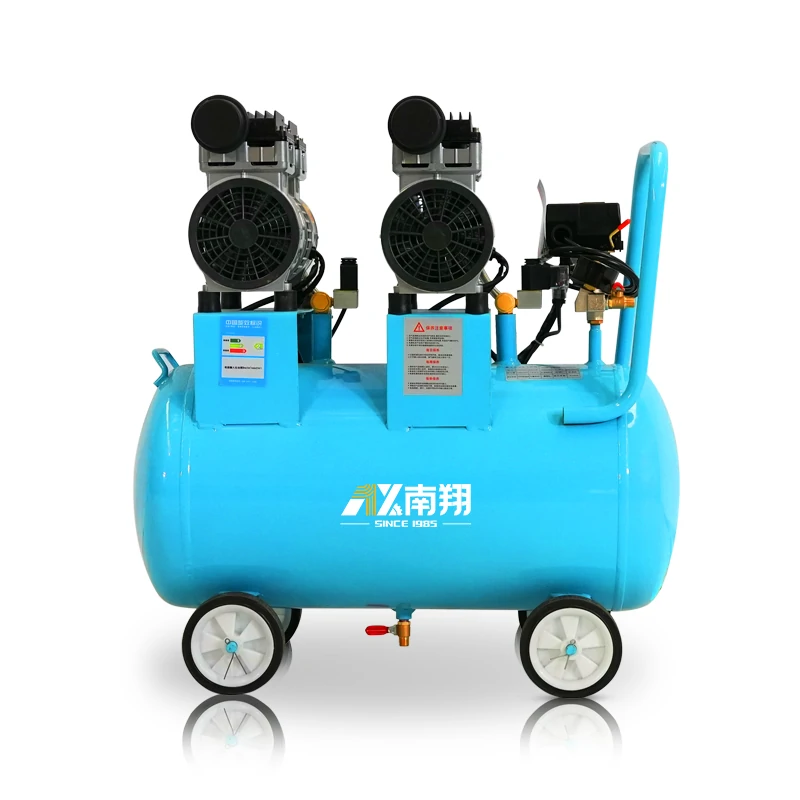
A reciprocating air compressor is a positive displacement machine that traps air in a cylinder and shrinks that volume with a piston until the pressure forces a discharge valve open. One stroke draws air in, the return stroke compresses it, and two self-acting valves keep the flow moving one way. It is a simple, robust and inexpensive route to high-pressure air at small to medium flow.
The sections below follow that definition through the cycle, the hardware, the variants and the selection logic.
What Is a Reciprocating Air Compressor?
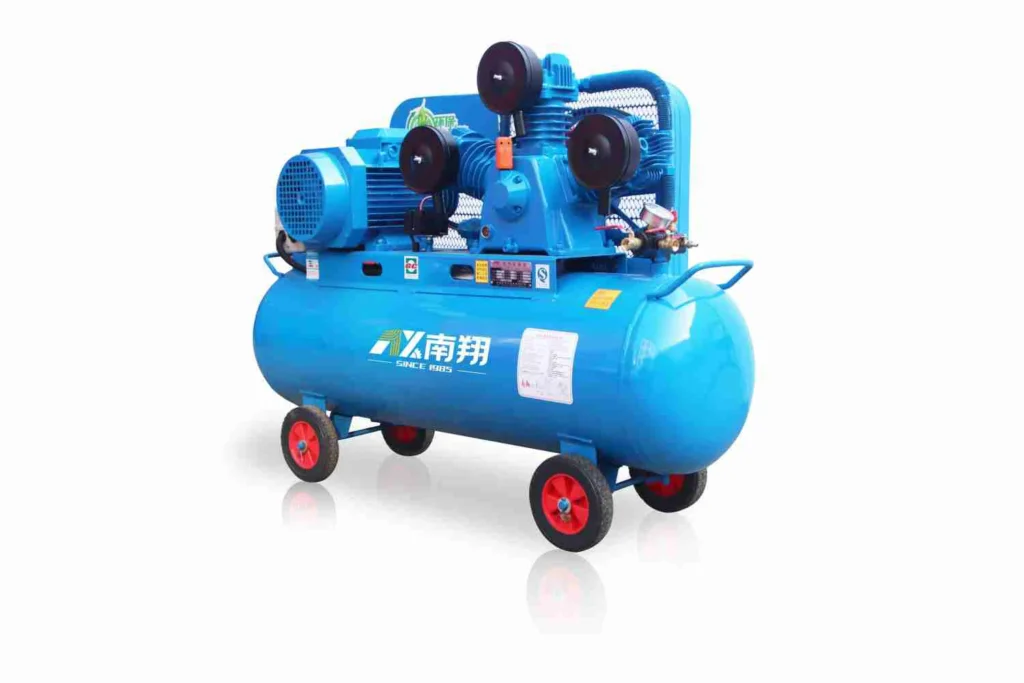
A reciprocating compressor turns the rotary power of a motor into the straight-line motion of a piston, and uses that motion to compress air inside a sealed cylinder. Pressure rises because the trapped volume shrinks, not because the gas is accelerated. Because the piston does the work, the same unit is also sold as a piston compressor.
A crankshaft turns, a connecting rod converts that rotation into a stroke, and the piston sweeps the bore. On the outward stroke the cylinder refills at atmospheric pressure; on the inward stroke the air is squeezed until the discharge valve opens. Lubricated and non-lubricated versions are catalogued separately, so an oil-lubricated piston air compressor and its oil-free equivalent sit in different product families despite sharing the mechanism.
Where Reciprocating Compressors Fit Among Compressor Types
Compressor types divide by principle, then by construction, and that map explains the pressure and flow limits a buyer meets.
| Family | Principle | Typical pressure | Natural fit |
| Reciprocating | Piston shrinks a trapped volume | 8 to 40 bar and above | High pressure, intermittent duty |
| Rotary screw | Rotors shrink a trapped volume | 7 to 13 bar | Continuous duty, larger plants |
| Rotary vane | Vanes shrink a trapped volume | 7 to 10 bar | Compact packaged air |
| Centrifugal | Kinetic energy to pressure | 3 to 25 bar | Very large plants |
Industry references split these into positive displacement machinery and dynamic machines. One stage handles a pressure ratio of about three or four to one, or 8 to 10 bar from atmospheric suction; beyond that, two stages are the practical choice.
Why It Is Also Called a Piston Compressor
Reciprocating describes the motion; piston describes the part. Spare-parts catalogues mix piston kit, reciprocating element and cylinder rebuild set for the same assembly. A specification that names only one term can miss valid suppliers.
How Does a Reciprocating Air Compressor Work?
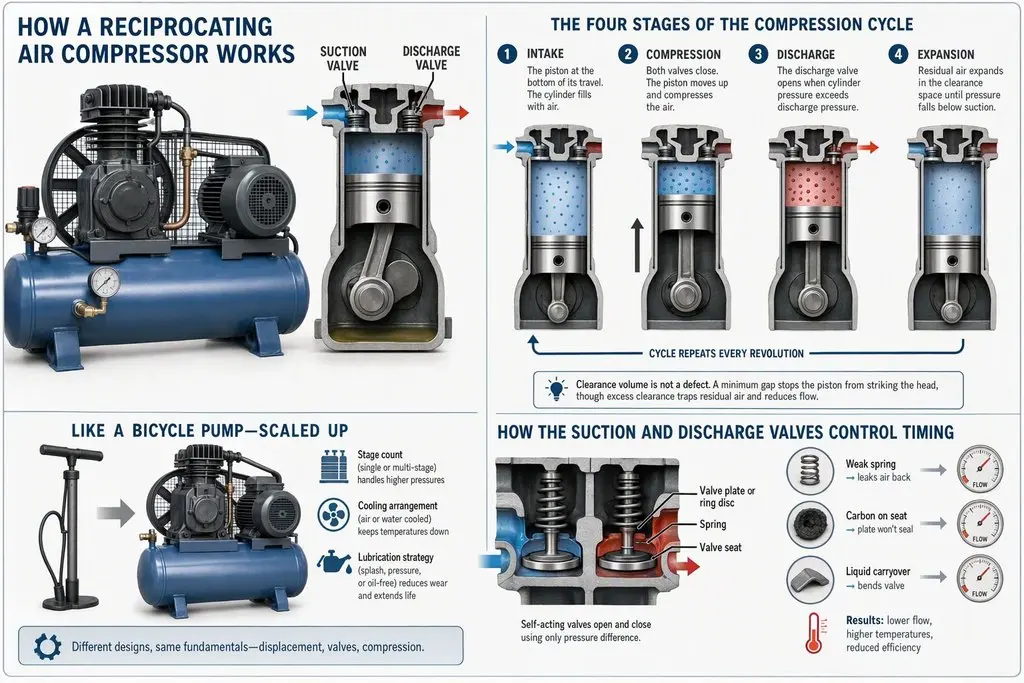
It works by displacement, not velocity. The piston retreats, cylinder pressure falls below atmospheric, and that difference pushes the suction valve open so air fills the bore. The piston advances, both valves close, the air is compressed, and the discharge valve lifts once cylinder pressure exceeds the pressure downstream. Every revolution repeats the sequence, so air leaves in pulses.
The mechanism is a bicycle pump scaled up, with automatic valves, cooling and control added. What separates a workshop unit from a process machine is the stage count, the cooling arrangement and the lubrication strategy, and the fundamentals of how an air compressor works apply to each variant.
The Four Stages of the Compression Cycle
Each revolution traces four phases, and technical analyses of reciprocating compressor behaviour use that pressure-volume loop to diagnose valve faults.
- Intake. The piston sits at the bottom of its travel and the cylinder fills.
- Compression. Both valves close and pressure rises until it matches the discharge line.
- Discharge. The discharge valve stays open while the piston finishes its stroke.
- Expansion. Residual air in the clearance space expands until pressure falls below suction, and the cycle restarts.
Clearance volume is not a defect. A minimum gap stops the piston from striking the head, though excess clearance traps residual air and quietly reduces flow.
How the Suction and Discharge Valves Control Timing
The valves are the most heavily loaded parts in the machine. They are self-acting plates or ring discs held on a seat by springs and pressure difference, with no camshaft to time them. That keeps them cheap but makes them sensitive to conditions. A weak spring leaks air back, carbon holds a plate off its seat, and liquid carryover bends a reed in one stroke, all showing up as lower flow and a hotter head.
What Are the Main Components of a Reciprocating Air Compressor?
The machine splits into a compression end and a drive end. The compression end holds the cylinder, piston, rings and valves. The drive end holds the crankshaft, connecting rod, bearings and flywheel, and converts motor rotation into piston stroke. Cooling, lubrication and control elements turn a bare pump into a working air system.
| Component | Function | Typical wear mode |
| Cylinder and liner | Contains the chamber, guides the piston | Bore scoring, ovality, glazing |
| Piston and rings | Displace air, seal the chamber | Ring wear, sticking, breakage |
| Rider bands | Carry piston weight | Even wear, replaced with rings |
| Suction and discharge valves | Control gas entry and exit | Plate fatigue, seat erosion |
| Connecting rod and bearings | Convert rotation into linear stroke | Bearing shell wear |
Lubrication, Cooling and Air Treatment
Small units use splash lubrication, with a dipper on the connecting rod throwing oil onto the bore and bearings. Larger machines use a pump feeding oil through a filter and cooler, and air-cooled fins give way to water jackets above roughly 30 kW. Downstream, a receiver smooths the pulsating discharge, a dryer removes moisture and filters catch aerosol.
What Are the Two Main Types of Reciprocating Air Compressors?
The two main types are single-acting and double-acting. In a single-acting machine, compression happens on one face of the piston only and the opposite face is exposed to the crankcase. In a double-acting machine, both faces sit in compression chambers, so air is compressed on both strokes and output roughly doubles for the same swept volume.
Two further axes describe how many compression steps the air passes through and whether the cylinder receives oil.
Single-Acting vs Double-Acting
| Feature | Single-acting | Double-acting |
| Compression per revolution | One stroke | Both strokes |
| Output for the same swept volume | Baseline | Roughly double |
| Piston rod and packing | Not required | Required |
| Balance and vibration | Higher pulsation | Smoother torque |
Single-Stage vs Two-Stage Configurations
A single-stage machine compresses once, from atmosphere to final pressure, and covers most workshop air at 8 to 10 bar. A two-stage air compressor compresses in two steps with an intercooler between them. Because the second stage starts from a cooler, denser charge, total work for the same final pressure is lower and discharge temperature drops. Below about 10 bar a single stage costs less; above 12 bar, two stages repay the extra cost.
Lubricated vs Oil-Free Cylinders
Lubricated cylinders rely on an oil film to seal, cool and protect the bore. They tolerate heat and cost less, but pass a small amount of oil carryover downstream. Oil-free cylinders use filled PTFE rings on coated bores, with no oil in the chamber, and suit food, pharmaceutical, electronics and medical air.
What Are the Advantages of a Reciprocating Air Compressor?
The main advantages are high pressure capability, low first cost, mechanical simplicity and strong part-load behaviour. A reciprocating compressor reaches pressure ratios rotary designs cannot match in one package, costs less at small and medium sizes, and uses standard parts that general technicians can fit.
- High pressure from a compact package. Multi-stage units reach 40 bar and beyond.
- Low capital cost at small sizes. Below roughly 50 CFM the price per unit of air is hard to beat.
- Simple technology. No rotor timing clearances to set, and few precision parts.
- Efficient part load. Load and unload control avoids the idling losses of some rotary packages.
- Serviceable anywhere. Valves, rings and gaskets are standard items, not proprietary assemblies.
What Is a Common Disadvantage of Reciprocating Compressors?
The most common disadvantage is pulsating delivery combined with a high count of wearing parts. Air leaves in bursts timed to the piston strokes rather than as steady flow, creating vibration, noise and pressure fluctuation downstream. Valves, rings, rider bands and bearings all wear, so maintenance is more frequent than on a rotary screw machine of comparable output.
Pulsation, Vibration and Noise
Discharge occurs during only part of each revolution, so the receiver and piping see a pressure wave rather than a constant head. Undersized receivers and rigid pipe runs amplify it into noise, cracked welds and drifting gauge readings. A receiver sized for the cycle, pulsation dampers and flexible connectors are the usual remedies.
Wear Parts and Duty Cycle Limits
A reciprocating machine has more sliding and impacting surfaces than a rotary one. Valve plates flex millions of times a month, rings slide against the bore, and bearings carry reversing loads, which is why intervals of 4,000 to 8,000 running hours are typical. Standard models are also rated for intermittent duty, and continuous full-load running accelerates that wear.
Reciprocating vs Rotary Screw: Which Is Better?
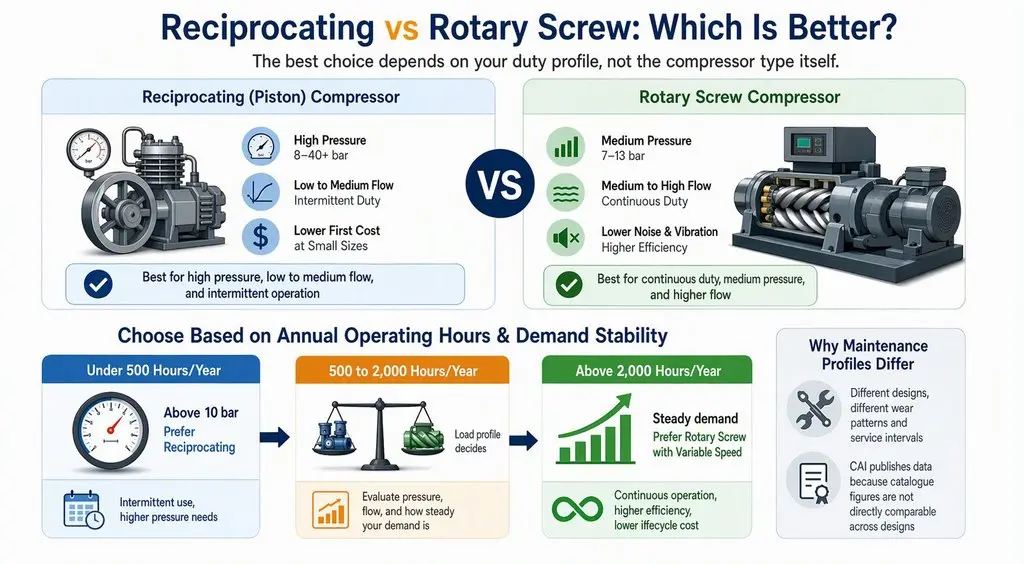
Neither design is universally better. Reciprocating wins for high pressure at low to medium flow with intermittent operation; rotary screw wins for continuous duty at medium pressure and higher flow. The deciding variable is the duty profile, meaning operating hours per year and how steady the demand is, not the compressor type in isolation.
| Criterion | Reciprocating | Rotary screw |
| Pressure capability | 8 to 40 bar and above | Typically 7 to 13 bar |
| Flow range | Low to medium | Medium to high |
| Efficiency at low demand | Good with load and unload control | Poor without variable speed |
| Delivery quality | Pulsating, needs buffering | Smooth and continuous |
| Noise and vibration | Higher | Lower |
| First cost at small sizes | Lower | Higher |
A direct rotary screw vs piston compressor comparison explains why the maintenance profiles diverge as much as the performance curves, and published data from the Compressed Air and Gas Institute exists because catalogue figures are not directly comparable across designs. Under 500 hours a year above 10 bar, prefer reciprocating; between 500 and 2,000 hours the load profile decides; above 2,000 hours at steady demand, prefer rotary screw with variable speed.
Where Are Reciprocating Air Compressors Used?
They suit duties that call for high pressure at modest flow, or short bursts of air separated by idle periods. Typical settings include vehicle workshops, fabrication shops, painting operations, laboratories and packaging lines, plus process duties in which a specific gas must reach a high pressure.
| Industry | Typical task | Why the design fits |
| Automotive service | Tyre inflation, impact tools, spraying | High pressure, intermittent, low flow |
| Metal fabrication | Plasma cutting, clamping, deburring | Burst demand at moderate pressure |
| Food and beverage | Packaging and bottling | Oil-free variants with verified purity |
| Pharmaceutical | Instrument air | High pressure, strict contamination limits |
How to Choose the Right Reciprocating Air Compressor
Size the machine on four inputs together: required pressure at the point of use, total flow in CFM or m³/min, duty cycle in operating hours, and the air quality class the process demands. Choosing on pressure alone produces a machine that cycles constantly; choosing on flow alone produces one that never reaches the pressure the tools need.
- Establish true demand. Add every simultaneous user, then apply a diversity factor.
- Set pressure at the furthest point of use. Add pressure drop across dryers, filters and piping; a 7 bar tool may need 8.5 bar at the outlet.
- Choose the stage count. One stage to about 10 bar, two stages above that.
- Choose the lubrication strategy. Lubricated for general industrial air, oil-free for product contact.
- Size the receiver and treatment. The receiver buffers pulsation and peaks; dryers and filters must handle full flow.
- Confirm the duty rating. Check the rated hours, then derate for altitude, ambient temperature and intake restriction.
Maintenance Practices That Extend Service Life
The highest-return task is regular valve and ring inspection, because those two items account for most lost capacity. Around them sit oil condition, intake filtration, cooling and condensate removal, which together decide whether wear parts reach their expected interval.
| Interval | Task | Purpose |
| Daily | Check oil level, drain condensate, note discharge pressure | Catch low lubrication and water carryover |
| Weekly | Inspect intake filter, check belt tension, listen for valve knock | Detect restriction and looseness |
| 1,000 to 2,000 hours | Change oil and filter, clean cooler fins | Maintain viscosity and heat rejection |
| 4,000 to 8,000 hours | Inspect valves, rings and bands, check bearing play | Restore volumetric efficiency |
Log discharge flow at a fixed pressure, because a gradual drop is the earliest reliable sign of valve or ring wear. Keep intake air clean and cool as well, since dust and heat shorten the life of every wear part at once.

FAQ
Can a reciprocating air compressor run continuously?
Most standard models are rated for intermittent duty and should not run at full load around the clock. Continuous operation is possible with heavy-duty, water-cooled models, but the price advantage over a rotary screw narrows sharply. Confirm the duty rating in writing before buying.
What pressure can a single-stage unit reach compared with a two-stage unit?
A single stage typically delivers 8 to 10 bar, limited by discharge temperature and the pressure ratio it handles in one step. A two-stage machine with an intercooler commonly reaches 15 to 40 bar, because cooling between stages reduces the work needed for the second stage.
How do you know when the valves or piston rings need replacing?
Three signals appear together: delivered flow falls at the same setpoint, the compressor runs a higher percentage of the time to hold receiver pressure, and the head runs hotter than normal. A failed valve often produces rhythmic tapping, while worn rings show up as oil consumption or blow-by at the breather.