
An air compressor is a machine that uses power from an electric motor or engine to increase the pressure of air. The compressed air can then operate pneumatic tools, move automated equipment, inflate tires, or support industrial processes.
Most compressors increase pressure by trapping air and reducing its volume. Others, such as centrifugal compressors, accelerate air and convert part of that velocity into pressure. Depending on the installation, compressed air passes through cooling and treatment equipment before entering a storage tank or flowing to the equipment that needs it.
Understanding this process makes it easier to compare compressor types, recognize essential system components, and choose equipment for your application.
Main Components of an Air Compressor System
A compressed air system includes more than the compressor itself. Each component helps produce, control, store, or deliver the air.
| Component | Main Function |
|---|---|
| Motor or engine | Supplies mechanical power to drive the compressor |
| Intake filter | Removes dust and larger particles from incoming air |
| Compression element | Raises air pressure using pistons, screws, or another mechanism |
| Cooling system | Removes heat generated during compression |
| Controls | Adjust compressor operation to maintain the required pressure |
| Air receiver tank | Stores compressed air and helps balance supply with demand |
| Dryers and filters | Reduce moisture, particles, and oil contamination as required |
| Distribution piping | Carries compressed air to tools, machines, and production equipment |
The compressor generates compressed air; the receiver tank stores it. Some smaller machines combine both in one package, while industrial installations often use separate compressors, receivers, and treatment equipment.
The receiver also provides a buffer when demand briefly rises and helps reduce pressure fluctuations. Its size and position depend on the system design.
How Does an Air Compressor Work?
The operating process can be explained in five steps. The compression mechanism and treatment arrangement vary by machine type and application.
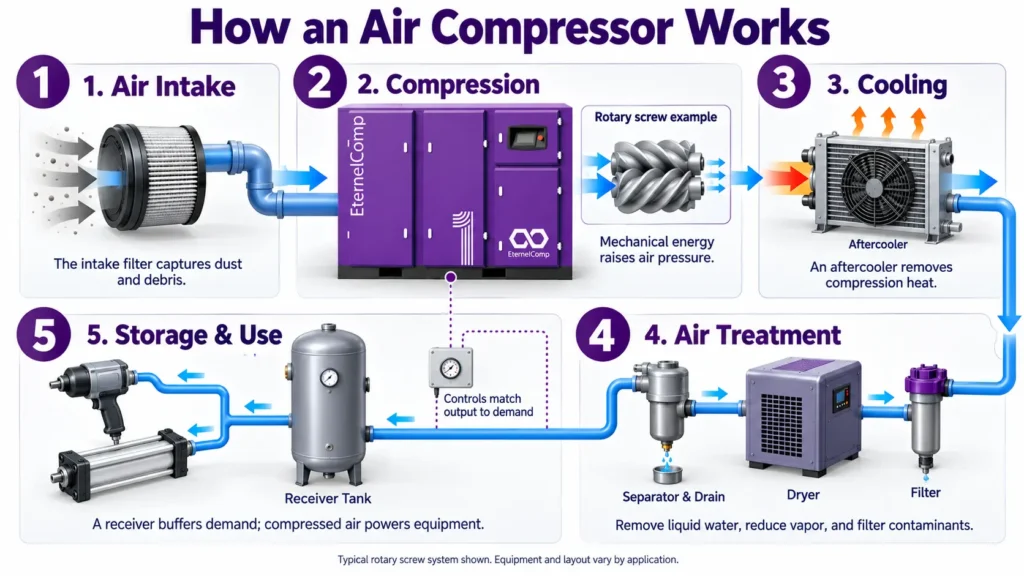
1. Air Enters Through the Intake
The compressor draws in atmospheric air through an intake filter. This filter helps protect internal components from airborne dust and debris.
The condition of the intake air matters. Hot, dusty, or contaminated surroundings can affect performance and increase maintenance requirements, so the installation needs suitable ventilation and a clean air supply.
2. The Compressor Raises Air Pressure
The motor or engine drives the compression element.
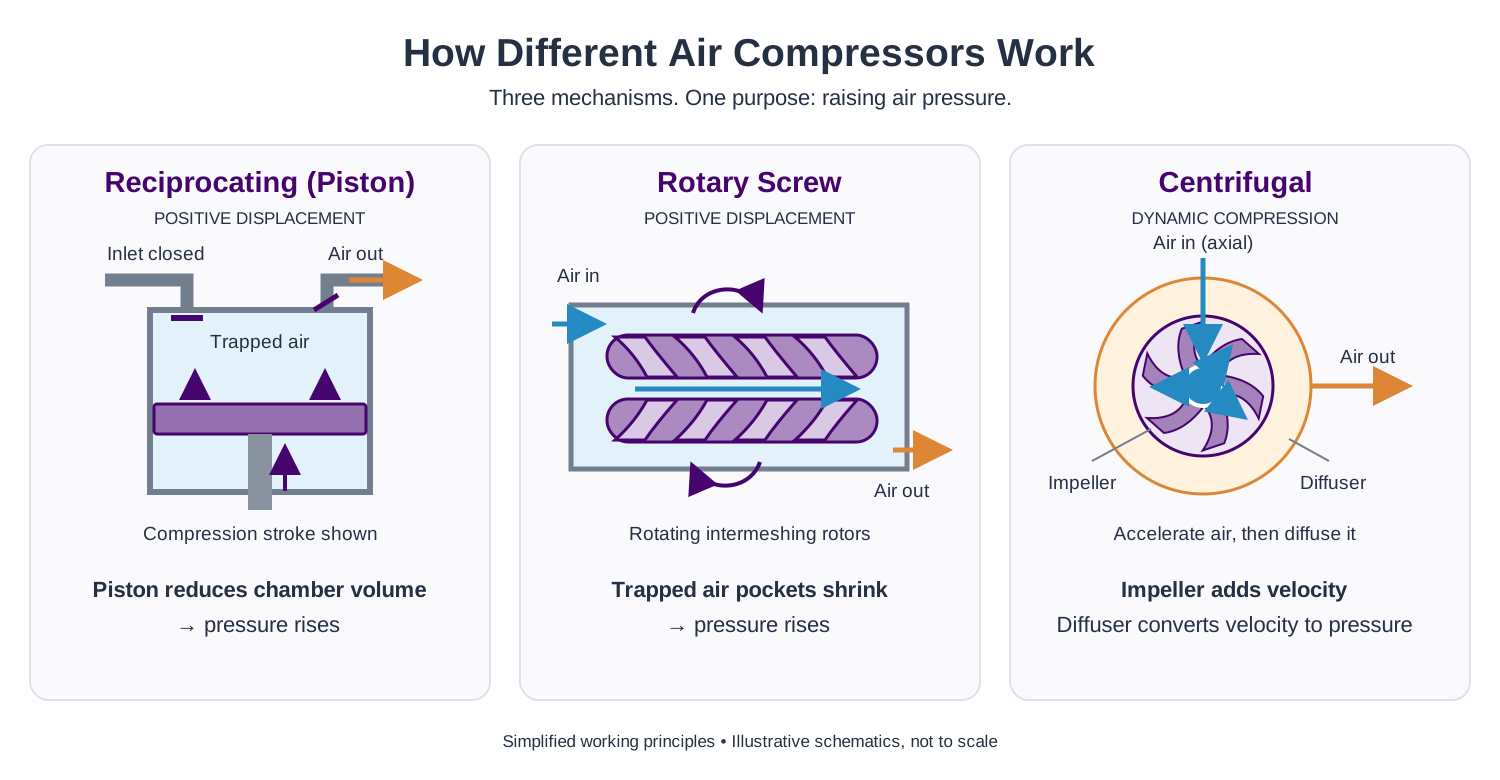
In a positive-displacement compressor, such as a piston or rotary screw machine, air becomes trapped inside a chamber. As the chamber volume decreases, the air pressure rises.
A centrifugal compressor works differently. Its rotating impeller increases air velocity, and the downstream diffuser converts part of that kinetic energy into pressure.
In either case, the machine transfers mechanical energy to the air.
3. Cooling Removes Compression Heat
Compressing air requires work, which raises its temperature. Cooling equipment removes much of this heat before the air reaches downstream equipment.
Depending on the design, a compressor may use cooling fins, fans, oil coolers, water cooling, or a combination of these methods. An aftercooler reduces the temperature of the discharged air. Multistage machines may also use intercoolers between compression stages.
Effective cooling helps protect components and reduces the load on downstream air treatment equipment.
4. Moisture and Contaminants Are Reduced
Atmospheric air contains water vapor. As hot compressed air cools, some of that vapor can condense into liquid water.
Moisture separators and drains remove collected liquid. A dryer reduces the remaining water vapor to the level required by the application. Filters address particles and, where necessary, oil aerosols or other contaminants.
These devices perform different jobs. A drain removes liquid water that has already collected; it does not replace a dryer.
The treatment required depends on how the air will be used. General pneumatic tools, spray painting, and sensitive production processes can have very different air quality requirements.
5. Air Is Stored or Delivered to Equipment
The compressed air enters the distribution system, with a receiver often providing storage and a buffer against changing demand.
When a connected tool or actuator operates, compressed air flows toward the lower-pressure point of use. Its pressure energy produces motion, force, or another useful effect.
Controls respond as system pressure changes. Smaller units commonly start and stop at preset pressure levels. Industrial machines may use load/unload control, variable-speed operation, or other methods to match output to demand.
How Different Types of Air Compressors Work
The main compressor types differ in how they increase air pressure. Their suitability depends on airflow, operating pressure, duty cycle, and the demand pattern.
Reciprocating — Piston — Compressors
A piston compressor uses a piston moving inside a cylinder.
During the intake stroke, the piston increases the cylinder volume and draws air through an inlet valve. During the compression stroke, it reduces the volume. Once cylinder pressure is high enough, the discharge valve opens and air flows out.
A single-stage compressor raises air from inlet pressure to final discharge pressure in one compression stage. A two-stage compressor passes air through two successive stages, usually with cooling between them.
Piston compressors are common in garages, repair shops, and applications with intermittent demand. Specialized industrial designs also serve high-pressure duties.
Their operating limits vary, so buyers should check the rated duty cycle instead of assuming every piston machine can run continuously.
Rotary Screw Compressors
A typical twin-screw compressor uses two intermeshing helical rotors. As they turn, air becomes trapped between the rotors and housing. The trapped space decreases as air moves toward the discharge, raising its pressure.
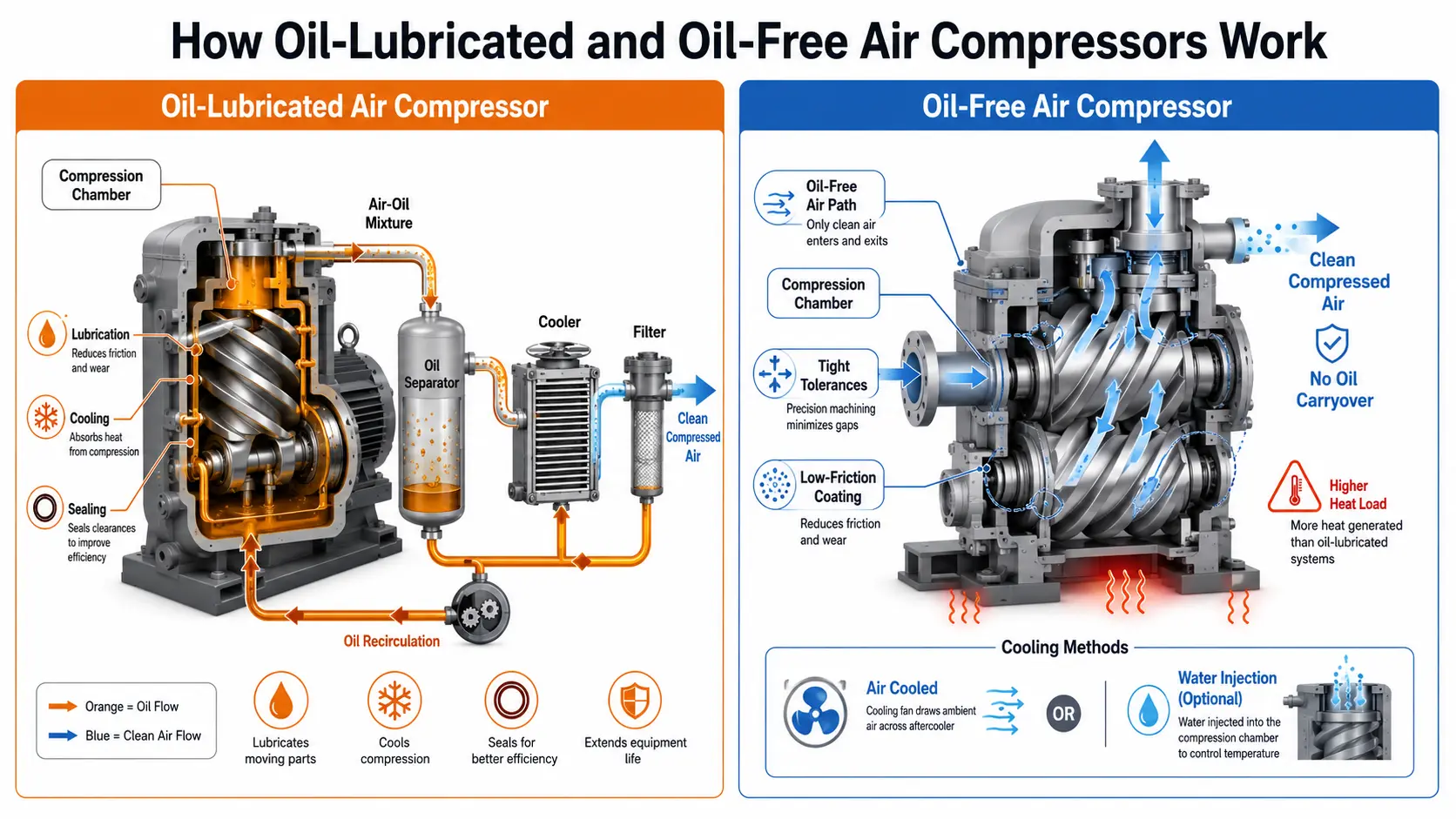
In an oil-injected design, oil helps cool the air, lubricate components, and seal internal clearances. The discharged air-oil mixture passes through separation equipment before the air continues downstream.
Oil-free screw designs keep lubricating oil out of the compression chamber and use different arrangements for cooling and sealing.
Rotary screw compressors are widely used for sustained industrial demand. They provide relatively steady airflow and are available with different control systems to suit production requirements.
Centrifugal Compressors
A centrifugal compressor uses a rapidly rotating impeller to accelerate air. A diffuser then slows the flow in a controlled way, converting part of its velocity into pressure.
Multiple stages may be used to reach the required discharge pressure.
These machines are often selected for large industrial installations with high airflow requirements. Their efficiency depends on operating conditions, so both normal demand and reduced-demand periods matter during selection.
Oil-Injected vs. Oil-Free Air Compressors
Oil-injected and oil-free describe the lubrication arrangement, not separate compression mechanisms. For example, a screw compressor can be oil-injected or oil-free.
Oil-Injected Compressors
Oil-lubricated machines use oil within the compression mechanism, although the lubrication method varies by design. In an oil-injected screw compressor, the oil provides cooling, lubrication, and sealing.
Most of it is separated from the discharged air and returned to the oil circuit.
Downstream treatment may still be needed to meet the required air quality. These machines are common in manufacturing, workshops, and general pneumatic systems.
Oil-Free Compressors
Oil-free air compressors do not use lubricating oil in the compression chamber. They may use dry-running screws, scrolls, specially designed pistons, or other compression technologies.
Oil-free does not mean the entire machine contains no lubricant. Bearings or gears may still require lubrication outside the air compression path.
It also does not automatically mean the delivered air is free of moisture, particles, or every possible contaminant. Air quality should be assessed against the application’s requirements and the equipment’s documented performance.
Neither category has a universal advantage in noise, service life, or continuous-duty capability. Those characteristics depend on the specific design, installation, maintenance, and operating conditions.
Why Use Compressed Air in Industrial Systems?
Compressed air is useful because it distributes power to many points of use and works well with a wide range of tools and actuators.
Pneumatic cylinders can provide simple, repeated linear motion. Tools can be compact, and a central system can supply several machines across a production area. Compressed air can also perform tasks such as atomizing paint or conveying suitable materials.
However, compressed air is not automatically cheaper or more efficient than direct electric power. Compression produces heat, and leaks, pressure drops, and unsuitable controls add further losses. The U.S. Department of Energy identifies compressed air as an expensive industrial utility that requires careful management.
The choice between pneumatic and electric equipment should therefore reflect the task, operating environment, maintenance needs, and total operating cost.
Key Specifications to Understand Before Choosing a Compressor
Understanding the working principle is the first step. Matching the machine to your application requires a few operating details.
Pressure — PSI or Bar
Pressure determines whether the air can provide the force required by the equipment.
The system must maintain adequate pressure at the point of use, allowing for losses through dryers, filters, and piping. Raising compressor pressure unnecessarily increases the work needed to compress the air.
Airflow — CFM or m³/min
Airflow describes how much air the compressor delivers over time.
Available flow must cover the equipment operating simultaneously, along with an appropriate allowance for demand changes. Compare compressor output at the required operating pressure and on a consistent measurement basis, such as free air delivery.
A high pressure rating alone does not mean a compressor can supply enough air.
Duty Cycle and Demand Pattern
Duty cycle indicates how much a machine can operate within its specified conditions. Demand pattern describes whether your equipment uses air steadily, intermittently, or in short bursts.
A small workshop and a continuously operating production line may need very different compressor arrangements, even if their peak airflow is similar.
Air Quality
Define the acceptable moisture, particle, and oil levels for the application.
These requirements influence the compression technology, dryer, filters, and system layout. They should be considered at the start rather than added after contamination problems appear.
Operating and Maintenance Costs
Purchase price is only one part of ownership cost. Electricity, servicing, consumables, and downtime also matter.
Compare machines under your expected operating conditions. A compressor that suits the actual demand profile can offer better long-term value than one selected only by motor power or initial price.