Compressed air is one of the most expensive utilities a plant can buy, yet it rarely appears clearly on an energy report because it arrives through pipes rather than a meter on the wall. Compressors typically draw about 10 percent of all industrial electricity, and in some plants that share passes 30 percent. Over a ten-year life, electricity accounts for roughly 76 percent of system cost, against 12 percent for equipment and installation and 12 percent for maintenance.
The most efficient type of air compressor is a variable speed, two-stage, oil-flooded rotary screw unit for continuous industrial duty below roughly 400 hp. Above that power level, with steady demand, a centrifugal compressor is more efficient. Scroll compressors lead only in small oil-free capacities, and reciprocating compressors are efficient only where demand is intermittent, because their duty cycle is limited to about 50 to 60 percent. No single design wins across all conditions, and a machine that performs well in one load profile can waste energy in another.
The comparison becomes useful once efficiency is defined precisely and each type is measured against the load profile it was built for.
The Short Answer: Which Compressor Type Is Most Efficient
Efficiency is not a fixed property of a machine. It is the product of the thermodynamic design of the compression element, how closely installed capacity matches real demand, and how the control system behaves when demand falls. A well-built screw throttled to 40 percent load is less efficient than a modest piston unit near full load, which is why rankings that ignore duty cycle mislead buyers.
A 75 kW screw running three shifts at 85 percent load is one of the most efficient ways to make compressed air; the same machine on a short shift at 30 percent load is one of the least efficient, because most of its electricity keeps the airend turning while little air leaves the discharge. Readers wanting a wider view can consult a guide to which type of air compressor suits a given duty.
| Compressor type | Best power band | Part-load behaviour | Efficiency position |
| Two-stage screw, variable speed | 30 to 400 hp | Strong, follows demand | Highest for most industrial duty |
| Single-stage screw, fixed speed | 10 to 300 hp | Weak, load and unload losses | Good near full load |
| Centrifugal | Above 400 hp | Poor below design flow | Highest at large steady flow |
| Single-stage reciprocating | Up to 30 hp | Poor | Lowest in continuous duty |
| Scroll | Up to about 30 hp | Moderate | Competitive only when small and oil-free |
What Efficiency Actually Means in Compressed Air
The only figure worth comparing between compressors is specific power, expressed as kilowatts of package input power per 100 cubic feet per minute of delivered air at a stated discharge pressure. Lower is better. A machine that delivers more air for the same electricity, at the same pressure and inlet conditions, is the more efficient one.
Specific power turns a thermodynamic story into one number that can be multiplied by hours and a tariff. Package input power also matters more than motor nameplate, because the meter sees the cooling fan, the controller, and every loss between supply and airend. Flow figures only compare at matching pressure, since a unit rated at 100 psig is not equivalent to one rated at 125 psig.
Isentropic Efficiency and Test Conditions
Isentropic efficiency accounts for operating pressure and lets like-sized machines with different ratings be compared directly; it is the value efficiency regulations are written around. The Compressed Air and Gas Institute publishes standardised data sheets and tests units against published ratings, which makes a verified sheet the closest thing the market has to a fair comparison. Ratings are corrected to a defined inlet temperature, pressure, and humidity, so a machine installed at altitude or in a hot room will fall short of the catalogue figure.
How Each Compressor Type Compares
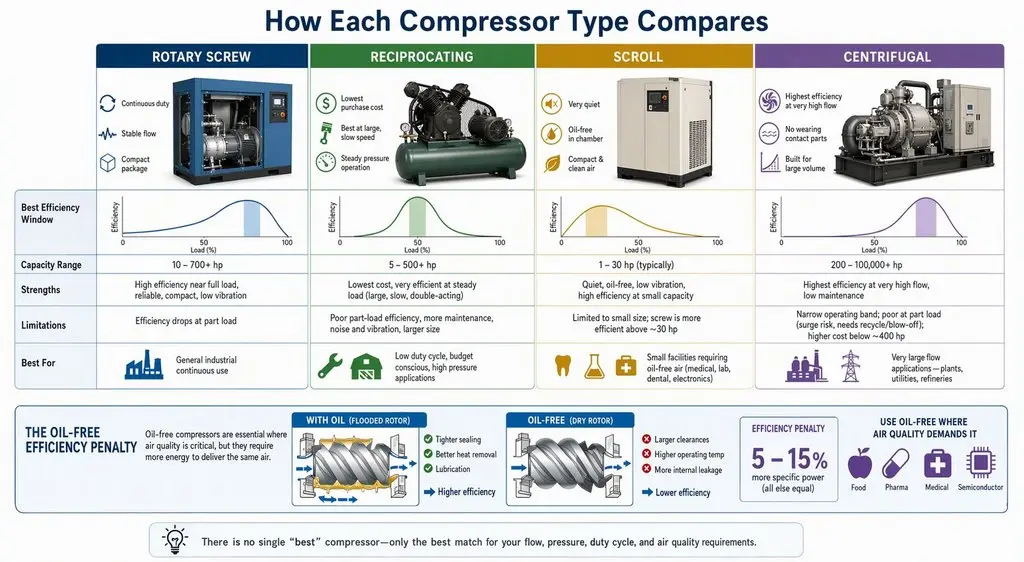
Each of the four main designs is efficient inside a specific window and inefficient outside it, so the honest comparison is not a single ranking but a map of where each one belongs.
Rotary Screw Compressors
The rotary screw dominates industrial compressed air because it combines continuous duty with stable flow from a compact package. Efficiency peaks near full load, where leakage past the rotors is small relative to output. Modern oil-lubricated air compressors use oil to seal clearances, absorb heat, and lubricate bearings, which is why they beat dry-running designs of the same size. A two-stage screw intercools between steps, so the second stage starts from a denser charge and returns 10 to 15 percent better specific power.
Reciprocating Compressors
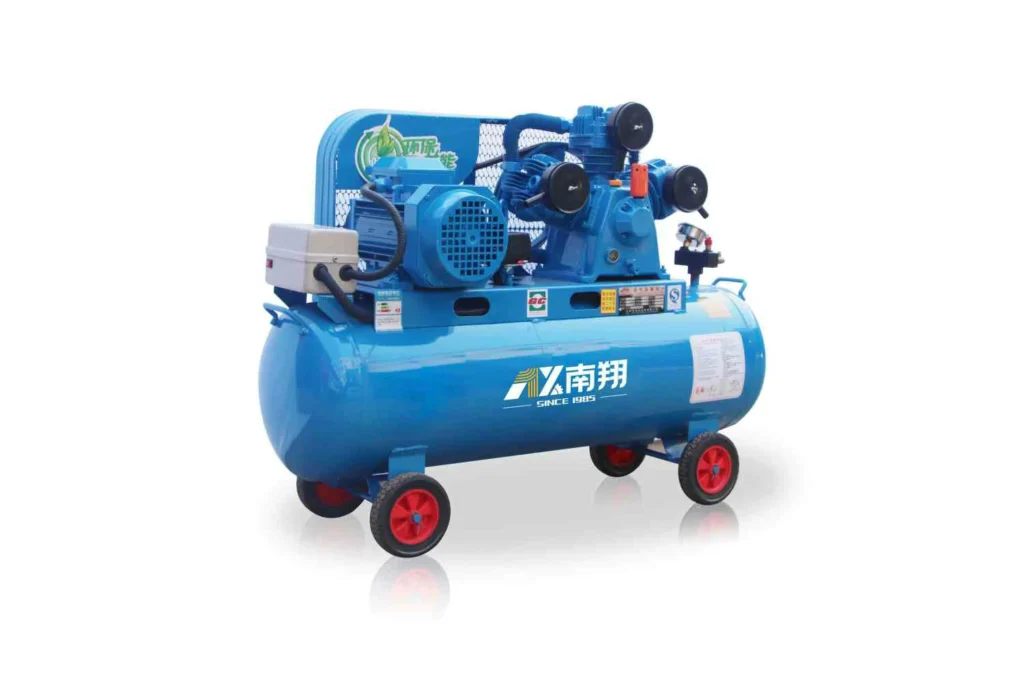
Piston machines are the cheapest way to buy compressed air and the most efficient way to make it in one narrow case: a large, slow-running, double-acting unit at steady pressure. Workshop models are a different proposition, built for intermittent duty, losing efficiency to start and stop cycling, and needing more horsepower than a screw for the same average flow.
Scroll Compressors
A scroll pair compresses air between two interleaved spirals with no valves and no oil in the chamber, producing quiet oil-free air efficiently at small capacity. The limit is scale: packages rarely exceed about 30 hp, and above that the screw overtakes them on specific power per unit of floor space.
Centrifugal Compressors
Centrifugal machines move very large volumes with a rotating impeller and no wearing contact surfaces, and at high flow nothing is more efficient. The weakness appears when demand drops. The stable band is narrow, and to avoid surge the machine must recirculate or blow off air, so at 60 percent demand it can draw nearly full power. Below roughly 400 hp a two-stage oil-flooded screw usually has the lower total cost of ownership.
The Oil-Free Efficiency Penalty
Oil-free compressors are mandatory in food, pharmaceutical, medical, and semiconductor work, where trace oil would compromise the product. They are also, all else equal, less efficient. Oil in a flooded rotor seals clearance gaps, removes heat, and lubricates; remove it and the rotors run hotter, clearances must be larger, and more air leaks back. The penalty is roughly 5 to 15 percent in specific power, which is why oil-free compressors belong where air quality demands them, not on a premium default.
Fixed Speed vs Variable Speed: Where the Savings Really Come From
The larger the swing in air demand, the larger the advantage of variable speed control. On a load varying between 40 and 100 percent, a variable speed drive typically cuts energy by 25 to 35 percent compared with a fixed-speed machine cycling load and unload.
The Part-Load Problem
A fixed-speed compressor has two states: fully loaded, or unloaded and turning while producing no air. Unloaded, a screw package still draws 20 to 35 percent of full-load power to spin the rotors and circulate oil. Add inlet throttling and the machine can sit at 60 percent demand while consuming 80 percent of full-load power. Variable speed control removes the mismatch by changing motor speed, so the power curve follows the flow curve instead of stepping over it. Permanent magnet motors extend that advantage across a wide speed range, and pairing one with a two-stage airend compounds the gain.
Matching Control Strategy to Load Profile
| Load characteristic | Recommended control | Expected effect |
| Steady within 10 percent of capacity | Fixed speed, correctly sized | Best specific power per unit cost |
| Varies 30 to 70 percent daily | Variable speed drive | 25 to 35 percent saving |
| Shift patterns with long idle periods | Variable speed plus shutdown | Largest saving, needs storage buffer |
| Multiple units on a shared header | Master controller with base and trim | Avoids cascading between units |
A closer look at VSD and fixed-speed control helps where the load profile sits between those cases.
Do Air Compressors Use a Lot of Electricity?
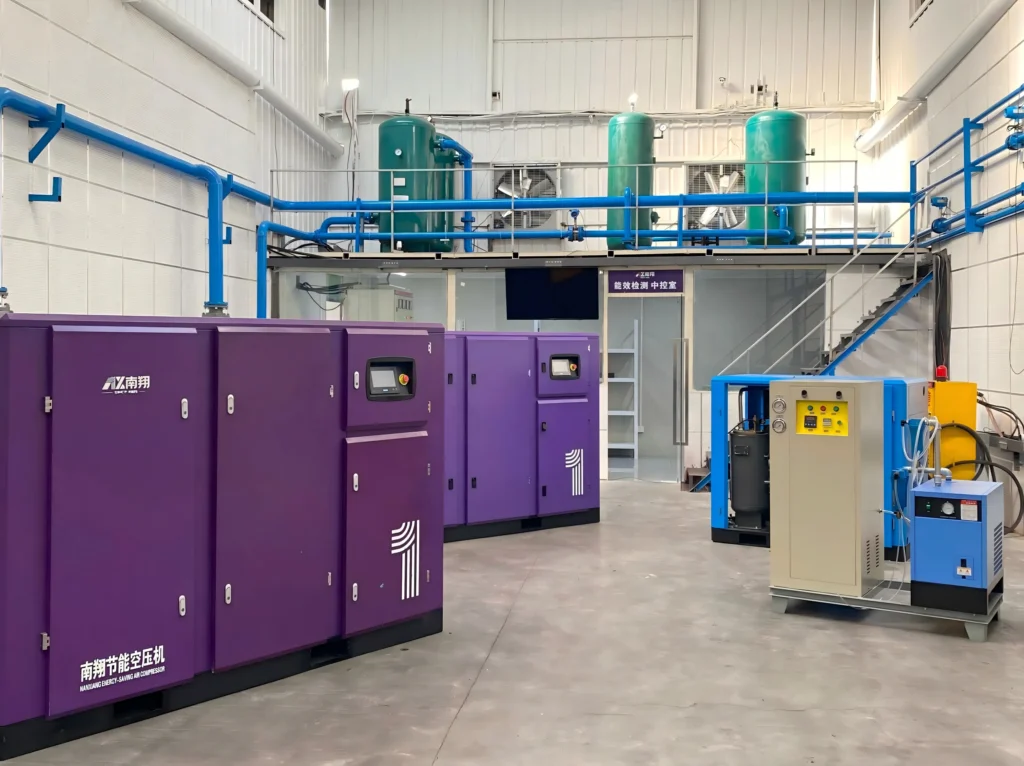
Yes. A compressor is usually the single largest electrical load in a manufacturing plant, and compressed air is one of the least efficient utilities available, because only about 10 to 15 percent of the energy entering the system reaches the point of use as useful work. The rest leaves as heat of compression, pressure drop, dryer load, and leakage.
The U.S. Department of Energy puts compressor electricity at roughly 10 percent of industrial consumption nationally, with individual plants far higher, and a 1 hp air motor at 100 psig needs 7 to 8 hp of input at the compressor. The figures below assume USD 0.12 per kWh and a load factor of 0.7.
| Motor rating | Annual hours | Energy use | Annual cost |
| 22 kW workshop screw | 2,000 | 30,800 kWh | USD 3,700 |
| 75 kW plant screw, two shifts | 4,000 | 210,000 kWh | USD 25,200 |
| 110 kW plant screw, three shifts | 6,000 | 462,000 kWh | USD 55,400 |
Above a few thousand running hours the electricity bill passes the purchase price, and each percentage point of specific power becomes a recurring annual saving.
What Type of Air Compressor Is Best for Home Use?
For a home workshop or garage, a single-stage reciprocating compressor with a tank of 20 to 60 gallons is the sensible choice. A two-stage piston or a small scroll unit is worth the premium only where tools run continuously or where oil-free air is required. Industrial efficiency metrics barely apply at this scale, because the machine runs for minutes rather than shifts.
Home selection is driven by tool demand rather than annual energy. An impact wrench or spray gun needs a burst of flow, and the tank carries that burst while the pump refills, which makes tank volume more important than motor rating. Noise is the second constraint: direct drive oil-free units often exceed 85 dBA at close range.
System Factors That Matter More Than Compressor Type
A plant that installs the most efficient compressor available and leaves its leaks, pressure setpoint, and piping untouched will usually save less than a plant that keeps an average compressor and fixes the system around it. Leak repair, pressure reduction, and control consolidation routinely deliver more than the gap between two compressor designs.
If a 100 kW compressor loses 25 percent of its output to leaks, sealing them removes 25 kW of demand, and no compressor model offers that advantage over another of the same type and size.
Leaks, Pressure Setpoint and Storage
Leaks waste 20 to 30 percent of output without a detection programme, and a single 3 mm hole at 7 bar can cost more than 1,500 kWh a year. Discharge pressure is the second lever: every 1 bar of unnecessary pressure adds roughly 7 to 8 percent to energy, so dropping from 8 bar to 6.5 bar can save more than 10 percent. Without enough air receivers capacity, a fixed-speed machine also loads and unloads constantly, wasting energy on every transition.
How to Specify an Efficient Machine
Start from measured demand rather than assumed demand, size on the flow curve rather than the peak, and compare candidates on specific power at your actual pressure. Purchase price is the last variable, not the first.
Measure flow and pressure for at least a week before sizing, because average demand is usually far below installed capacity. Audit the system first, fixing leaks and lowering the setpoint, since that often removes a whole frame size. Then choose the type from the load profile, decide oil-free only on air quality grounds, and model ten-year cost of ownership with verified specific power written into the order.
FAQ
These questions cover what matters after the order is signed: whether the complex design always pays, how efficiency drifts with age, and when replacement is justified.
Are two-stage compressors always more efficient than single-stage?
No. Two-stage compression improves specific power when the pressure ratio is high and the machine runs near its design point. At low pressure ratios around 7 bar, and at ratings below about 30 hp, the extra stage adds cost and mechanical loss without recovering enough thermodynamic gain. Part-load operation erodes the advantage too, because the second stage becomes a restriction when flow drops.
Does compressor efficiency change as the machine ages?
Yes, usually by more than owners expect. Airend wear opens rotor clearances, loaded filters raise pressure drop, cooler fouling pushes discharge temperature up, and control valves develop leakage. Together these can add 5 to 10 percent to specific power within five to seven years. Because the decline is gradual, it is rarely noticed without a baseline, so record specific power at commissioning and re-measure it annually.
Is it worth replacing a working compressor to gain efficiency?
Only when the numbers support it. If the existing machine is more than 25 percent oversized for measured demand, it runs unloaded most of the time and a correctly sized unit pays back quickly. If it is fixed speed on a widely swinging load, variable speed control captures most of the saving at a fraction of replacement cost. When neither applies, leak repair and pressure reduction return more per dollar spent.