Compressed air is often described as the fourth utility of modern industry because it powers tools, actuates instruments, and drives critical processes across nearly every production environment. For food and beverage plants, pharmaceutical manufacturers, electronics fabrication lines, and healthcare facilities, however, ordinary compressed air is not enough. Even trace amounts of lubricating oil carried downstream can contaminate products, fail regulatory audits, and trigger costly recalls. That risk makes the selection of a supplier far more consequential than a routine equipment purchase, because the engineering, quality controls, and long-term support behind the machine determine whether certified oil-free air actually reaches your process, shift after shift, year after year.
To choose the right oil-free air compressor manufacturer, shortlist suppliers that can present ISO 8573-1 Class 0 test reports from independent laboratories, offer the compressor technologies suited to your flow, pressure, and duty profile, hold current ISO 9001 and CE certifications, maintain a responsive service network with genuine spare parts in stock, and can document the total cost of ownership of their machines instead of quoting the purchase price alone.
The six evaluation criteria below turn that checklist into a practical framework you can apply to any candidate supplier.
Why Oil-Free Air Quality Matters in Manufacturer Selection
Purity performance is the single most important qualification of an oil-free air compressor manufacturer, because air quality is decided by design precision and production discipline, not by marketing claims or after-the-fact filtration.
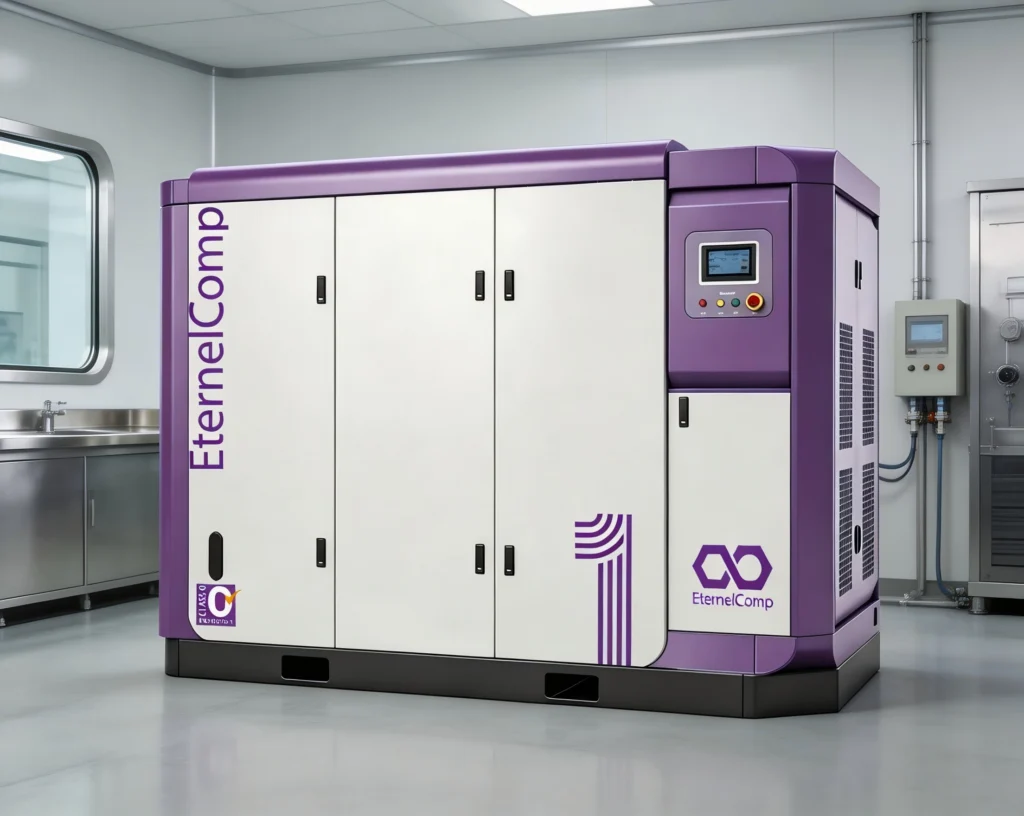
An oil-free air compressor keeps lubricant completely away from the compression chamber, relying on precision-machined air ends, specialized coatings, and advanced sealing systems to compress air without injecting oil into the airstream. This is a fundamentally different engineering discipline from conventional compressed air equipment, where oil intentionally lubricates and seals the moving parts. When air meets your product directly, or when a certification audit samples your compressed air supply, no amount of downstream filtration can fully compensate for a machine whose compression path was never truly oil-free. This is why experienced buyers begin by studying the technical documentation behind a complete range of Oil-Free Compressors so they can recognize what transparent specifications actually look like before approaching any manufacturer.
Oil vs. Oil-Free: Which Compressor Type Is Best?
Neither design is universally superior. The best compressor type is the one whose air purity, duty capability, and lifecycle economics match what your process genuinely requires.
| Item | Explanation |
| Contamination risk | Oil-lubricated machines carry inherent oil carryover risk; oil-free machines eliminate lubricant from the compression path entirely |
| Purity ceiling | Only oil-free technology can support ISO 8573-1 Class 0 claims at the source |
| Initial investment | Oil-lubricated units typically cost less up front; oil-free units cost more but avoid filtration and disposal burdens |
| Maintenance profile | Oil-lubricated machines require oil and filter changes; oil-free machines shift maintenance to air ends, seals, and cooling systems |
| Best applications | Oil-lubricated suits general workshop air; oil-free suits product-contact, sterile, and precision processes |
Industries That Rely on Certified Oil-Free Air
Food and beverage producers depend on oil-free air for filling, packaging, aeration, and product transport lines where air contacts food directly. Pharmaceutical plants require it for tablet coating, fermentation, drying, and cleanroom utilities. Electronics manufacturers use it to clean and cool sensitive components where oil films would destroy yields. Hospitals and laboratories rely on oil-free air for surgical instruments, dental equipment, and breathing air systems. In each of these sectors, the compressor manufacturer becomes part of the compliance chain, which is why purity claims must be verified rather than assumed.
Define Your Application Requirements First
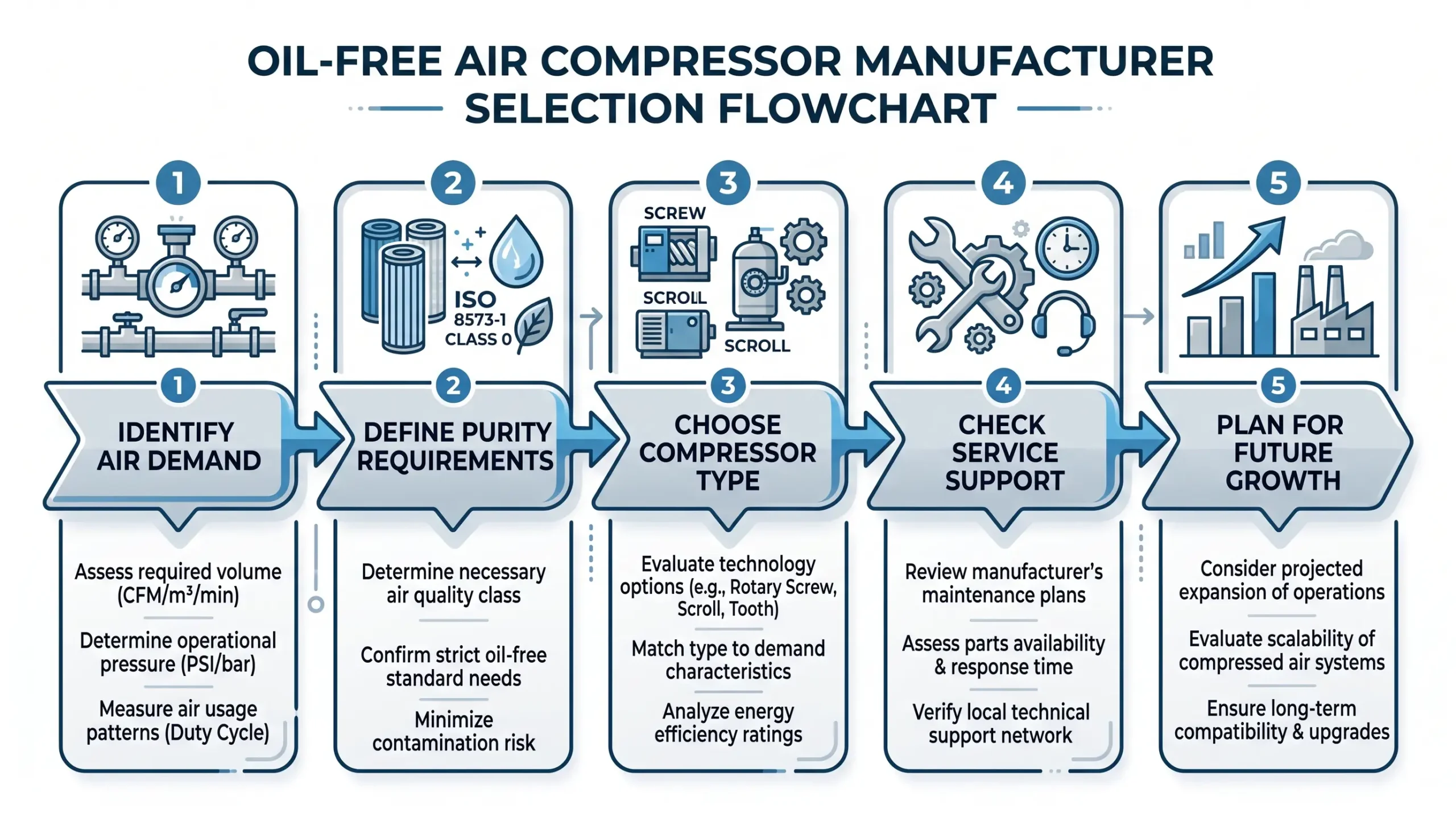
Prepare a written requirement covering air purity class, air flow, operating pressure, and duty cycle before you request a single quotation, because a manufacturer can only be evaluated against a benchmark you have already defined.
Suppliers respond to precise specifications with precise proposals. When buyers approach manufacturers with vague requirements, they receive generic equipment recommendations that often overshoot or undershoot real needs, inflating both capital cost and energy bills. A disciplined requirement document also filters out suppliers who cannot or will not engineer to a stated purity class, which is exactly the screening a serious B2B procurement should perform.
Specify Your Air Purity Class
The internationally accepted framework for compressed air purity is ISO 8573-1, which classifies air according to particle content, water content, and oil content across numbered classes, with Class 0 representing the most stringent, customer-specified limits. Requesting a specific class in writing forces each manufacturer to state which class its machines achieve at defined measurement points, which turns a marketing conversation into an engineering one. Ask every candidate supplier to confirm the class, the measurement method, and whether the claim refers to the compressor outlet or to air delivered after downstream treatment.
Match Flow, Pressure, and Duty Cycle
| Parameter | What It Tells the Manufacturer |
| Air flow (CFM or l/s) | The total demand of all connected tools and processes, with a margin for peak simultaneous use |
| Operating pressure (PSI or bar) | The minimum pressure your end uses require; overspecifying pressure wastes energy |
| Duty cycle | Whether demand is continuous, intermittent, or highly variable, which determines suitable compressor technologies and control strategies |
| Ambient conditions | Temperature, humidity, and air quality at the installation site, which affect sizing and treatment needs |
| Growth plans | Expected demand expansion that the selected machine and manufacturer must support |
Evaluate Technical Expertise and Product Portfolio
Favor manufacturers that design and build several oil-free technologies in house, because breadth of portfolio signals genuine engineering capability rather than the resale of purchased assemblies.
Oil-free air is achieved through multiple distinct technologies, and each has a different natural territory. A manufacturer with only one technology will naturally recommend that technology for every application, whether it fits or not.
| Technology | Typical Strengths and Applications |
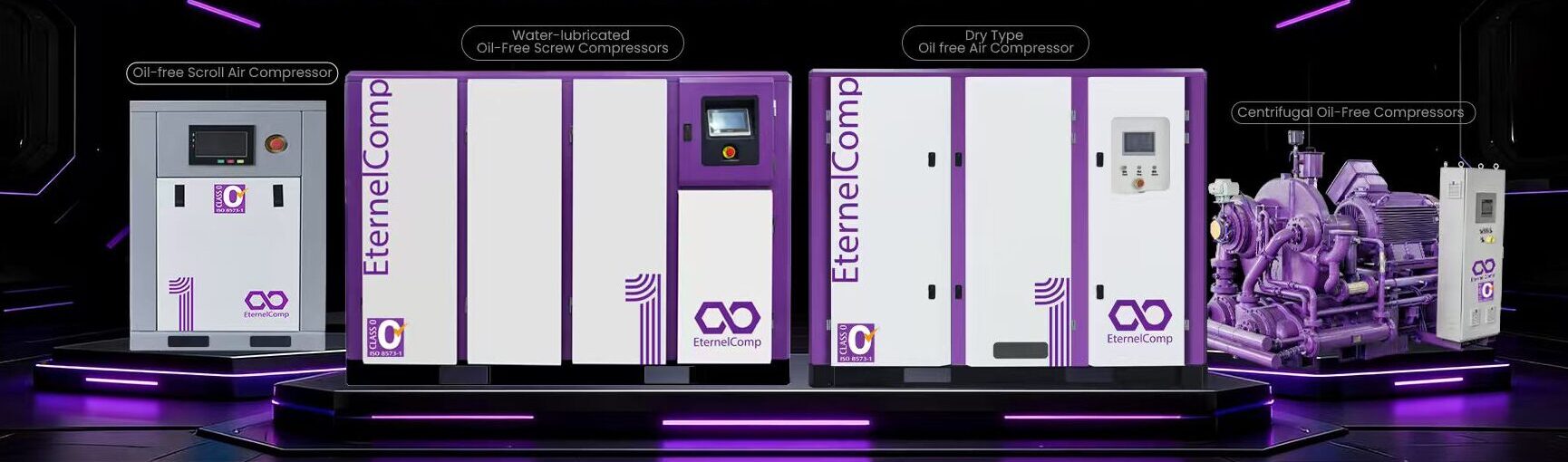
| Oil-free scroll | Quiet, low maintenance, excellent for low to medium flow and purity-critical point-of-use applications |
| Water-lubricated screw | Near-isothermal compression with water replacing oil, suited to food, pharma, and clean processes in medium flow ranges |
| Dry oil-free screw | High flow and high pressure capability for continuous industrial duty |
| Centrifugal | Very high flows with few wearing parts, best for large plants with steady demand |
For medium and high flow requirements, comparing an Oil-Free Screw Air Compressor against water-lubricated and centrifugal alternatives reveals how differently each architecture behaves at part load, in hot environments, and across duty cycles. A capable manufacturer conducts that comparison with you instead of steering you toward whatever it happens to stock.
Matching Technology to Your Operating Profile
Present your actual load profile to each candidate and ask which technology they recommend and why. Continuous 24/7 demand favors screw and centrifugal designs engineered for uninterrupted running. Intermittent or variable demand favors machines that unload efficiently or pair well with variable speed drives. A recommendation delivered without asking about your load profile is itself a warning sign that the supplier sells boxes rather than engineered solutions.
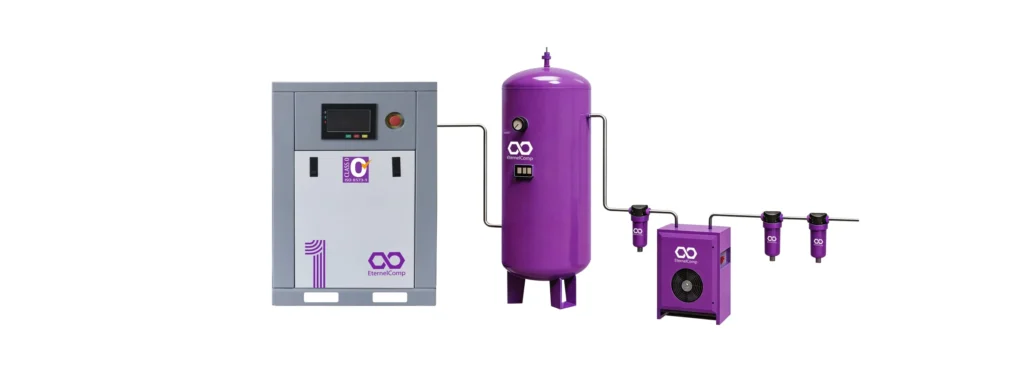
Verify Manufacturing Quality, Certifications, and Testing
A credible oil-free air compressor manufacturer backs every purity claim with third-party test reports and current certifications that you can independently verify with the issuing bodies.
Certifications are the fastest way to separate established manufacturers from trading companies that rebrand other factories’ products. Work through the following verification sequence:
- Confirm a current ISO 9001 quality management certificate covering the actual production site.
- Confirm CE marking or the regional compliance regime relevant to your market.
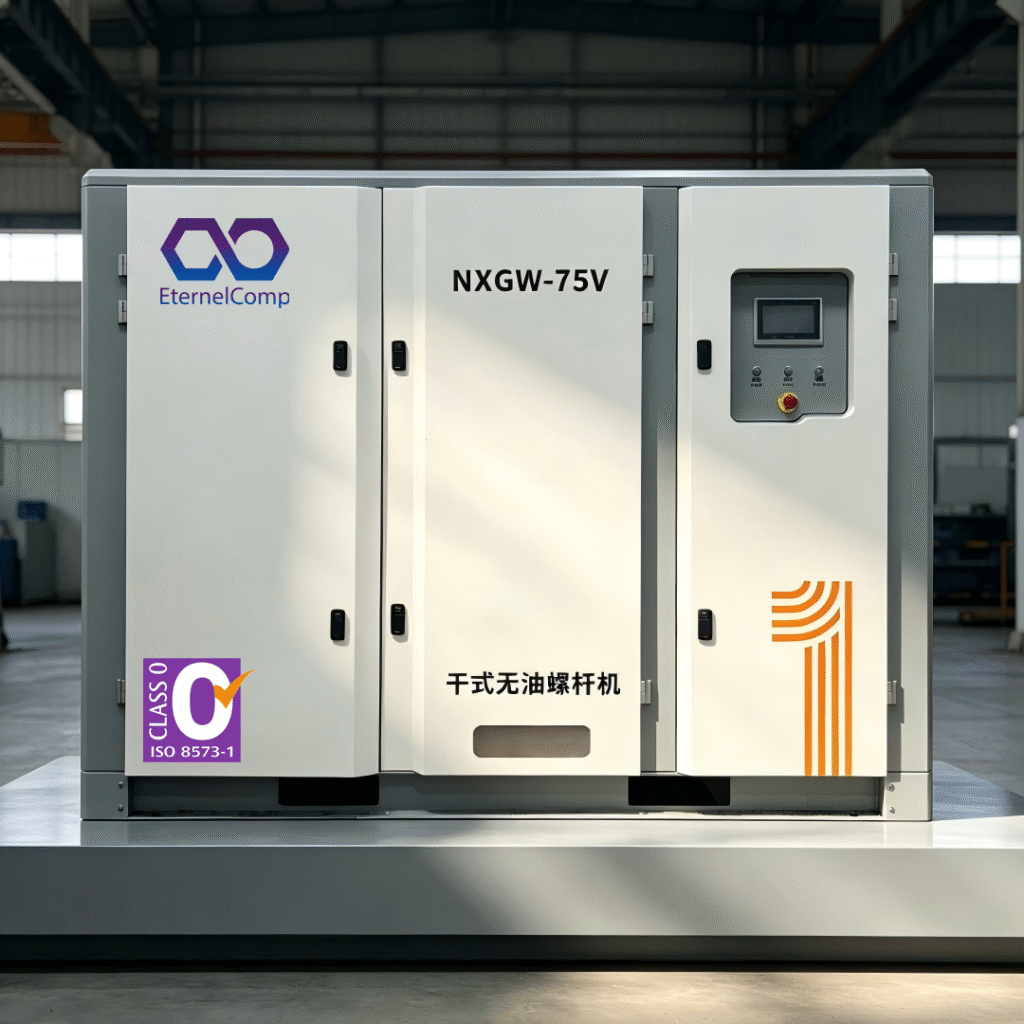
- Request ISO 8573-1 Class 0 (or your required class) test reports issued by an independent laboratory, not merely internal measurements.
- Ask whether each delivered unit undergoes factory test bench verification, and request the test protocol.
- Verify traceability of critical components such as air ends, seals, and bearings back to their production batches.
- Check how long the manufacturer has produced oil-free machines specifically, since the technology has a longer learning curve than conventional designs.
Red Flags When Evaluating a Manufacturer
Treat the following signals as grounds for removal from your shortlist:
- Unwillingness to share laboratory test reports or certificate numbers that can be checked online
- Certificates that are expired, suspended
- No in-house machining or assembly of compression elements
- Vague warranty language with undefined response obligations
- Inability to name the sealing technology used in the compression chamber
- Pressure to close the sale before technical documentation has been reviewed
Assess After-Sales Support and Spare Parts Capability
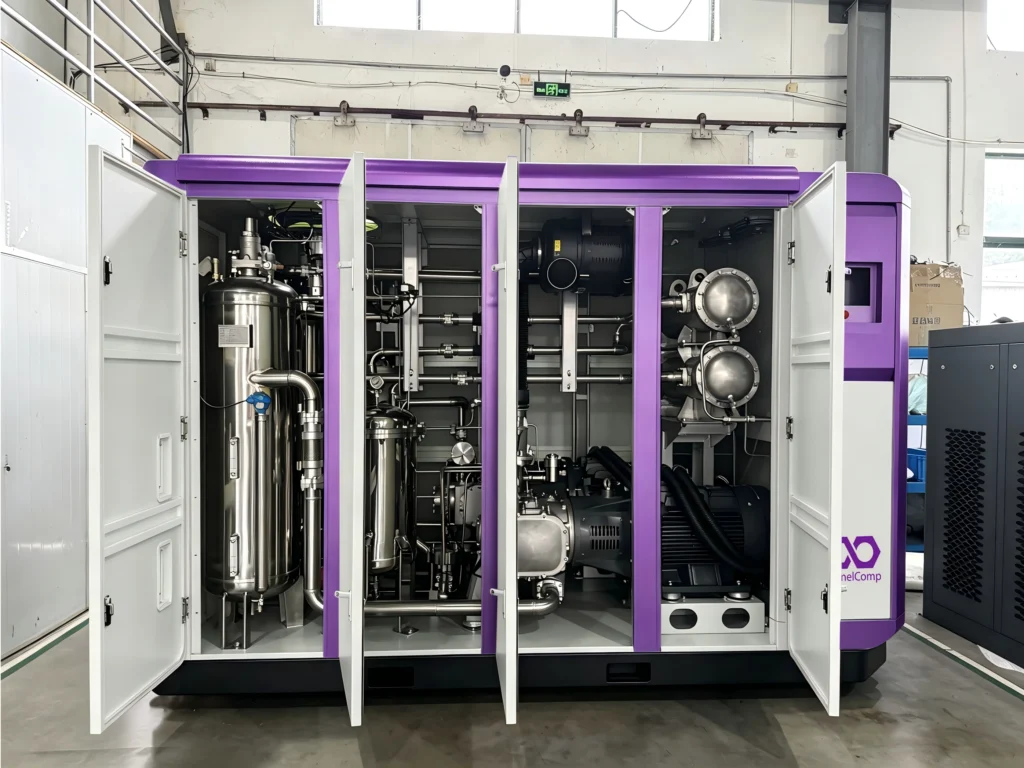
Judge after-sales capability by service network coverage, guaranteed response times, spare parts availability, and transparent maintenance schedules, because oil-free machines reward disciplined care with a long and predictable service life.
Oil-free compressors generally require less routine maintenance than oil-lubricated units, but the maintenance they do need is more specialized. Industry maintenance references give a sense of the rhythm involved: scroll compressors typically require scheduled attention every 2,500 operating hours, scroll heads around every 10,000 hours or four years at 122 psi ratings, and dry screw machines commonly call for an air end overhaul around six years or 48,000 hours of service. A manufacturer should state these intervals openly for the specific machine you are buying, and a well-structured Oil Free Air Compressor Maintenance program should translate them into planned, budgeted service rather than emergency repairs.
| Support Factor | What to Confirm |
| Service network | Certified technicians within a workable distance of your site, or documented remote support arrangements |
| Spare parts stock | Genuine parts held regionally with stated delivery lead times |
| Response commitment | Contractual response and resolution timeframes for breakdowns |
| Warranty scope | Covered components, duration in hours and years, and exclusions |
| Training | Operator and maintenance training included with commissioning |
Calculate Total Cost of Ownership, Not Just Price
The lowest quotation rarely delivers the lowest cost over a ten-year service life, because energy consumption, not the purchase price, dominates the total cost of ownership of any industrial compressed air system.
The U.S. Department of Energy maintains that compressed air is one of the most expensive utilities in a plant, noting that a large share of input electricity is lost as heat and that system-wide compressed air improvements can cut related electricity consumption dramatically. For oil-free machines specifically, the purchase price is only the entry ticket to a decade of energy bills, scheduled maintenance, and eventual component overhauls.
| Cost Component | Influence on Ten-Year Cost |
| Purchase price | Fixed at acquisition, typically the smallest share of lifetime cost |
| Energy | Usually the largest share; motor efficiency and control strategy drive it |
| Maintenance | Predictable spend covering consumables, inspections, and service labor |
| Overhaul | Major mid-life events such as air end or scroll head replacement |
| Downtime risk | Hidden cost determined by service quality and parts availability |
Ask every manufacturer to model these elements together. A ten-year Oil-Free Air Compressor TCO comparison between two offers frequently reverses the ranking suggested by their quotations, especially when variable speed drives and permanent magnet motors enter the calculation. A supplier that resists presenting lifecycle numbers is telling you something important about how it expects to make its money.
Frequently Asked Questions
These answers cover the follow-up questions buyers most often raise once they begin comparing specific oil-free air compressor manufacturers.
Should I buy an oil-free air compressor?
Buy oil-free when compressed air contacts your product, supports sterile or precision processes, or must satisfy a defined purity class, because in those conditions oil-free technology removes a contamination risk that filtration alone cannot guarantee. If your air only powers general workshop tools in an environment where trace oil is harmless, a well-maintained oil-lubricated machine with standard filtration can be the more economical choice. The decision should follow from your purity requirement, not from the technology’s popularity.
What is the recommended oil grade for an air compressor?
True oil-free machines use no oil in the compression chamber, so no air-side oil grade applies; they only require the manufacturer-specified lubricant for gearboxes or external bearings, if fitted. For oil-lubricated compressors, the correct grade depends on the compressor design, and the machine manual is the authoritative source, with rotary screw units commonly calling for dedicated compressor oils in the ISO VG 32 to 46 viscosity range. Substituting automotive or general-purpose oils is a frequent cause of varnish, separator blockage, and voided warranties.
Do oil-free air compressor manufacturers offer OEM customization?
Established B2B manufacturers commonly do, including pressure and flow tuning to application data, motor and drive options, custom receiver and treatment packages, private-label paint and branding, and documentation prepared for the buyer’s own certification files. OEM capability matters because it demonstrates genuine engineering depth rather than catalog resale, and it gives growing operations a partner able to standardize equipment across multiple sites. Confirm the scope, minimum order quantities, and lead times in writing during evaluation.