Oil-Free Screw Air Compressor vs Water-Lubricated vs Centrifugal: The Definitive Comparison
Industrial compressed air systems represent one of the largest energy consumers in manufacturing facilities, accounting for up to 30% of total electricity consumption in some plants. The choice of compressor technology — oil-free screw, water-lubricated, or centrifugal — is not merely an engineering preference. It is a decision with decades-long implications for energy cost, air quality, maintenance burden, and production reliability. Each of these three technologies approaches the fundamental task of compressing air differently, and each imposes a distinct set of trade-offs in capital expenditure, operating efficiency, and application suitability. This article provides a technically rigorous, side-by-side comparison to help facility engineers, plant managers, and procurement professionals determine which compressor technology aligns with their specific operational requirements.
An oil-free screw air compressor delivers ISO 8573-1 Class 0 air purity without oil carryover risk, making it essential for food, pharmaceutical, and electronics applications. A water-lubricated compressor achieves near-isothermal compression through direct water injection, offering superior energy efficiency at the cost of water treatment complexity. A centrifugal compressor excels in high-volume, continuous-duty applications above 500 HP, delivering unmatched CFM-per-square-foot density but with limited turndown capability. The right choice depends on your required air quality class, flow demand profile, operating pressure range, and total lifecycle budget.
Comparing these three technologies requires moving beyond simplified manufacturer claims and examining real-world performance data across multiple dimensions: specific power consumption, maintenance intervals, air quality certification levels, turndown ratios, and total cost of ownership over a 10 to 15-year service life. Each section of this guide addresses a specific aspect of the comparison, with data presented in structured tables wherever possible to enable direct, objective evaluation. The following topics are covered in detail.
Table of Contents
- How Does an Oil-Free Screw Air Compressor Work
- What Is a Water-Lubricated Compressor and How Does It Differ
- How Centrifugal Compressors Operate and When They Excel
- Head-to-Head Comparison: Performance, Efficiency, and Cost
- Which Compressor Technology Is Right for Your Application
- Maintenance and Lifecycle Considerations Across All Three Technologies
How Does an Oil-Free Screw Air Compressor Work
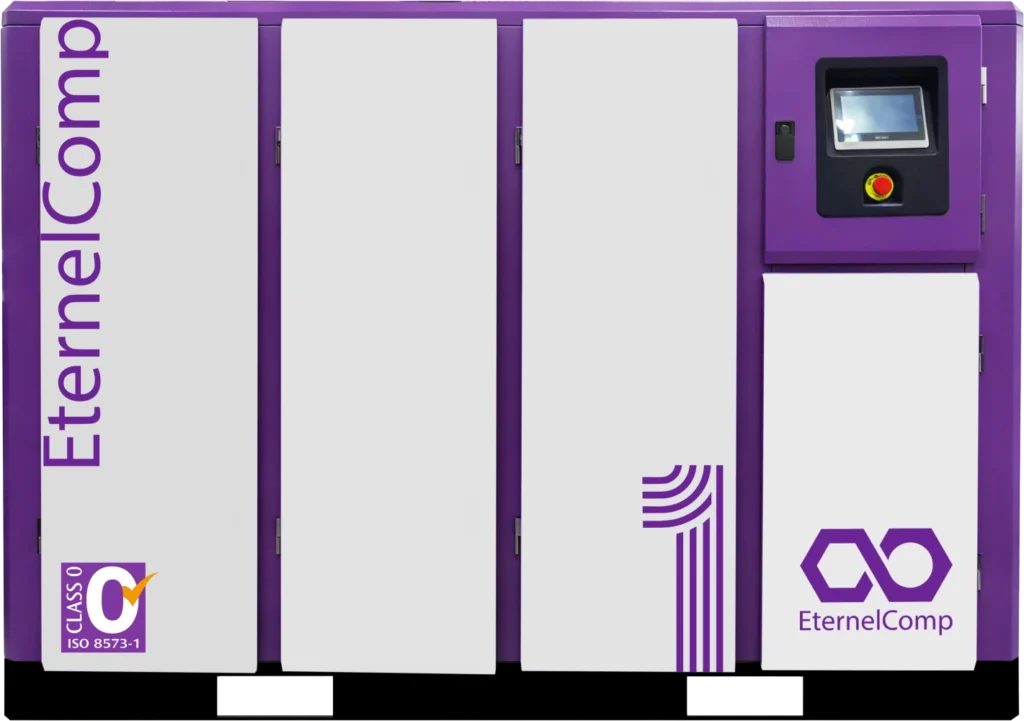
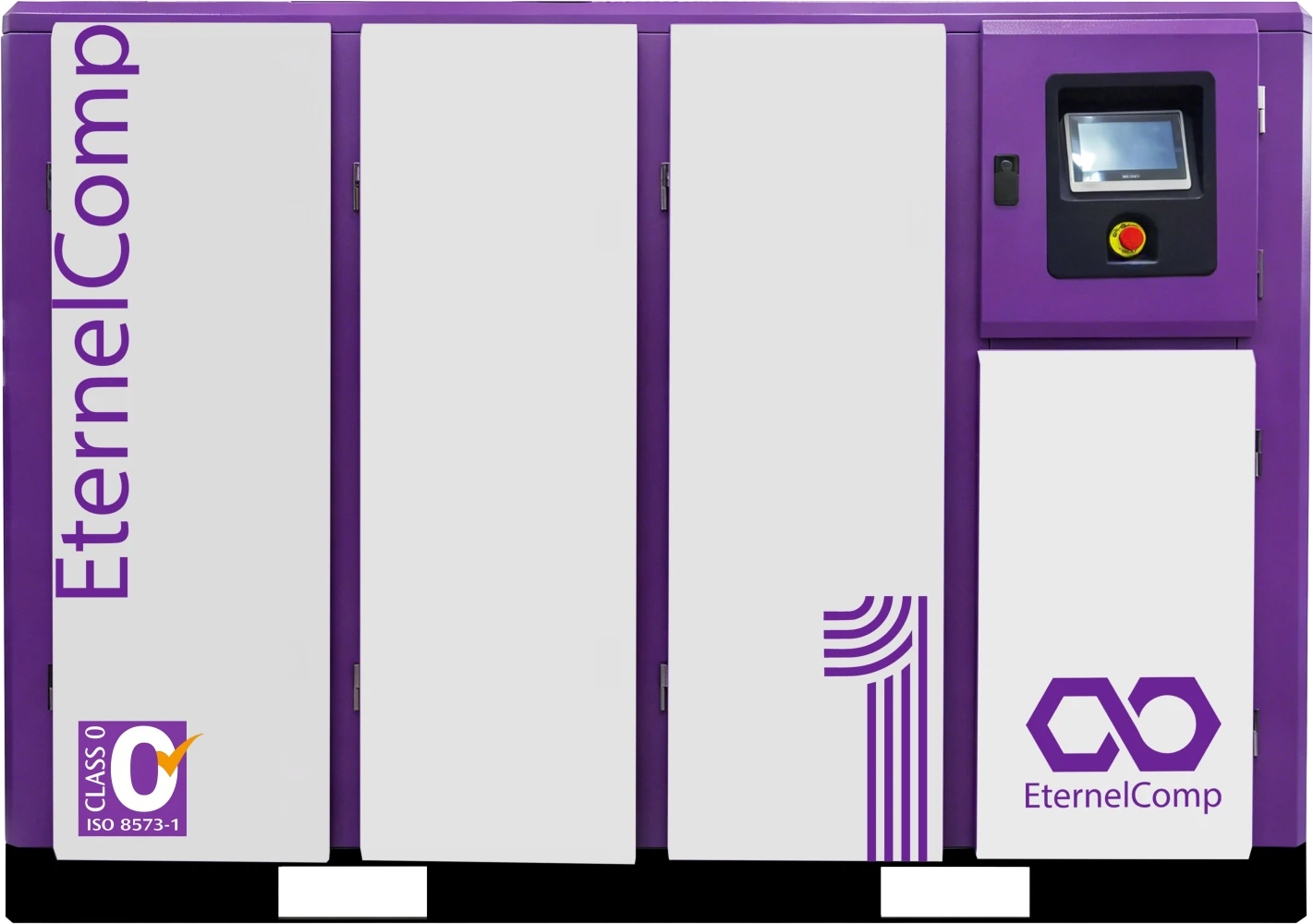
An oil-free screw air compressor uses two intermeshing rotors driven by precision timing gears to compress air without any lubricant in the compression chamber. The rotors never make physical contact — a micro-clearance of 0.001 to 0.002 inches is maintained by the gears — eliminating the need for oil injection and ensuring that the discharged air contains zero oil aerosol. This dry-running design is what enables ISO 8573-1 Class 0 certification, the highest air purity standard.
The Dry Compression Principle
In an oil-free screw compressor, air enters through an inlet valve and is trapped between the male and female rotor lobes as they rotate. As the rotors turn, the trapped volume decreases, raising the air pressure through pure mechanical compression. Unlike an oil-injected screw compressor, where oil serves the triple function of lubricating, sealing, and cooling, the oil-free design separates each of these functions into dedicated subsystems:
- Timing gears mounted on the rotor shafts maintain precise rotor synchronization and prevent metal-to-metal contact.
- Internal coatings — typically PTFE, PEEK, or ceramic-based — are applied to rotor surfaces to reduce friction and improve durability without lubrication.
- Interstage cooling is accomplished through external air or water jackets rather than injected fluid, with two-stage compression being standard for pressures above 100 PSI to manage discharge temperatures.
The process air path remains entirely free of lubricant from inlet to discharge, which is the defining characteristic of an oil-free screw air compressor. This is fundamentally different from an oil-injected machine followed by downstream filtration to capture carryover — a configuration that can never achieve Class 0 because filtration cannot guarantee zero oil content under all operating conditions, including filter element bypass or saturation.
Two-Stage Configuration and Thermal Management
Because there is no oil to absorb the heat of compression, oil-free screw compressors operate at substantially higher discharge temperatures than their oil-injected counterparts. Single-stage compression from atmospheric to 100 PSI can generate discharge temperatures exceeding 350°F (177°C). To manage this, virtually all industrial oil-free screw compressors above 30 HP employ a two-stage configuration:
| Stage | Inlet Pressure | Discharge Pressure | Typical Discharge Temperature |
|---|---|---|---|
| First stage | Atmospheric | 30–45 PSI | 300–380°F (149–193°C) |
| Intercooler | 30–45 PSI | 30–45 PSI (cooled) | 80–110°F (27–43°C) |
| Second stage | 30–45 PSI | 100–150 PSI | 280–350°F (138–177°C) |
| Aftercooler | 100–150 PSI | 100–150 PSI (cooled) | 80–110°F (27–43°C) |
The intercooler and aftercooler are critical components. Inadequate cooling capacity — whether due to undersizing, fouling, or high ambient temperature — directly reduces compressor output and accelerates wear on rotor coatings and bearings.
Air Quality and Certification
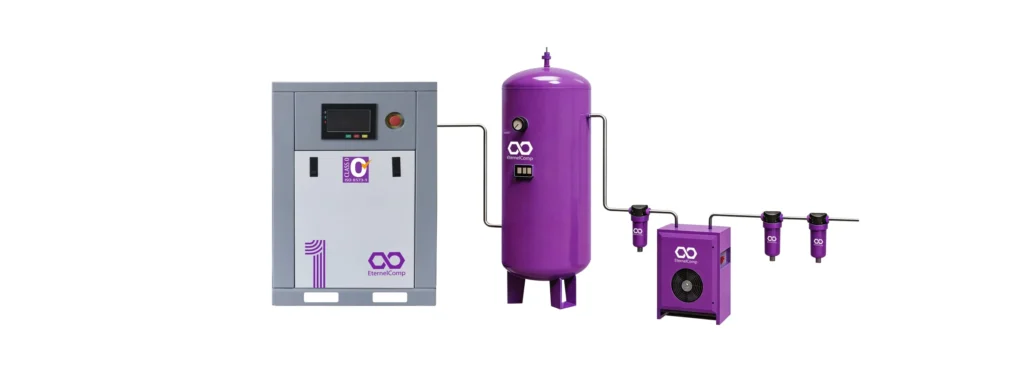
The primary reason facilities choose oil-free screw technology is air quality assurance. ISO 8573-1 defines compressed air purity across three categories: solid particulates, humidity (pressure dew point), and total oil content. An oil-free compressor certified to Class 0 eliminates oil from the compression source, but achieving a complete ISO class specification also requires downstream compressed air treatment equipment — dryers and filtration — to address particulates and moisture. The compressor itself guarantees the oil component; the treatment chain guarantees the rest.
What Is a Water-Lubricated Compressor and How Does It Differ
A water-lubricated compressor injects purified water directly into the compression chamber instead of oil, using the water for rotor sealing, lubrication, and most critically, for heat absorption. The high specific heat capacity of water — approximately four times that of oil — enables near-isothermal compression, meaning the temperature rise during compression is drastically reduced. This thermal advantage translates into superior energy efficiency, typically 5% to 15% lower specific power (kW per 100 CFM) compared to dry oil-free screw compressors of equivalent capacity.
The Near-Isothermal Advantage
The fundamental thermodynamic principle underlying compressor efficiency is that compression work is minimized when the process approaches isothermal conditions — that is, when the temperature of the air remains as close to constant as possible during compression. In a theoretical isothermal compression, all heat generated is instantly removed. In a real compressor, the process is polytropic, falling somewhere between isothermal and adiabatic (no heat transfer).
Water-lubricated compressors come closer to the isothermal ideal than any other positive-displacement compressor technology. The injected water, atomized into the compression chamber, absorbs the heat of compression as it is generated. Discharge temperatures in a water-lubricated compressor operating at 100–125 PSI are typically 100–140°F (38–60°C), compared to 350°F+ for a dry oil-free screw. This has three direct consequences:
- Lower specific power: The compressor motor performs less thermodynamic work per CFM of output. Typical specific power for a 100 HP water-lubricated compressor at 100 PSI is 17–19 kW per 100 CFM, versus 19–22 kW per 100 CFM for a dry oil-free screw.
- No intercooler required: Because the discharge temperature is already low, two-stage compression with an intercooler is unnecessary. Single-stage water-lubricated compressors can achieve 125–150 PSI in one step, reducing component count and mechanical complexity.
- Water as the only consumable: There is no oil to change, no oil filters to replace, and no oily condensate to treat. The water is recirculated through a closed-loop system with filtration and periodic replenishment.
The Water Treatment Burden
The energy efficiency advantage of water-lubricated compression comes with a significant operational requirement: the water must remain clean and chemically stable. Untreated water in a recirculating compression system will quickly accumulate dissolved solids, support microbial growth, and corrode internal components. A water-lubricated compressor installation requires:
- A water treatment system that maintains pH, controls conductivity, and prevents scaling and biological fouling.
- Regular water quality monitoring, including pH, total dissolved solids (TDS), and bacteria counts — typically on a weekly basis.
- Periodic water replacement, with the frequency depending on inlet air quality, operating hours, and treatment system effectiveness.
The water treatment subsystem adds both capital cost and ongoing maintenance labor that does not exist with a dry oil-free screw compressor. For facilities in regions with poor water quality or limited access to purified water, this burden can offset the energy savings. Conversely, facilities that already maintain water treatment systems for other processes — such as pharmaceutical plants with purified water generation — can integrate the compressor water loop with minimal incremental cost.
Air Quality Comparison with Oil-Free Dry Screw
Water-lubricated compressors, like dry oil-free screw compressors, eliminate oil contamination from the compression chamber. The water itself is oil-free, so no oil is introduced into the air stream. However, the water circulating through the system requires continuous treatment and purification. Without proper maintenance, the warm, wet environment inside the compressor can harbor bacterial growth, which risks contaminating the discharge air. Humidity is another key difference. The discharge air from a water-lubricated compressor is saturated with water vapor at the discharge temperature. Downstream drying is mandatory for any application requiring a pressure dew point below ambient temperature, and the dryer load is higher than for a dry compressor because the incoming air starts fully saturated rather than partially saturated.
How Centrifugal Compressors Operate and When They Excel
A centrifugal compressor, also known as a dynamic or turbo compressor, uses a high-speed rotating impeller to accelerate air and then converts the kinetic energy into pressure through a diffuser. Unlike positive-displacement compressors (screw or piston types) that physically trap and squeeze a volume of air, centrifugal machines impart velocity and rely on aerodynamic principles. This fundamental difference makes centrifugal compressors the dominant technology for very high-volume, continuous-duty applications — typically above 500 HP and 2,000 CFM — where their exceptional flow-to-footprint ratio and oil-free design justify their higher capital cost and limited turndown capability.
The Dynamics of Centrifugal Compression
A centrifugal compressor stage consists of an impeller rotating at 20,000 to 60,000 RPM, drawing air in axially and discharging it radially at high velocity. The high-speed air then passes through a diffuser — a ring of stationary vanes that decelerate the air and convert velocity into static pressure. Each stage can achieve a pressure ratio of approximately 2:1 to 3:1, meaning multiple stages are required for typical industrial pressures. A three-stage centrifugal compressor can deliver 100–150 PSI from atmospheric inlet.
The key performance characteristic that defines centrifugal compressor sizing is the relationship between flow, pressure, and impeller speed, governed by the fan laws. Unlike a screw compressor, which delivers a relatively constant CFM across a range of discharge pressures, a centrifugal compressor’s output is highly sensitive to system pressure:
- As system pressure increases above the design point, flow decreases along the compressor’s characteristic curve.
- At a critical minimum flow (approximately 60–70% of design flow for most machines), the compressor enters surge — a violent, potentially destructive flow reversal condition that must be avoided through anti-surge control systems.
- As system pressure decreases below the design point, flow increases until the compressor reaches choke or stonewall, where no further flow increase is possible regardless of pressure reduction.
This narrow operating envelope makes centrifugal compressors ideal for base-load applications where demand is steady and predictable, and unsuitable for applications with wide flow variability unless multiple machines are sequenced or a VSD is employed — though centrifugal VSD turndown is typically limited to 40–50% of design flow versus 20–30% for screw machines.
Efficiency at Scale
The specific power (kW per 100 CFM) of centrifugal compressors becomes increasingly favorable as machine size increases. Below approximately 400 HP, screw compressors — particularly VSD-equipped oil-free machines — are typically more efficient. Above 1,000 HP, centrifugals hold a clear efficiency advantage for base-load operation:
| Compressor Size | Oil-Free Screw (kW/100 CFM) | Water-Lubricated (kW/100 CFM) | Centrifugal (kW/100 CFM) |
|---|---|---|---|
| 100 HP / ~500 CFM | 20–22 | 17–19 | Not available at this size |
| 300 HP / ~1,500 CFM | 19–21 | 17–18 | 20–22 (entry-level) |
| 500 HP / ~2,500 CFM | 18–20 | 16–18 | 18–20 |
| 1,000 HP / ~5,000 CFM | 17–19 | Not typically available | 16–18 |
| 2,000 HP / ~10,000 CFM | Not typically available | Not available | 15–17 |
The crossover point where centrifugal efficiency surpasses screw technology lies in the 500 to 700 HP range for continuous-duty applications. Below this threshold, the centrifugal’s higher capital cost, complex anti-surge controls, and narrower operating window usually do not justify the marginal efficiency gain.
Oil-Free by Nature, But Not Class 0 by Default
Like oil-free screw compressors, centrifugal compressors have no oil in the process air path. Lubrication is confined to bearings and gears, which are isolated from the compression chamber by shaft seals. However, centrifugal compressors are not automatically certified to ISO 8573-1 Class 0. Ambient air drawn into the compressor contains atmospheric hydrocarbons, and if the compressor room itself has oil vapor present — from other machinery, for example — those contaminants will be drawn into the compressor and potentially concentrated in the discharge. The compressor technology is inherently oil-free in the compression chamber, but the system must still be assessed holistically, including inlet air quality and downstream treatment, to achieve a specific ISO class.
Head-to-Head Comparison: Performance, Efficiency, and Cost
When all three technologies are evaluated across the criteria that matter most in industrial procurement — capital cost, energy efficiency, maintenance burden, air quality, reliability, and turndown capability — no single technology dominates across the board. Oil-free screw compressors offer the best balance of air quality assurance and operational flexibility across the widest range of applications. Water-lubricated compressors deliver the lowest specific energy consumption but require water treatment infrastructure. Centrifugal compressors are unmatched for very high volume base-load applications but impose tight operating constraints.
Comprehensive Technology Comparison Matrix
| Evaluation Criterion | Oil-Free Screw | Water-Lubricated | Centrifugal |
|---|---|---|---|
| ISO 8573-1 Oil Class | Class 0 certified | Class 0 certified | Class 0 capable (system dependent) |
| Typical Power Range | 30–1,000 HP | 30–500 HP | 300–5,000+ HP |
| Typical CFM Range | 100–5,000 | 100–2,500 | 1,500–25,000+ |
| Pressure Range (single unit) | 100–150 PSI (2-stage) | 100–150 PSI (1-stage) | 100–150 PSI (3-stage) |
| Specific Power at 100 PSI | 19–22 kW/100 CFM | 17–19 kW/100 CFM | 18–22 kW/100 CFM (size-dependent) |
| Turndown Ratio (with VSD) | 20–100% | 20–100% | 40–100% |
| Discharge Temperature | 280–380°F (138–193°C) | 100–140°F (38–60°C) | 200–300°F (93–149°C) |
| Typical Capital Cost ($/HP) | $800–$1,200 | $1,000–$1,400 | $1,200–$2,000 |
| Major Consumables | Air filters, bearing grease | Water treatment chemicals, filters | Air filters, bearing oil |
| Maintenance Interval | 4,000–8,000 hours | 4,000–6,000 hours | 8,000–16,000 hours |
| Surge Risk | None | None | Below ~60% design flow |
| Noise Level (1 meter) | 72–82 dBA | 68–78 dBA | 85–105 dBA (requires enclosure) |
| Installation Footprint | Moderate | Moderate | Large per CFM at small scale; compact at large scale |
Capital Cost vs. Total Cost of Ownership
The initial purchase price tells an incomplete story. A 10-year total cost of ownership analysis for a representative 300 HP, 1,500 CFM installation operating 6,000 hours per year reveals the following:
| Cost Category (10 Years) | Oil-Free Screw | Water-Lubricated | Centrifugal |
|---|---|---|---|
| Initial equipment cost | $270,000 | $330,000 | $420,000 |
| Installation (electrical, piping, foundation) | $45,000 | $60,000 | $85,000 |
| Energy ($0.10/kWh, 6,000 hr/yr) | $1,260,000 | $1,080,000 | $1,170,000 |
| Routine maintenance (parts + labor) | $120,000 | $150,000 | $95,000 |
| Consumables (filters, treatment chemicals) | $25,000 | $45,000 | $28,000 |
| Unscheduled repair allowance | $35,000 | $40,000 | $50,000 |
| 10-Year Total | $1,755,000 | $1,705,000 | $1,848,000 |
The water-lubricated compressor achieves the lowest 10-year total cost in this scenario due to its energy efficiency advantage, which compounds across 60,000 operating hours. The centrifugal compressor carries the highest total cost at this power level — the energy savings that centrifugals achieve at larger scales have not yet materialized, and the higher capital and installation costs dominate. The oil-free screw occupies the middle ground, with predictable maintenance costs and no requirement for water treatment infrastructure.
Energy Efficiency: The Dominant Cost Factor
Across all three technologies, energy consumption accounts for 70% to 75% of total lifecycle cost. This means that a 10% improvement in specific power — for example, from 20 kW/100 CFM to 18 kW/100 CFM — saves approximately $108,000 over 10 years on a 300 HP machine. This is why the water-lubricated compressor’s energy advantage, despite its higher initial cost and water treatment complexity, can deliver superior lifetime economics in the right application. However, this calculation assumes stable, continuous operation near the compressor’s design point. In facilities with highly variable demand, a VSD-equipped oil-free screw compressor operating efficiently across a wide turndown range may achieve lower actual energy consumption than a fixed-speed water-lubricated machine that cycles on and off, incurring blowdown losses and start-up inefficiencies with each cycle.
Which Compressor Technology Is Right for Your Application
Application requirements — not technology preference — should drive the compressor selection decision. The three technologies serve distinctly different operational profiles: oil-free screw compressors for applications demanding certified air purity with flexible demand patterns, water-lubricated compressors for facilities prioritizing energy efficiency and already equipped for water treatment, and centrifugal compressors for very high-volume, steady-state base-load applications where turndown is not required.
Decision Matrix by Application
| Application | Recommended Technology | Reason |
|---|---|---|
| Food and beverage processing | Oil-Free Screw | ISO 8573-1 Class 0 certification required; moderate CFM range fits screw technology envelope |
| Pharmaceutical manufacturing | Oil-Free Screw | Regulatory compliance (FDA, EU GMP) demands certified oil-free air; VSD capability matches batch production cycles |
| Electronics and semiconductor | Oil-Free Screw or Centrifugal | Large fabs with steady demand above 2,000 CFM benefit from centrifugal efficiency; smaller facilities use oil-free screw |
| Textile manufacturing | Water-Lubricated | Lower energy cost critical for low-margin industry; air quality requirements less stringent than pharma/food |
| Automotive assembly (large plant) | Centrifugal | Very high, relatively steady CFM demand across multiple shifts; excellent fit for centrifugal’s base-load profile |
| Automotive tier-1 supplier (medium plant) | Oil-Free Screw with VSD | Variable production volumes across shifts; VSD tracks demand and saves energy during low-production periods |
| Chemical processing | Water-Lubricated or Oil-Free Screw | Depends on process air contact; water-lubricated preferred where energy is the dominant cost driver |
| Medical device manufacturing | Oil-Free Screw | ISO 13485 quality systems; predictable air quality documentation trail |
| General manufacturing (diverse tools) | Oil-Free Screw with VSD | Wide demand variability; VSD provides efficient part-load operation |
| Large-scale nitrogen generation | Centrifugal | Very high continuous air demand; 5,000+ CFM required for large nitrogen plants |
The Nitrogen Generation Example
Facilities that generate nitrogen on-site using PSA or membrane technology place uniquely demanding loads on the compressed air system. The air factor — the ratio of compressed air input to nitrogen output — ranges from 2.5:1 to 7.0:1 depending on required purity. A facility producing 500 CFM of 99.999% nitrogen requires approximately 2,500 to 3,500 CFM of compressed air at 8 to 10 bar. This volume falls squarely in the crossover region between large oil-free screw and small centrifugal compressors. The decision hinges on demand variability: if nitrogen demand is steady 24/7, a centrifugal may offer lower lifecycle cost; if nitrogen demand varies by shift or product mix, the superior turndown of a VSD oil-free screw typically wins. The air compressor feeds the industrial gas generation system, and any compressor downtime directly halts nitrogen production — making reliability and service support equally important as efficiency in this application.
The VSD Factor
Variable speed drive technology has reshaped the competitive landscape between these three compressor types over the past decade. A VSD-equipped oil-free screw compressor can efficiently operate from 20% to 100% of its rated output, matching real-time air demand and eliminating the blowdown losses, idling power consumption, and pressure band inefficiencies of load/unload control. This capability has two strategic implications:
- It narrows the efficiency gap with water-lubricated compressors in applications with variable demand. A VSD oil-free screw may achieve lower total energy consumption than a fixed-speed water-lubricated machine because it avoids the inefficiencies of part-load operation.
- It extends the practical application range of screw technology into flow ranges previously dominated by centrifugals. A 500 HP VSD oil-free screw with 20-100% turndown can handle demand variability that would force a centrifugal into inefficient bypass or multi-machine sequencing.
The oil-lubricated compressor with VSD remains the most common configuration for general industrial use, but the oil-free VSD screw is increasingly the standard for applications where air quality cannot be compromised.
Maintenance and Lifecycle Considerations Across All Three Technologies
The three compressor technologies impose fundamentally different maintenance profiles. Oil-free screw compressors require regular bearing and seal inspections at 4,000 to 8,000-hour intervals, with major overhauls — rotor coating inspection and timing gear replacement — at 20,000 to 40,000 hours. Water-lubricated compressors add water quality management to this baseline, with water treatment system maintenance and water replacement cycles consuming additional labor. Centrifugal compressors have the longest intervals between major overhauls — 40,000 to 80,000 hours — but when an overhaul is required, the cost and downtime are substantially higher due to the precision balancing and specialized tooling involved.
Maintenance Interval Comparison
| Maintenance Activity | Oil-Free Screw | Water-Lubricated | Centrifugal |
|---|---|---|---|
| Air filter replacement | 2,000 hours | 2,000 hours | 2,000 hours |
| Oil change (gear/bearing sump) | 4,000–8,000 hours | Not applicable (water system) | 8,000 hours |
| Bearing inspection | 8,000 hours | 6,000 hours | 16,000 hours |
| Water quality analysis | Not applicable | Weekly | Not applicable |
| Water system sanitization | Not applicable | Quarterly | Not applicable |
| Cooler cleaning | 4,000–8,000 hours | 4,000 hours | 8,000–12,000 hours |
| Anti-surge valve test | Not applicable | Not applicable | Quarterly |
| Minor overhaul | 20,000 hours | 20,000 hours | 40,000 hours |
| Major overhaul (airend/impeller) | 40,000 hours | 40,000 hours | 80,000 hours |
| Typical major overhaul cost (300 HP) | $25,000–$40,000 | $30,000–$50,000 | $60,000–$120,000 |
System-Level Reliability
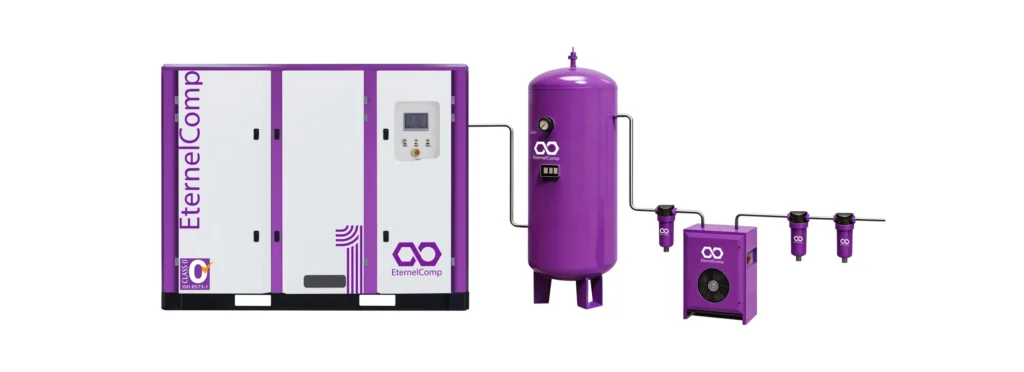
The reliability of the compressor itself is only one factor in overall system uptime. The compressed air treatment equipment downstream of the compressor — dryers, filters, condensate management — represents a significant portion of system-level failure risk. A refrigerated dryer failure can introduce liquid water into the distribution piping even while the compressor is running perfectly. System design must consider single points of failure across the entire compressed air chain, not just the compressor package.
For critical applications where compressed air downtime stops production, redundancy planning is essential regardless of compressor technology. A common configuration for industrial compressed air applications is an N+1 arrangement: one more compressor than the peak demand requires, with automatic sequencing to rotate the running machines and equalize operating hours. This approach adds capital cost but eliminates single-compressor dependency.

Technology Evolution and Future-Proofing
All three technologies continue to evolve. Recent advances include:
- Permanent magnet motor technology integrated directly into oil-free screw airends, eliminating gearboxes and improving drivetrain efficiency by 2–4%.
- IoT-enabled predictive maintenance using vibration analysis, temperature trending, and specific power monitoring to predict bearing and coating degradation before audible or visible symptoms appear.
- Magnetic bearing centrifugal compressors that eliminate oil entirely from the compressor package — no gearbox oil, no bearing oil — reducing maintenance to air filter changes and periodic cooler cleaning.
Selecting a compressor today involves not just comparing current specifications but anticipating how each technology platform will support maintenance, monitoring, and efficiency improvements over a 15 to 20-year service life. Compressors with open communication protocols, modular component design, and upgradeable control systems preserve the option to incorporate future advances without a full machine replacement.
Conclusion
The choice between an oil-free screw compressor, a water-lubricated compressor, and a centrifugal compressor is ultimately a choice about which trade-offs your facility can best absorb. An oil-free screw compressor provides the most versatile combination of certified air quality, wide turndown capability, and predictable maintenance across the broadest range of industrial applications. A water-lubricated compressor offers the lowest specific energy consumption — and therefore the lowest electricity cost — but requires water treatment infrastructure and disciplined water quality management that not every facility is equipped to support. A centrifugal compressor is unmatched for very high-volume base-load applications above 2,000 CFM, where its efficiency advantage and long overhaul intervals justify the higher capital cost and narrower operating envelope.
The most expensive compressor is not the one with the highest purchase price. It is the one that is mismatched to the application — oversized and wasting energy at partial load, undersized and bottlenecking production, or technology-inappropriate and imposing air quality risks that carry regulatory or product-quality consequences. Investing the engineering time to model your actual demand profile, evaluate your air quality requirements against ISO 8573-1 standards, and conduct a 10-year total cost of ownership analysis across all viable technologies is the single most valuable step in the procurement process.
FAQ
Can a water-lubricated compressor replace an oil-free screw compressor in a food processing facility?
In principle, yes — water-lubricated compressors can achieve ISO 8573-1 Class 0 certification for oil content. However, food safety audits under SQF, BRC, or FSSC 22000 often require documentation specific to oil-free screw technology because it is the established standard in the industry. Water-lubricated technology is less familiar to many food safety auditors, which can create compliance friction even when the technical performance is equivalent. Additionally, the saturated discharge air from a water-lubricated compressor increases the load on downstream dryers, which must be sized accordingly. If water quality management processes — including microbial control — are not already mature in the facility, the food safety risk of improperly treated compressor water may outweigh the energy savings.
At what CFM threshold does it make sense to switch from screw to centrifugal technology?
The crossover point is not a single CFM number but a function of three factors: flow volume, demand variability, and desired redundancy. For a single-compressor installation with steady 24/7 demand, centrifugal technology becomes economically competitive around 2,000 CFM (approximately 400–500 HP). Below this threshold, the centrifugal’s higher capital cost and installation complexity are difficult to justify. However, if demand is variable — for example, dropping to 50% during a night shift — a VSD oil-free screw at 3,000 CFM may deliver lower total energy cost than a centrifugal operating at 50% load with bypass or blow-off. For multi-compressor installations, the availability of sequencing controls and the cost of N+1 redundancy — where an extra centrifugal represents a much larger capital commitment than an extra screw — often shift the decision in favor of multiple screws up to significantly higher total system CFM.
How does altitude affect the performance of these three compressor technologies differently?
All three technologies lose mass flow output at altitude due to reduced inlet air density. However, the mechanisms differ. For positive-displacement machines (oil-free screw and water-lubricated), the swept volume remains constant, so the volumetric CFM at the inlet is unchanged, but the mass flow — and therefore the delivered CFM at standard conditions — decreases proportionally to density loss. At 5,000 feet, a screw compressor loses approximately 17% of its sea-level mass flow. For centrifugal compressors, the effect is compounded: the reduced inlet density also reduces the impeller’s ability to generate pressure rise, and the machine’s characteristic curve shifts. A centrifugal compressor specified for sea level may be unable to achieve its rated discharge pressure at altitude, requiring either a larger machine or a multi-stage configuration with one additional stage. Facilities at significant elevation should request altitude-corrected performance curves from the manufacturer for any of these technologies — generic sea-level specifications applied to high-altitude installations are unreliable.