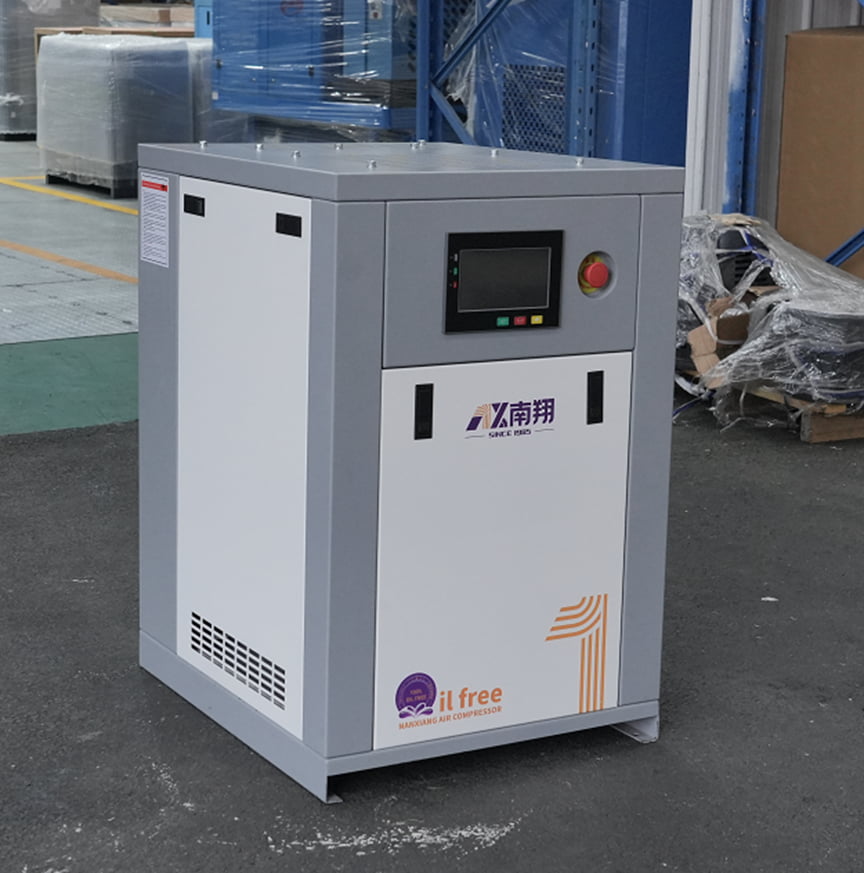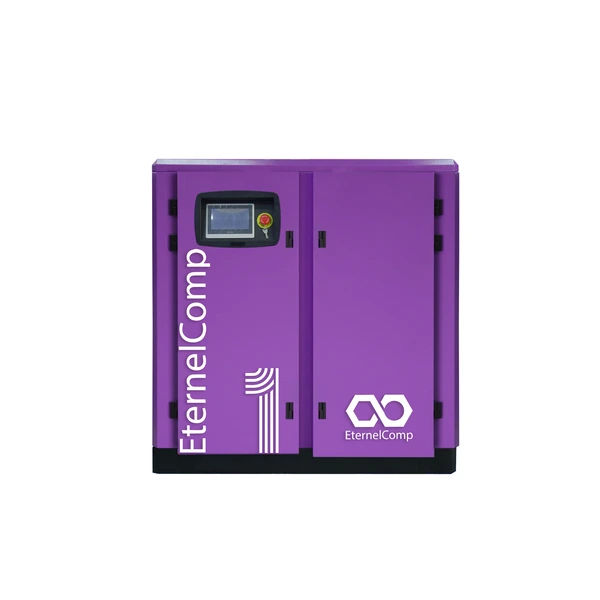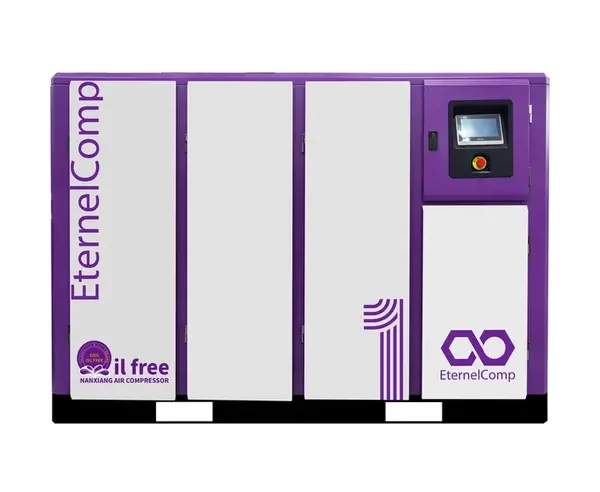
Aeration is usually the largest electrical load in a biological wastewater plant, and blowers often run around the clock at 0.4 to 1.0 bar. Buyers comparing air bearing and maglev turbo blower designs see two machines that look identical on paper: the same permanent magnet motor, the same drive, the same promise of large savings over a lobe blower. The difference sits in a component that datasheets skip.
Both are high-speed, direct-drive, oil-free machines with the same impeller and motor technology, and the real difference is how the rotor is suspended. An air bearing turbo blower floats the shaft on an air film the rotor generates itself, so it needs no sensors, controller or backup bearing, which makes it simpler and cheaper. A maglev turbo blower levitates the shaft with electromagnets under closed-loop control, adding active damping and diagnostics, but also electronics, an auxiliary bearing and a dependence on reliable power. For continuous duty with ordinary power quality and clean inlet air, the air bearing design usually returns the better lifecycle cost. For wide turndown, remote diagnosis or strict vibration limits, the maglev design earns its premium.
The sections below work through the engineering, then through the money.
The Core Difference in One Sentence
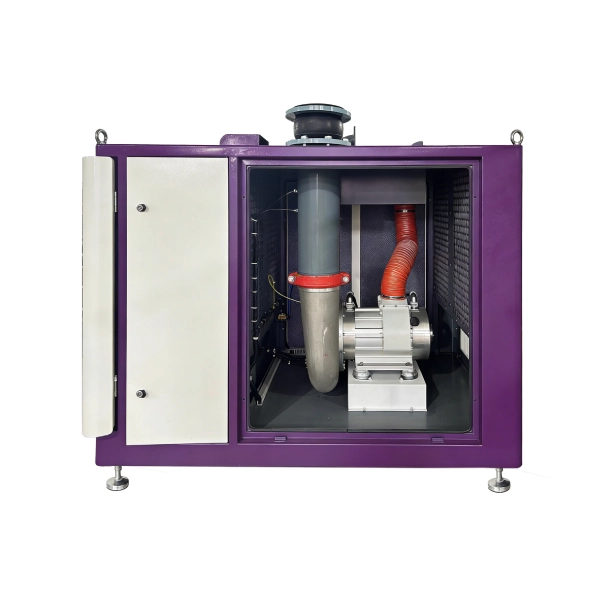
Strip away the enclosure and the two machines differ in one component: the bearing. One uses the air it is already moving; the other uses electromagnetic force and a control loop.
Everything upstream is shared: a permanent magnet motor drives a machined impeller directly at 20,000 to 60,000 rpm, with no gearbox or oil circuit, and the drive sets the speed that sets the flow. Across the wider range of industrial blowers used for aeration, the bearing decides the service model.
How an Air Bearing Supports the Shaft
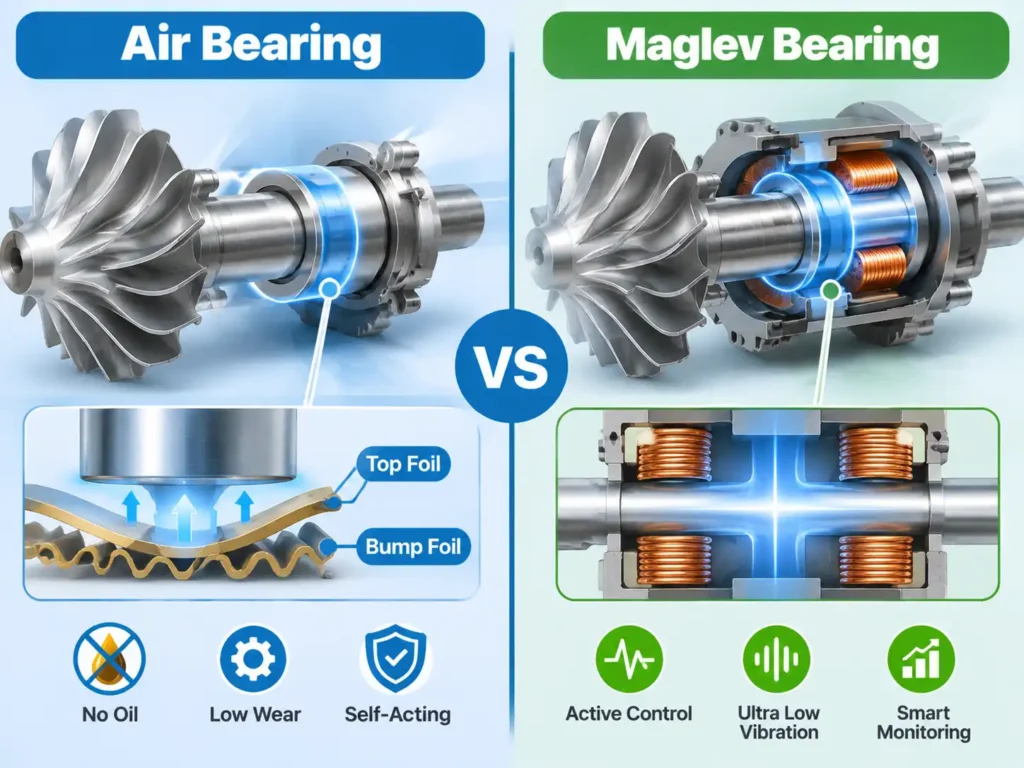
A compliant foil bearing places a smooth top foil over a corrugated bump foil. As speed rises, viscous drag carries air into the converging wedge between shaft and foil, and the pressure built there lifts the rotor onto a film 10 to 20 microns thick. The film is self-acting, so no external air supply or electronics are involved, and the foil flexes to damp motion. Before lift-off the shaft slides on the foil, with a solid lubricant coating carrying that contact. Work by NASA Glenn Research Center describes exactly this: no wear while the film supports the rotor, sliding at start-up and shutdown. Details are on the Air Bearing Turbo Blower page.
How a Maglev Bearing Supports the Shaft
An active magnetic bearing suspends a laminated rotor with stator coils. Displacement sensors sample position thousands of times per second, and a controller modulates coil current to hold the rotor near the centre of the gap across five axes. Because the suspension is active, it can be stiffened or softened across the speed range, filter synchronous vibration and produce orbit data for diagnosis. Levitation exists only while the controller is powered, so the supply becomes part of the bearing system. On power loss the rotor drops onto auxiliary bearings while the controller, held up by a UPS or by regenerative braking, manages the landing. The Maglev Bearing Turbo Blower page shows how this is arranged.
Side-by-Side Bearing Comparison
| Parameter | Air bearing (compliant foil) | Maglev (active magnetic) |
| Rotor support | Self-generated air film | Electromagnetic force from coils |
| Control hardware | None; foil geometry sets stiffness | Sensors, controller, amplifiers |
| Contact at standstill | Yes, on coated foil | After a drop onto auxiliary bearings |
| Start-up | Ramps through lift-off speed | Levitated before it turns |
| Power loss | Settles onto foil, no electronics | Controller must survive coast-down |
| Monitoring | Vibration, temperature | Orbit, displacement, current, drop count |
| Relative price | Lower | Higher |
Efficiency: Where the Real Difference Shows Up
At the design point the two bearing types sit within one to three percentage points of each other, inside the uncertainty of most site tests. Part-load behaviour decides the purchase, not the headline figure.
Design Point and Part Load
Specific power, in kW per cubic metre per minute at a stated pressure, is the only figure that allows fair comparison between frame sizes. These ranges are indicative for 0.6 bar gauge at standard inlet conditions, not a guarantee.
| Blower type | Specific power, kW per m3/min | Practical turndown |
| Lobe (positive displacement) | 1.45 to 1.75 | 100 to 60 percent |
| Multistage centrifugal | 1.15 to 1.35 | 100 to 70 percent |
| Air bearing turbo | 1.00 to 1.15 | 100 to 50 percent |
| Maglev turbo | 0.98 to 1.12 | 100 to 50 percent |
The bottom rows overlap because bearing type is not what limits performance mid-map; surge margin and motor cooling do. A machine that is 5 percent worse at design point but holds efficiency at 55 percent flow can beat one that is marginally better at full flow, so ask for the curve, not a single number.
What Actually Moves the Electricity Bill
The U.S. Department of Energy notes in its guidance on energy savings performance contracting for water resource recovery facilities that aeration usually exceeds 50 percent of a facility’s energy use. Regional analysis has also estimated that high-speed turbo blowers cut aeration energy by 15 to 20 percent against conventional technology. Yet dissolved oxygen control alone can save 10 to 30 percent, so a plant that runs the best blower at fixed speed captures little of that.
Start-Stop Behavior and Power Failure Ride-Through
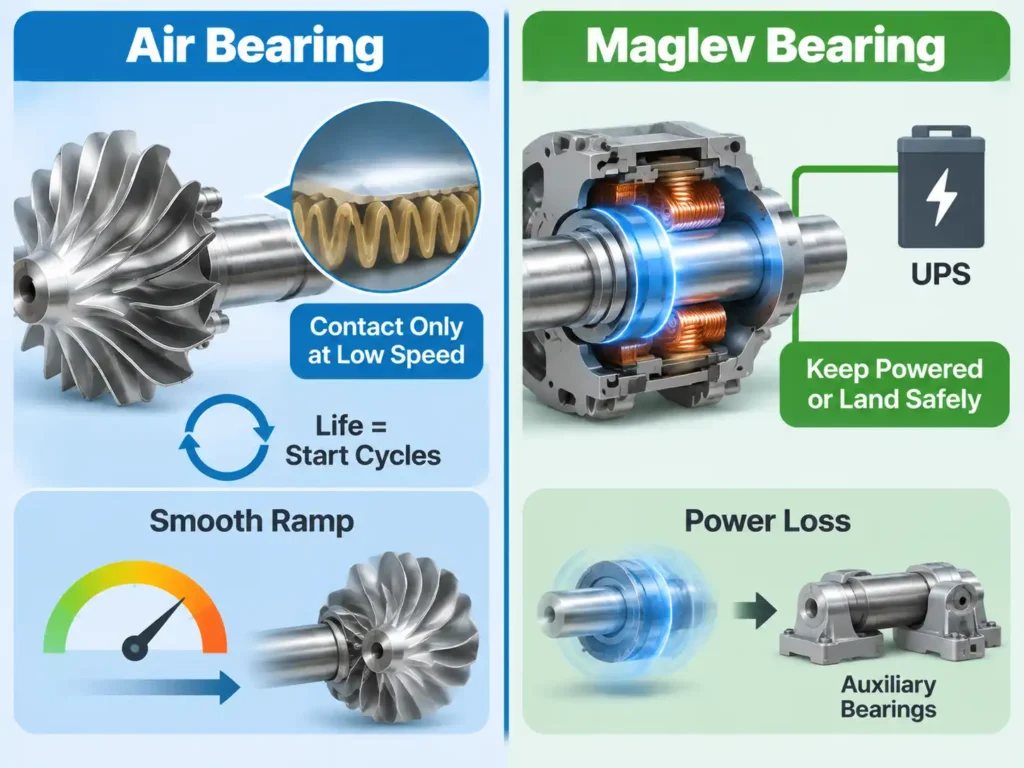
This is the part most datasheets omit. An air bearing wears only during start-up and coast-down, so its life is counted in cycles rather than hours. A maglev bearing touches nothing while levitated, but must stay powered to remain levitated, so a power failure becomes an electrical design problem rather than a mechanical one.
Touchdown Wear on Foil Bearings
Because contact occurs only at low speed, foil bearing consumption tracks the number of starts, not operating hours. Published ratings commonly fall between 20,000 and 100,000 cycles depending on coating and load. Two starts a day on a continuously running plant means about 730 cycles a year, so a 20,000 cycle rating covers decades, while a sequencing batch reactor cycling six times an hour makes the bearing a scheduled consumable. Protection is procedural: set a minimum run time, ramp speed rather than starting direct, and trim speed instead of stopping.
Coast-Down and Backup Power on Maglev Units
The rotor stores enough energy at full speed to spin for minutes after a trip, and the controller must keep it centred or deliver it to the auxiliary bearings in a controlled way. Common provisions are a UPS sized for the coast-down, a regenerative arrangement feeding the controller from motor back-EMF, or both. Each landing consumes auxiliary bearing life, so the drop counter is a maintenance input and the rated drop count belongs in the quotation. Power quality matters too: sags, transients and harmonics reach the controller before they reach the motor.
Maintenance, Failure Modes, and Site Conditions
Neither machine needs oil changes, belt tensioning or coupling alignment, and both are genuinely low-maintenance compared with a lobe blower. The difference is what you maintain: an air bearing consumes mechanical parts, a maglev unit consumes electronics.
| Symptom | Air bearing likely cause | Maglev likely cause |
| Vibration rising at constant load | Foil wear, coating loss, contamination | Sensor drift, coil fault, unbalance |
| Repeated trip at start-up | Lift-off not reached, inlet restriction | Levitation failure, controller fault, sag |
| High discharge temperature | Fouled impeller, blocked filter | Same, plus cabinet cooling fault |
| Sudden loss of pressure | Surge, impeller damage | Surge, amplifier trip |
A blower 8 percent above its commissioning specific power reports filter condition or bearing drag before it fails. Foil cartridges last five to eight years or the rated cycle count, controller electronics roughly 8 to 12 years. Both designs sit at 70 to 80 dB(A) at one metre with enclosure, against 95 to 105 for an unenclosed lobe blower, and both derate about 1 percent per 100 m above 1,000 m.
Total Cost of Ownership: A Practical Way to Compare
Purchase price is usually 45 to 60 percent of a ten-year cost for either machine, so a decision made on capital cost alone is a decision made on the smaller number.
| Cost line | Air bearing | Maglev | Note |
| Purchase and installation | Baseline | 10 to 25 percent higher | Skid, drive, protection, commissioning |
| Energy over 10 years | Baseline | 0 to 5 percent lower | Depends on load profile |
| Scheduled maintenance | Filters, foil cartridge | Filters, electronics | Local labour rate dominates |
| Unplanned downtime | Mechanical, field-serviceable | Board or sensor swap | Check support depth |
A 90 kW machine running 8,000 hours a year at 0.10 USD per kWh costs about 72,000 USD in electricity, and an 8 percent efficiency advantage saves roughly 5,760 USD a year. Against a 30,000 USD premium, payback is about 5.2 years, not the one to two years marketing literature implies. The method is set out in this guide to Air Compressor ROI in Manufacturing.
Matching the Technology to Your Plant and Duty Cycle
Choose on duty cycle and site conditions, not on how advanced the technology sounds. The questions are whether the machine restarts many times a day, and whether your electrical and maintenance teams can support each design.
When Air Bearing Is the Better Fit
Continuous operation with few starts per week, cleanable inlet air, a tight capital budget, ordinary power quality, and a mechanical rather than electronic maintenance team, especially where controller spares are slow to arrive.
When Maglev Is the Better Fit
Widely varying flow tracked without blow-off, strict vibration limits, a control room that wants orbit data, stable power, and a regional partner committed to a response time.
When Neither Is the Best Answer
Below roughly 15 cubic metres per minute the capital cost of either high-speed machine is hard to justify against a well-controlled positive displacement blower, and above about 1.2 bar the turbo stage becomes a compressor problem with different economics. Intermittent duty on a tight budget can favour a simpler machine whose lower efficiency is offset by a lower price, such as an oil-free screw blower.
A Procurement Checklist Before You Sign
Comparable bids are engineered, not received. Fix the guarantee conditions, the measurement method and the remedy in the enquiry, or the numbers will not mean the same thing.
- Require specific power at design point and at 75, 60 and 50 percent flow, corrected to your altitude and ambient temperature.
- State the conditions at which those figures are guaranteed, and the tolerance on the test.
- Specify the acoustic standard and distance, and require octave band data rather than one dB(A) figure.
- Confirm whether a factory acceptance test is included and whether a site performance test follows installation.
- For air bearing units, request the rated cycle count; for maglev units, the drop rating, coast-down time and UPS provision.
FAQ
These three questions come up in almost every technical bid review, and they reach beyond the sections above.
Can either type handle high ambient temperatures and a dusty inlet?
Both can, with different penalties. Above 40 degrees Celsius expect derating and rising motor temperature, so ask for corrected curves rather than nameplate data. Dust is the sharper constraint for an air bearing, because particulate disrupts the film, while a maglev unit tolerates dirty air but needs clean, cool air for its cabinet.
What spare parts should we stock for each bearing type?
For an air bearing machine, hold a filter set, a foil cartridge if the duty cycles often, and the recommended sensors and seals. For a maglev machine, hold filters, a controller board, a displacement sensor and an auxiliary bearing, because a board failure stops the machine outright.
Can a turbo blower replace a lobe blower without changing the piping?
Mechanically usually yes, since both deliver air at similar pressure into a similar header. Hydraulically not always, because a positive displacement machine pushes against high back pressure while a turbo machine has a surge limit and can surge if the discharge volume and control valve suit a different characteristic. Check header volume, sensor location relative to the non-return valve, and blow-off capacity before ordering.