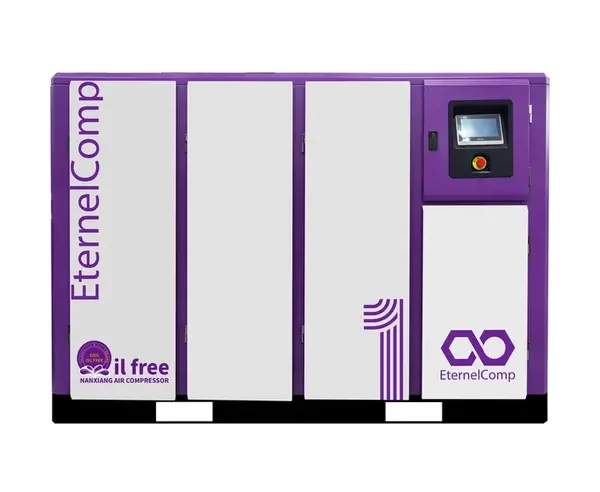
Specifying a clean compressed air system usually comes down to two positive displacement designs: the oil-free scroll compressor and the rotary screw compressor. Both are compact, both are quieter than a reciprocating machine of similar output, and both appear on the same tender documents. Procurement teams shortlisting Oil-Free Compressors quickly find the overlap real but shallow, because the differences that decide the outcome surface only after a year of running.
A scroll compressor traps air between two interlocking spiral scrolls and squeezes it through crescent pockets migrating toward the centre, while a rotary screw compressor traps air between two meshing rotors and compresses it along the rotor length. Scroll machines are oil-free by design, very quiet, and suited to modest flows with intermittent duty. Screw machines come in oil-injected and oil-free versions, scale to far higher flows and pressures, and are built for continuous operation. The decision is less about which technology is superior than about matching capacity, duty cycle, air purity class and ten-year cost to the process you actually run.
The sections below cover the mechanics, the measurable differences, and a selection sequence for a live project.
How Scroll and Screw Compression Actually Work
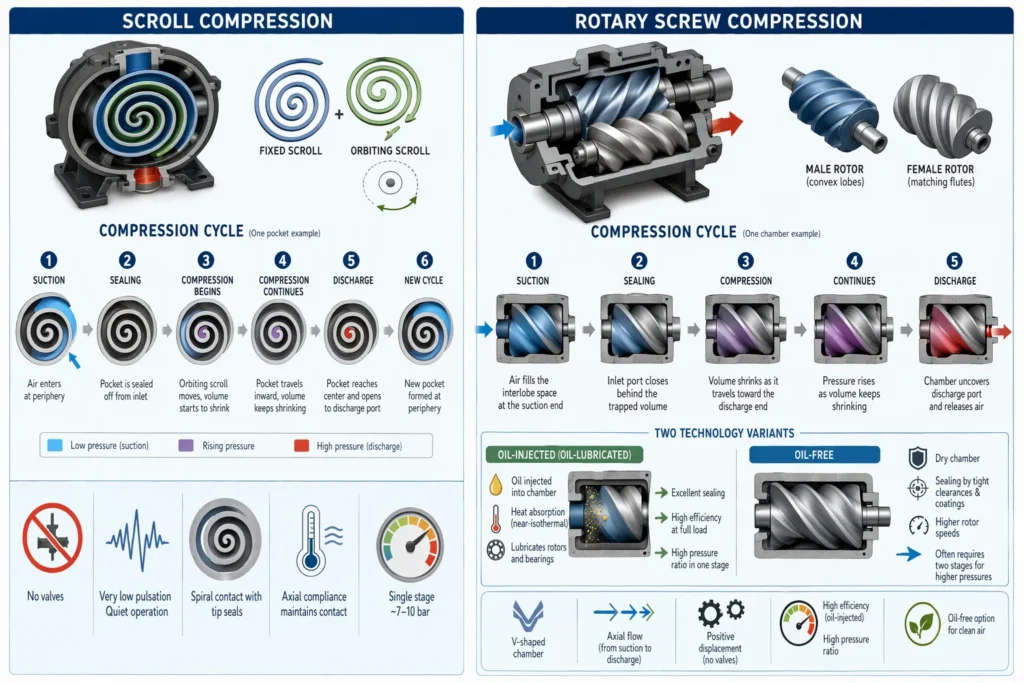
Both designs are positive displacement machines, raising pressure by shrinking a trapped volume of air rather than accelerating it. The difference is how that volume forms and closes: a scroll pair creates crescent pockets travelling inward toward the discharge port, while a screw pair creates a V-shaped chamber travelling axially from suction to discharge.
The scroll compression cycle
A scroll set is two identical spiral walls, one fixed and one orbiting. The orbiting scroll does not rotate. It is held by an anti-rotation coupling and driven through a small eccentric radius, so it sweeps around the fixed scroll without turning. Where the spirals touch they form sealed pockets. Air enters at the periphery, is sealed off as the orbit progresses, and is pushed toward the centre as pocket volume falls, discharging when the innermost pocket reaches the central port.
No suction or discharge valves are needed, because the geometry decides when the pocket opens. That explains the behaviour: no valve slap, very low pulsation, and noise dominated by motor and fan rather than gas pulses. Industrial packages such as the LW-Series Oil-Free Scroll Compressors apply this geometry with tip seals and axial compliance holding the spiral faces in contact as the machine warms. Sealing still depends on a small clearance, and the resulting back-leakage caps what one stage holds economically at around 7 to 10 bar.
The rotary screw compression cycle
A screw air end contains a male rotor with convex lobes and a female rotor with matching flutes, turning inside a close-tolerance casing. Air fills the interlobe space at the suction end. As the rotors turn, the inlet port closes behind the trapped volume and the space shrinks as it travels toward the discharge end until it uncovers the discharge port.
What differs between variants is what occupies the gap between the rotors. In oil-injected machines, oil is sprayed into the chamber to seal clearances, absorb heat and lubricate bearings. That near-isothermal behaviour is why an Oil-lubricated Rotary Screw Air Compressor holds a high pressure ratio in one stage with strong full-load efficiency. In an oil-free machine the chamber runs dry, sealing depends on tight clearances and coatings, rotor speeds are higher, and two stages are often needed for higher pressures.
Key Differences at a Glance
The two technologies separate along four axes: achievable flow and pressure, efficiency across the load profile, noise and footprint, and the air purity each holds without extra treatment. Capacity is the hardest constraint, and in most projects it eliminates one option before the other criteria are discussed.
| Parameter | Oil-free scroll | Oil-injected screw | Oil-free screw |
| Capacity per unit | 2 to 15 CFM single-scroll, 60 to 120 CFM multi-scroll | 20 to 500 CFM | 30 to 400 CFM |
| Discharge pressure | Usually 7 to 10 bar | 7 to 13 bar single stage | 7 to 10 bar, higher in two stages |
| Duty cycle | Intermittent to moderate | Continuous, 24/7 | Continuous, 24/7 |
| Noise | 48 to 70 dBA | 70 to 85 dBA | 70 to 80 dBA |
| Residual oil in air | Effectively zero | 1 to 5 ppm after separation | Effectively zero |
| Part-load control | Fixed displacement, staged by scroll bank | Load/unload, slide valve or VSD | Load/unload or VSD |
| Capital cost per CFM | Low at small sizes | Lowest | Highest |
Capacity and pressure ceiling
Capacity is the first filter because it is not a matter of preference. A single scroll stack has a physical displacement ceiling, and multi-scroll packages extend the range by stacking small elements rather than scaling one large element. Above roughly 120 CFM the number of stacks and the floor space they occupy become hard to justify against one screw air end. Pressure runs the same logic in reverse: scroll geometry struggles above about 10 bar without staging, while a two-stage screw machine reaches 13 bar as a routine configuration.
Part-load efficiency and control
Full-load figures are the easiest to quote and the least useful alone, because few plants run at full load for long. A fixed-speed scroll compressor produces a fixed displacement, so capacity is modulated by stopping and starting or by switching scroll banks in and out, leaving a sawtooth pressure profile between steps. A screw compressor with a slide valve or variable speed drive follows demand more smoothly across a wide band. The comparison only becomes fair when both machines are rated on the same basis, which is why third-party verified data published through CAGI exists.
Noise, footprint and installation
Scroll compressors earn their quiet reputation honestly, but headline numbers need context. A figure quoted at one metre is a sound pressure level and depends on the acoustic environment, while sound power describes the machine itself and is always numerically higher. Comparing one supplier’s sound pressure figure with another’s sound power figure produces a gap that does not exist in the room. Footprint mirrors capacity: a scroll package delivering 40 CFM occupies far more floor area than a screw package of the same flow, which is why scroll units suit plant rooms and laboratories while screw units suit central compressor rooms feeding a ring main.
Are Rotary Screw Air Compressors Oil Free?
Not by default. Most rotary screw compressors in service are oil-injected, with oil sprayed into the chamber to seal, cool and lubricate. Oil-free screw compressors exist and are widely used in sensitive industries, but they are a separate design with different rotors, coatings, cooling strategy and price.
Oil-injected, water-lubricated and dry-running designs
| Design | What seals the chamber | Delivered air quality | Notes |
| Oil-injected | Oil film | Needs coalescing filters and often a dryer | Best full-load efficiency, lowest cost per CFM |
| Water-lubricated | Injected water | Oil-free at source, water must be managed | Single stage, cooler discharge, needs water treatment |
| Dry-running | Clearance only, timing gears | Oil-free at source | Highest rotor speed and cost |
A buyer asking whether screw compressors are oil-free is really asking which of these three is on the quotation. That answer belongs in the technical data sheet, not in a sales conversation.
What oil-free actually means in practice
Oil-free describes the compression chamber, not the whole system. The reference for the delivered result is ISO 8573-1, which classifies compressed air by particles, water and oil using a three-digit code. Class 0 is not a fixed threshold in the standard: it is a class the supplier and end user define together, and it must be stricter than Class 1. That distinction matters in audits, because “Class 0” on a brochure means nothing without a stated limit and a test method. Nor does an oil-free compressor guarantee oil-free air at the point of use, since ambient air already carries hydrocarbon traces and downstream piping can add contamination.
Oil or Oil-Free: Which Fits Your Process?
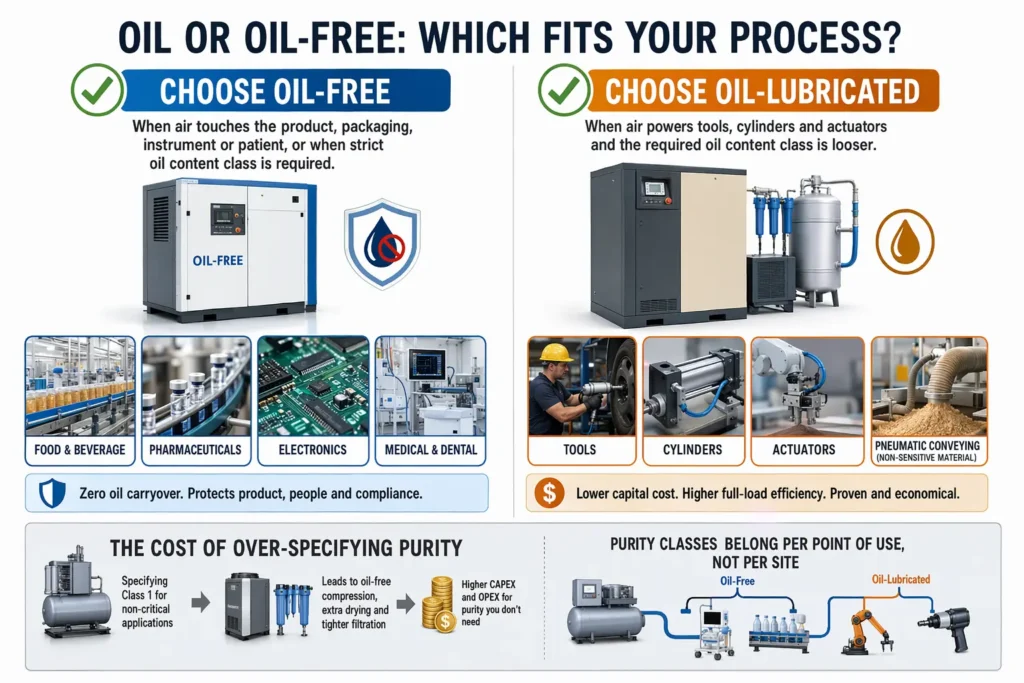
Choose oil-free when compressed air touches the product, the packaging, the instrument or a patient, or when the specification names a class that oil-injected equipment cannot hold without a heavy treatment train. Choose oil-lubricated when air drives tools, cylinders and actuators and the accepted class is looser, because lower capital cost and better full-load efficiency usually outweigh the treatment savings.
When oil-lubricated makes commercial sense
General manufacturing, workshops, construction sites and most pneumatic conveying of non-sensitive material run comfortably on oil-injected machines with a coalescing filter and a refrigerated dryer. The economics are simple: less capital per CFM, more sizes to choose from, and full-load efficiency that dry-running designs struggle to match because the oil film closes leakage paths air alone cannot. The trade-off is a consumable schedule of oil, filters and separator elements, plus residual oil in the delivered air that filtration never entirely removes.
When oil-free is non-negotiable
Food and beverage production, pharmaceuticals, electronics, medical gas and dental air, and any process where air contacts a sterile surface generally cannot accept oil carryover at any concentration, because the risk is a batch loss or a regulatory finding rather than a maintenance cost. In these settings the question is not efficiency. It is whether the system can demonstrate compliance on the day of the audit, which favours oil-free compression at source over filtration of contaminated air.
The cost of over-specifying purity
The opposite error is common too. A plant specifies Class 1 oil content for air that only drives cylinders, then pays for oil-free compression, extra drying and tighter filtration to protect a purity level nothing requires. Purity classes belong per point of use, not per site, and one site often justifies more than one compressor type.
Which Is Better, Rotary or Scroll?
Neither is better in absolute terms. Scroll wins where flow is modest, duty is intermittent and noise or indoor installation is the binding constraint. Rotary screw wins where flow is high, duty is continuous and one machine must hold pressure across a shifting load. Most disputes dissolve once the load profile is measured rather than estimated.
Start with the load profile
Before comparing models, log the demand: peak and average flow in CFM, shifts per day, the ratio of average to peak, and how often the plant runs below half load. A plant with a 200 CFM peak and a 60 CFM average has a part-load problem, not a capacity problem, and the answer may be a small trim compressor beside a larger base-load unit. Add the expansion plan to the same record, since a compressor sized for today with no headroom becomes a second purchase within three years.
Compare ten-year total cost of ownership
Purchase price is rarely the largest number. Electricity dominates lifetime cost, and a detailed Oil-Free Air Compressor TCO breakdown usually puts energy at roughly 70 to 80 percent of the total. The U.S. Department of Energy sourcebook on compressed air system performance reaches the same conclusion and shows how pressure level, leaks and artificial demand inflate that share. Model three scenarios at the measured load profile rather than at rated capacity: annual energy at average flow, consumables at the specified interval, and the cost of standby capacity. A scroll package with a long service interval can win on maintenance and still lose on energy if it runs continuously at part load.
Hybrid and multi-unit configurations
The technologies are not mutually exclusive, and efficient plants often mix them. A common arrangement uses a larger screw unit for base load and a small scroll or screw trim unit to cover low demand without cycling the main machine. Multiple smaller units in parallel provide redundancy a single large machine cannot, at the cost of more floor space and control logic.
Maintenance and Service Life
Scroll compressors have few wear parts but are difficult to rebuild, so maintenance tends toward long intervals and whole-cartridge or whole-unit replacement. Screw compressors have more serviceable components and a defined consumable schedule, but the air end is a precision assembly whose life depends on oil condition and operating temperature.
Scroll maintenance profile
With no valves, pistons or connecting rods, routine work is limited to inlet filters, cooling surfaces, tip seal condition and bearing inspection at long intervals. Because the chamber is dry, there is no oil analysis to run and no separator element to change. The counterweight is repairability: once scroll faces or bearings reach their limit, the usual course is to replace the cartridge or the unit rather than rebuild in place.
Screw maintenance profile
An oil-injected screw compressor follows a predictable consumable cycle: oil and oil filter at defined hours, separator element at a longer interval, air filter by ambient dust, cooler cleaning by site conditions. Oil analysis is the cheapest early warning available, because varnish and acidity appear in the sample long before they appear as a temperature alarm. The air end normally lasts tens of thousands of hours provided the oil stays clean.
What actually shortens compressor life
Across both technologies the same four factors dominate: high ambient or discharge temperature degrades lubricant and clearances, frequent stop-start cycling loads bearings and motors, excessive differential across filters wastes energy and raises temperature, and poor inlet air brings abrasive dust and moisture into the compression path. None are inherent to the compressor type, and all are cheaper to fix than to replace.

FAQ
Can an oil-free scroll compressor run continuously around the clock?
Many industrial scroll packages are rated for continuous duty, but continuous running changes the maintenance calculation rather than removing it. Bearing life and tip seal wear accumulate by hours, and at high duty the cost advantage narrows against a screw unit sized for the same average flow. Model a three-shift plant on a 6,000-hour year before deciding.
Is one large compressor more efficient than several smaller ones?
Only if the large machine runs near its full-load point. Several smaller units in sequence can hold a better part-load average because each runs closer to its efficient band, and they provide redundancy a single unit does not. The trade-off is more floor space, piping, controllers and service events per year.
Do I need a standby compressor if the plant runs a single shift?
A standby unit is usually justified when a shutdown stops production rather than merely slowing it, and that test is independent of shift pattern. Single-shift plants often run critical processes such as coating, packaging or testing for longer than the shift itself. A small trim unit that carries the critical load, or a rented unit on standing agreement, usually costs less than an idle duplicate.