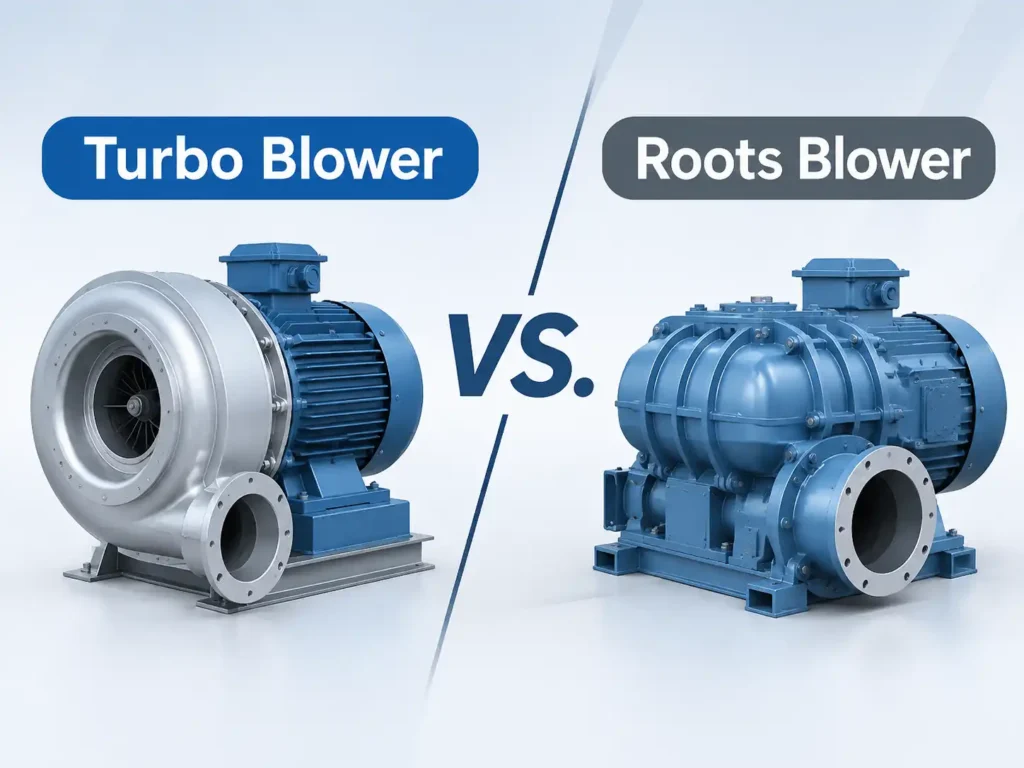
Most compressed air systems are still assembled the hard way: a compressor from one supplier, a dryer from another, a tank from a third, then someone makes the three fit into the floor space left. That assembly work is where budgets slip and wet air problems start, because the dryer is usually chosen on price rather than on real compressor output.
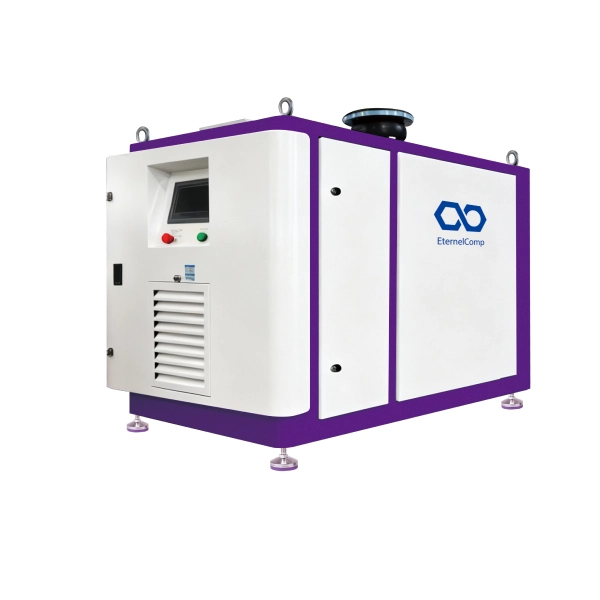
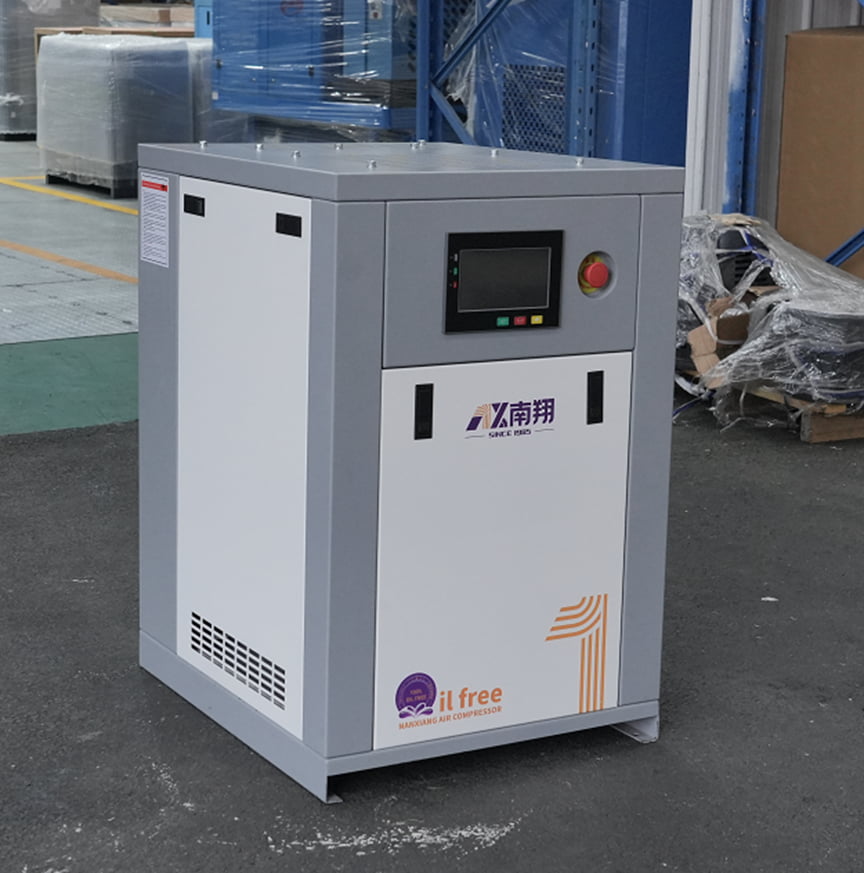
A 3-in-1 integrated screw air compressor puts the screw airend, the air dryer and the receiver tank on one base under one controller, so it arrives matched, wired and ready to run. It wins on footprint, installation speed and a dew point that holds because the dryer was matched to actual compressor flow. It loses on purchase price, expansion flexibility and single-point failure risk.
This guide covers how the package works, what it saves, where it costs more, and which operations should buy one.
What Is a 3-in-1 Integrated Screw Air Compressor?
It is a single skid-mounted assembly that combines three functions once bought separately: compression, drying and storage. The label is literal, and it separates the package from a 2-in-1 unit that pairs a compressor with a tank but leaves drying to a separate machine.
That distinction decides whether the air is usable. A 2-in-1 unit delivers saturated air that condenses in the piping as soon as it cools, the root cause of most corrosion and finish defects in small plants. Keeping drying inside the enclosure also shortens the air path, so pressure loss is lower.
| Component | Function | What integration changes |
| Screw airend | Compresses ambient air to line pressure | Sized with the dryer, so flow ratings match |
| Aftercooler | Condenses bulk water from discharge air | Shares cooling air with the package |
| Dryer | Removes remaining vapor to a target dew point | Rated against real output, not a guess |
| Receiver tank | Buffers spikes and stabilizes header pressure | Volume matched to duty cycle |
| Filters and controller | Strip oil mist, drain condensate, coordinate alarms | Plumbed and tested as one assembly |
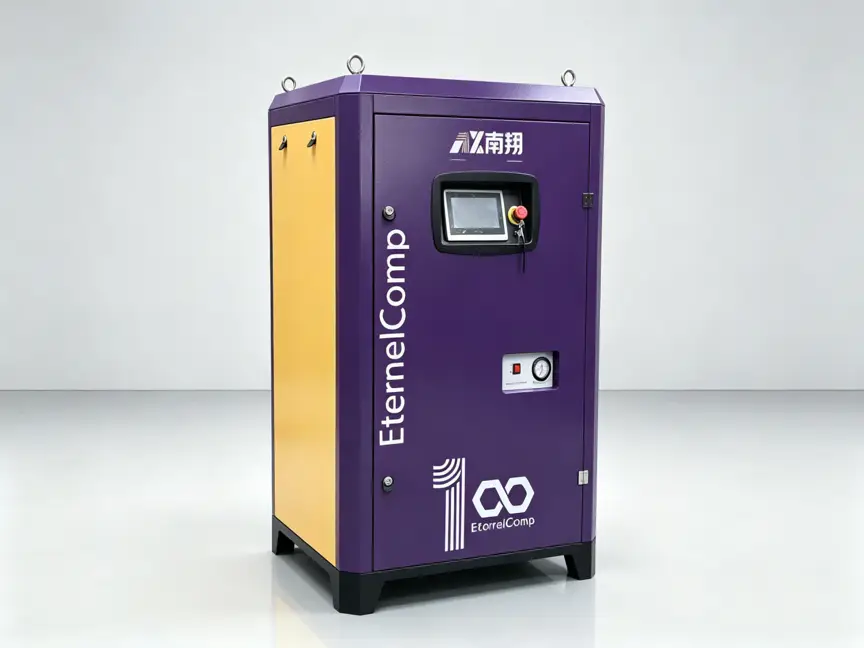
A compact 3 in 1 integrated screw air compressor is usually built around a sound-attenuated cabinet, which is why catalogs also call these units all-in-one or packaged stations.
How the Three Stages Work Together
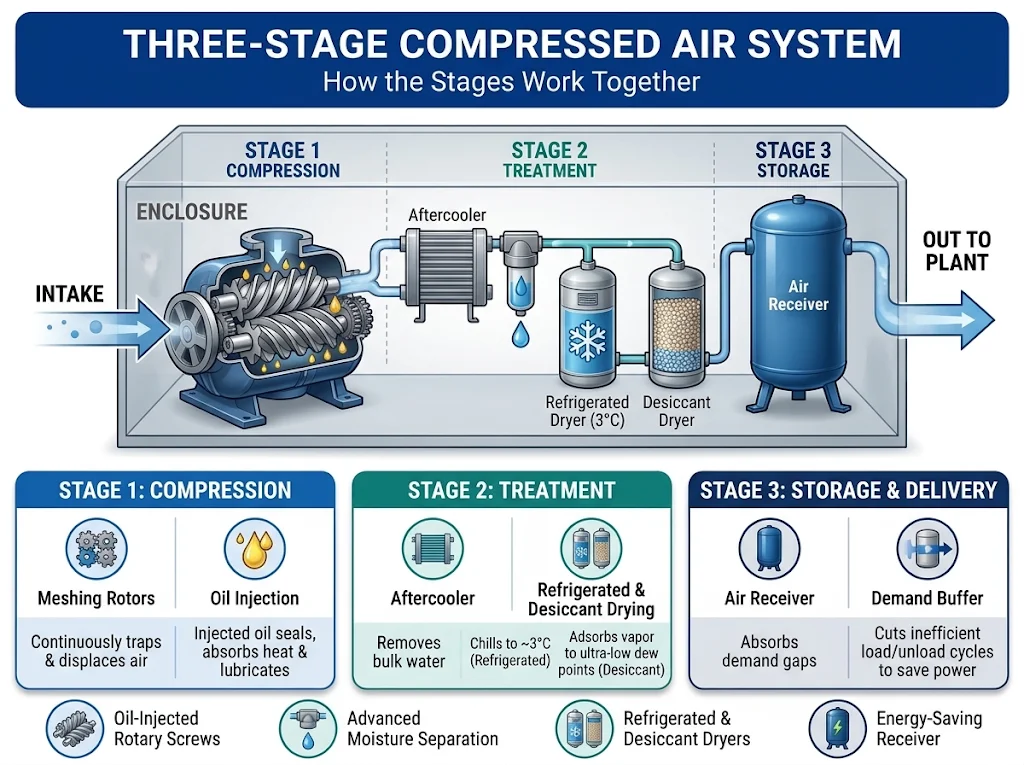
Air moves through the package in one direction and never leaves the enclosure: intake, compression, aftercooling, moisture separation, drying, storage, then out to the plant. That short closed path is the engineering reason the format performs consistently.
Meshing rotors trap a volume of air, carry it along the rotor length and discharge it continuously. Injected oil seals clearances, absorbs heat and lubricates bearings, which is why oil-injected screws hold lower specific power than dry-running designs at industrial pressures.
The aftercooler removes bulk water by cooling the air, but the remaining vapor still saturates it, so the dryer takes over: refrigerated drying chills air to roughly 3 degrees C, while desiccant drying adsorbs vapor to far lower dew points. The receiver then absorbs the gap between intermittent demand and compressor response, cutting the load and unload cycles that burn power without producing air.
Pros: What You Actually Gain
The gains are practical: less floor space, hours instead of weeks to commission, fewer leak points, and air quality that does not drift as the machine ages. For a shop that needs air this quarter, they usually outweigh the price premium.
Smaller Footprint and Faster Commissioning
Three machines need three footprints, three power connections and piping between them. A packaged unit needs one base, one feed and one outlet, which decides the question where floor area carries rent.
Matched Components and a Stable Dew Point
Because the dryer is selected against rated flow at a stated inlet condition, the unit avoids the mismatch where a 30 kW compressor feeds a dryer rated for 20 kW of air. Dew point holds its band instead of rising with load.
Lower Pressure Drop and Fewer Leak Points
Every joint and filter housing between components is a potential leak and a permanent pressure loss. Short internal runs let the compressor hold header pressure at a lower setpoint, and lowering setpoint is among the cheapest efficiency measures available.
One Supplier, One Warranty, One Schedule
When something fails, nobody argues about whether the fault sits with the compressor or the dryer. That accountability matters in plants without an in-house maintenance team.
Cons: The Trade-Offs You Should Accept Before Buying
The honest disadvantages of a screw compressor in packaged form are cost, rigidity and risk concentration. It costs more per kilowatt than three budget components, it cannot be expanded piece by piece, and every function depends on one enclosure staying healthy. Part-load efficiency also suffers if the machine is oversized.
Higher Unit Price Than Mixing Budget Components
Precision rotors, a matched dryer and a certified receiver cost more than three cheap alternatives. The justification is installed and running cost, and that argument holds only when the unit is sized correctly.
Limited Headroom and Awkward Expansion
A split system lets a plant upsize the dryer alone or add a receiver as demand grows. A 3-in-1 unit expands by adding another skid, duplicating capacity rather than extending it.
One Failure Stops the Whole Air Supply
Sharing an enclosure means sharing a fate. A dryer fault, blocked drain or controller failure can take the compressor offline with it, while a split system might still deliver undried air as a stopgap.
Part-Load Loss and Tighter Service Access
An unloaded screw compressor still draws much of its full-load power while producing nothing, so an oversized unit can waste more in energy than the price gap it saved. Enclosures also trade service access for noise control, so ignoring clearances means late service and early overheating.
3-in-1 vs a Traditional Split System
Neither format is universally better. The integrated unit removes decisions and installation risk; the split system preserves flexibility and independent servicing. The answer turns on whether speed and air quality matter more than long-term configurability.
Most plants running oil-injected machines find the packaged format covers their range, since oil-lubricated rotary screw air compressors dominate general manufacturing duty.
| Factor | 3-in-1 integrated unit | Split system |
| Floor space | One base, often wall-adjacent | Three or more footprints |
| Installation | Hours to days | Weeks of piping and wiring |
| Purchase price | Higher per unit | Lower per component |
| Installed cost | Lower overall | Higher once labor counts |
| Dew point consistency | Designed in | Depends on matching |
| Expansion | Add a skid | Upsize individual pieces |
| Redundancy | None inside the package | Spares can stay online |
A split system stays better for a plant with a ten-year capacity plan, an existing dryer room, or a need to keep air flowing during service.
Common Problems with Screw Compressors in Integrated Units
The failures that matter in packaged units are the ones the enclosure makes worse: heat that cannot escape, water with nowhere to drain, and oil that saturates a separator sooner than the service interval assumes.
| Symptom | Likely cause | Fix |
| High discharge temperature | Recirculated hot air, blocked cooler fins | Duct inlet and exhaust, clean the coil |
| Water reaching tools | Dryer overloaded by hot inlet air, failed drain | Check dryer rating at real inlet temperature |
| Oil in the lines | Saturated separator element | Replace at interval, check differential pressure |
| Frequent load and unload | Tank too small for the demand pattern | Add storage, not compressor capacity |
| Condensate in the lubricant | Short cycling, machine stays cold | Correct sizing, widen load bands |
| Nuisance controller trips | Voltage dip on start, loose terminals | Check supply capacity and starting method |
Overheating is the most common complaint. An enclosure breathing its own exhaust runs hot regardless of ambient, and the dryer beside it inherits that heat.
Choosing the Right Dryer Inside the Package
Refrigerated drying covers most industrial needs at a pressure dew point near 3 degrees C, while desiccant drying is reserved for processes that cannot tolerate condensation. The choice follows the required air quality class, not the option price.
ISO 8573-1 defines purity in three digits for particles, water and oil, and the water digit is pressure dew point at operating pressure, not atmospheric dew point. Specifying a dew point without saying which one is a common purchasing error, and the ISO 8573-1 classification removes the ambiguity.
| Water class | Pressure dew point | Typical dryer | Typical use |
| 1 | -70 degrees C | Desiccant | Instruments, breathing air |
| 2 | -40 degrees C | Desiccant | Pharma, electronics, critical pneumatics |
| 3 | -20 degrees C | Desiccant or membrane | Cold climates, outdoor lines |
| 4 | +3 degrees C | Refrigerated | General industrial, pneumatic tools |
| 5 | +7 degrees C | Refrigerated | Utility air, non-critical duty |
Two traps catch buyers. Dryer capacity is quoted at a reference inlet temperature, so a unit rated for 45 degrees C delivers far less flow at 60 degrees C. The dryer must also be rated above compressor output, because fouled filters and summer ambient erode margin. A matched air compressor dryer removes that calculation, but only when the specification states its rating conditions.
Sizing the Compressor, Dryer and Tank
Sizing starts with the tools, not the catalog. Add the flow of every device that can run at once, apply a margin for leakage and growth, then set pressure from the highest-pressure tool in the plant. Tank volume follows duty cycle rather than compressor size alone.
A practical flow estimate is total tool consumption multiplied by 1.3 to 1.5. That margin covers leakage, which the U.S. Department of Energy has estimated at 20 to 30 percent of output in poorly maintained plants. Pressure should come from the highest requirement plus line losses, since raising header pressure to compensate for undersized piping wastes energy everywhere.
Tank sizing follows a proportional rule: gallons of storage roughly equal output in CFM multiplied by 1 for light duty and 2 to 3 for continuous duty. In metric terms, litres approximate output in cubic meters per minute multiplied by 60 to 100. The air receiver tank inside a packaged unit is matched to that math at the factory.
Best Use Cases for a 3-in-1 Integrated Screw Air Compressor
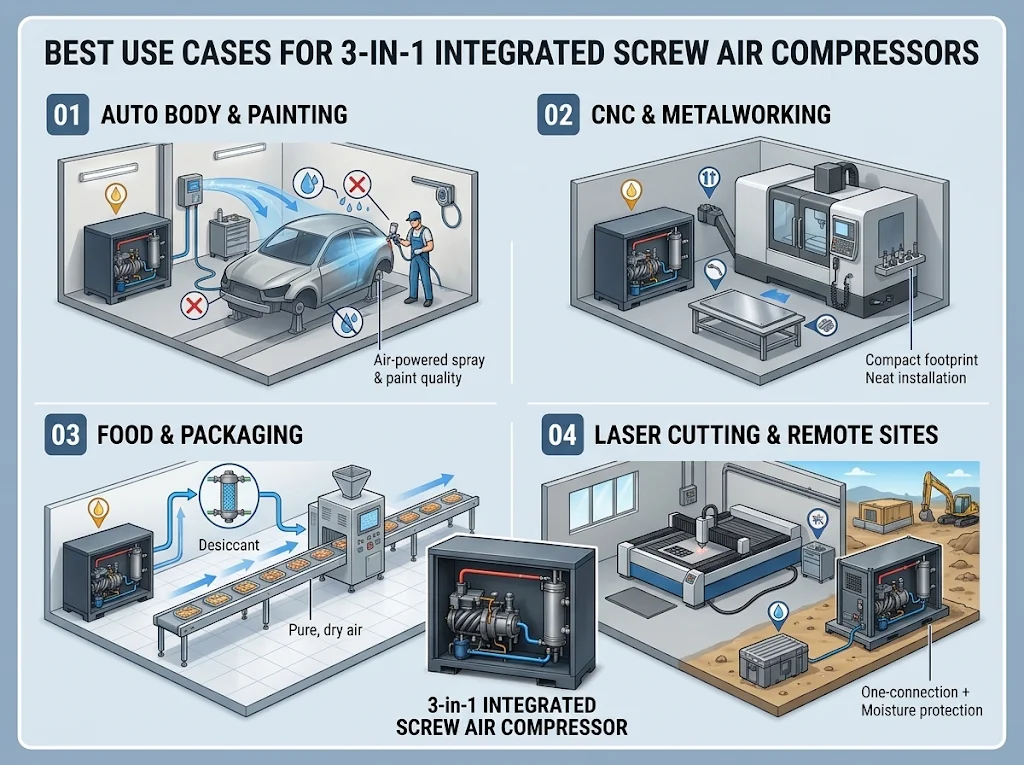
The format fits operations with limited floor space, intermittent to two-shift demand and a genuine need for dry air. It is at its best where one compact station serves the whole process and installation speed matters more than configurability.
Auto Body, Paint and Refinishing
Paint defects trace back to moisture and oil far more often than to pressure. A refrigerated dryer with coalescing filtration in one cabinet gives a body shop dry air without a separate dryer room.
CNC Shops and Metalworking Cells
Machine tools, blow-off and tool changers want steady pressure at modest flow. A unit against a wall serves a cell without consuming production floor.
Food, Beverage and Packaging
Filling and packaging lines need continuous, predictable air, and any product contact raises the purity requirement. These installations usually specify desiccant drying and filtration to a defined class.
Laser, Plasma and Remote Sites
Assist gas quality shapes cut edge quality, and moisture drives inconsistent cuts and consumable wear. Skid-mounted packages also suit construction, rental fleets and containerized plants that need one connection and no on-site assembly.
| Application | Flow range | Dryer type | Why the package fits |
| Auto body and paint | 15 to 30 CFM | Refrigerated | Dry air, small footprint |
| CNC and metalworking | 20 to 50 CFM | Refrigerated | Steady pressure for tools |
| Food and packaging | 30 to 80 CFM | Desiccant | Defined purity class |
| Dental and laboratory | 5 to 20 CFM | Desiccant | Low dew point, quiet |
| Rental and remote sites | 50 to 200 CFM | Refrigerated | Fast deployment, one skid |
Where a 3-in-1 Unit Is the Wrong Choice
Packaged units stop making sense when a plant needs redundancy, very high flow, or purity beyond what one integrated dryer can hold. Forcing the format into those cases produces a system that is expensive to run and hard to service.
Cases to avoid it include three-shift operation above roughly 200 kW where N+1 redundancy is mandatory, processes requiring Class 1 oil content that depend on dedicated downstream filtration, discharge pressures above the standard package range, and hazardous areas needing certified explosion protection.
Installation and Maintenance Essentials
Most packaged-unit problems are installation problems. Give the unit cool inlet air, a clear exhaust path and a service front, and it will reach its design life. Starve it of ventilation and the dryer, cooler and lubricant all suffer at once.
Keep the enclosure out of dead corners where exhaust recirculates, hold the manufacturer’s clearance in front of service panels, and protect drains from freezing. Compressed air is an expensive utility and system efficiency is far lower than operators assume, as the U.S. Department of Energy compressed air guidance sets out.
| Interval | Task |
| Daily | Check drains, note pressure and temperature |
| Weekly | Clean intake screens, listen for abnormal noise |
| Quarterly | Inspect or replace intake filter |
| Six months | Test dew point, inspect dryer and separator |
| Annually | Full service, check couplings and terminals |
What to Check Before You Buy
The specification sheet decides whether the package performs. Insist on written values for dew point, dryer rating conditions and noise, and confirm that service access and spare parts are realistic for your site.
- Pressure dew point stated in writing, with the ISO 8573-1 class it satisfies.
- Dryer flow rating at actual inlet temperature and ambient, not at reference conditions.
- Receiver certification to the pressure vessel code for your market.
- Fixed or variable speed drive, matched to how much demand actually swings.
- Sound pressure level in dBA at a stated distance, measured rather than estimated.
- Recommended clearances and the floor space they demand.
- Consumables list with part numbers, lead times and local stock.
Frequently Asked Questions
Can a 3-in-1 unit be installed outdoors or in an unheated room?
Only if the package is specified for it. Refrigerated dryers and condensate drains are the vulnerable parts, because trapped water freezes and splits tubing, and a frozen drain blocks removal until the dryer floods. Outdoor installations need weatherproofing, drain trace heating and a refrigerant circuit rated for low ambient.
Can I add a second receiver or a second unit later?
Yes, for different reasons. A remote receiver is the cheapest way to stop load and unload cycling when demand is bursty, since storage costs far less than compressor capacity. A second packaged unit buys redundancy as well as capacity, which is usually the better path once a plant outgrows its first machine.
How much noise should I expect from an enclosed 3-in-1 package?
Enclosed screw packages commonly run in the low to mid 60s dBA at one meter, quiet enough for a workshop where people talk at normal volume. Actual figures depend on enclosure design, fan and load point, so ask for a measured value at a stated distance rather than a generic claim.