
A Quick Visual Guide
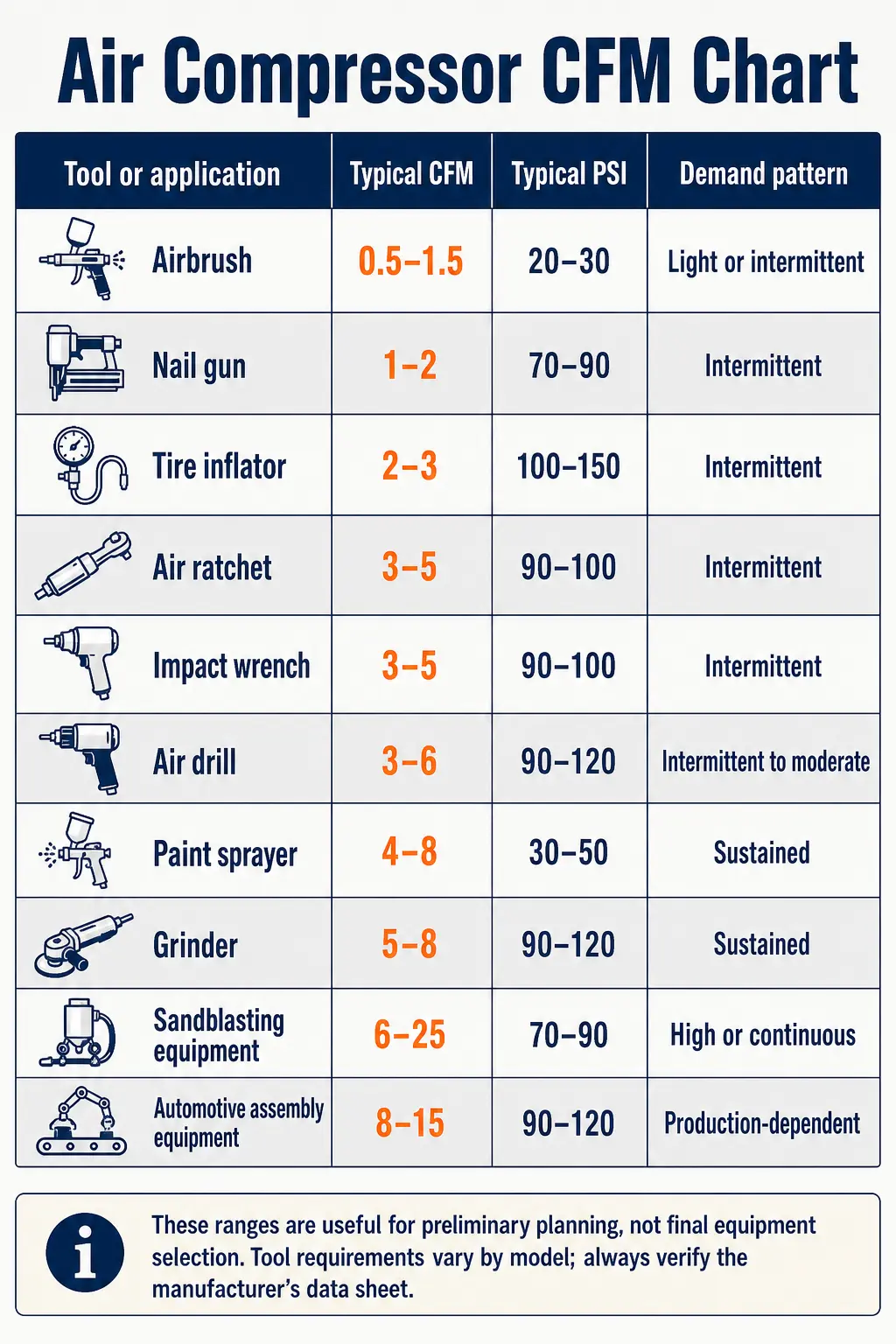
Air Compressor CFM Chart by Common Tool Type
A chart is most useful when it connects the machine to the job. The numbers below are general planning values, not exact rules, but they are close enough to guide realistic selection.
| Tool or Application | Typical CFM Requirement | Notes |
|---|---|---|
| Tire inflator / blower | 1–3 CFM | Short-duty applications with low airflow demand |
| Brad nailer / finish nailer | 0.5–2 CFM | Uses short bursts of compressed air |
| Stapler | 0.5–2 CFM | Suitable for small portable compressors |
| Airbrush | 0.5–2 CFM | Requires stable airflow rather than high volume |
| Ratchet wrench | 3–6 CFM | Intermittent automotive and maintenance use |
| Impact wrench | 5–10 CFM | Higher airflow needed for repeated fastening |
| Die grinder | 5–10 CFM | Continuous operation requires more airflow |
| Drill | 4–8 CFM | Depends on drilling speed and material |
| Cut-off tool | 6–10 CFM | Frequent use increases airflow demand |
| HVLP spray gun | 8–15 CFM | Requires consistent airflow for coating quality |
| Orbital sander | 8–15 CFM | Continuous operation consumes significant air |
| Sandblaster | 15–40+ CFM | Requires high-capacity compressors for efficient blasting |
Light-duty tools
Light-duty tools are the easiest to serve, and most smaller garage compressors can handle them without drama. Nailers, staplers, inflators, and airbrushes usually need only modest airflow. Even so, pressure consistency still matters. A compressor can technically meet the numbers yet feel weak if the regulator or hose setup creates restriction.
Common examples include:
- Brad nailers
- Finish nailers
- Tire inflators
- Airbrush systems
- Small blow-off tasks
These tools rarely need a huge tank. They do, however, benefit from a compressor that recovers quickly after each burst.
Mid-range tools
This is where many buyers start to underestimate demand. Ratchets, impact wrenches, drills, and die grinders may not sound extreme, but repeated use changes the picture. A tool that seems easy on paper can become air-hungry during longer work sessions.
If the job is occasional wheel removal or light fabrication, a mid-size compressor may be enough. If the tool is used continuously, the airflow requirement rises fast. A compressor that barely meets the listed number often feels underpowered in the shop.
High-demand tools
Sanders, spray equipment, and sandblasters are where the chart becomes especially important. These tools are not just hungry; they are often sensitive to pressure instability. A momentary drop can affect finish quality, cutting speed, or blasting consistency.
For this reason, buyers usually need to size well above the bare minimum. A compressor that works for a few seconds at a time may fail badly in applications that need sustained delivery.
What CFM Means in an Air Compressor
CFM stands for cubic feet per minute. In plain language, it describes how much air a compressor can deliver over time. For most buyers, that is the number that tells the truest story about performance. A compressor with a big tank but weak airflow may still run out of usable air quickly when a demanding tool starts working continuously.
Why CFM matters more than tank size in many cases
Tank size stores air, but CFM replenishes it. That difference is easy to miss. A large tank can help a compressor handle short bursts, such as firing nails or inflating tires, but it does not automatically make the machine stronger.
A useful way to think about it:
- Tank size = air reserve
- CFM = refill speed
- PSI = delivery pressure
For tools that cycle on and off, tank capacity can feel important. But for anything with steady demand, the compressor’s airflow becomes the real bottleneck. That is why many owners discover that a “large” unit still struggles with sanders, grinders, or paint guns.
How manufacturers measure CFM
This is where buyers often run into confusion. Compressor ratings can be listed at one pressure level, while the tool may need another. Some brands also advertise peak performance rather than sustained output, which can make the numbers look better than they feel in practice.
Industry resources such as Atlas Copco explain that CFM is tied to pressure and operating conditions, not just a raw label on the box. In other words, a compressor’s real-world usefulness depends on how the air is delivered under load, not just the headline number. The U.S. Department of Energy also notes that compressed air systems lose efficiency through pressure drops, leakage, and poor sizing, which is why margin matters more than optimism.
How to Read an Air Compressor CFM Chart the Right Way
A chart should not be read as “match the number exactly and you are done.” That approach often leads to frustration. The better method is to compare tool demand to compressor output and then add a safety cushion.
Match tool CFM to compressor output
A practical rule is to choose a compressor that delivers more CFM than the tool requires at the pressure the tool actually uses. For casual work, a modest buffer may be enough. For frequent or continuous use, a larger margin is smarter.
A simple method:
- Find the tool’s required CFM
- Check the compressor’s rated CFM at the same pressure
- Add 25% to 30% for headroom
- Increase the margin if the tool is used continuously
That extra margin helps cover hose losses, aging components, and the reality that published numbers are not always identical to field performance.
Consider duty cycle and continuous use
Duty cycle is easy to overlook and hard to ignore once the compressor starts heating up. Some machines are meant to run briefly, rest, and then cycle again. Others are designed for longer operation. The problem is that tool demand often outlasts the machine’s comfort zone.
Intermittent vs continuous demand
Intermittent tools such as nailers and inflators consume air in short bursts. Continuous tools such as grinders, spray guns, and sanders draw air almost all the time they are active. That difference changes sizing dramatically.
A compressor might appear adequate for a quick burst test, yet still fail during an actual job. This is why professionals tend to size for workload, not just for the most flattering scenario.
CFM vs PSI vs Tank Size: What Actually Matters Most?
Each factor matters, but not in the same way.
| Factor | What It Does | Why It Matters |
|---|---|---|
| CFM | Measures airflow delivery | Often the main limiter for tool performance |
| PSI | Measures pressure | Needed to run the tool at the proper force |
| Tank size | Stores compressed air | Helps with short bursts and cycling |
PSI tells you how hard the air is being pushed. CFM tells you how much of it is arriving. Tank size tells you how long the compressor can coast before pressure drops. In most real-world situations, CFM is the most decisive factor for selecting an Air Compressor.
A compressor with high PSI but low airflow may still fail to keep up with a demanding tool. A bigger tank can delay that failure, but it cannot remove it. That is why the smartest purchases balance all three numbers rather than chasing only one.

Choosing the Right Air Compressor for Different Applications
Different jobs create different loading patterns. There is no single “best” compressor, only the best fit for the workload.
Home garage and DIY use
For basic maintenance, tire inflation, trim work, and occasional fastening, a smaller unit may be enough. The main thing is to avoid buying a compressor that looks appealing on tank size alone but cannot recover fast enough after each cycle.
A home user usually benefits from:
- Moderate CFM output
- Reasonable portability
- Stable pressure control
- Low maintenance demands
Auto repair and mechanic work
Vehicle service often requires more than people expect. Impact wrenches, ratchets, air hammers, and occasional grinders can push a compressor hard, especially in a busy shop. If tools are used back-to-back, a stronger CFM rating becomes much more important than a large storage tank.
For mechanic work, the better compressor is often the one that can maintain output through repeated use, not the one that only performs well on paper.
Painting and finishing
Painting is particularly unforgiving. A spray gun may not require massive PSI, but it often needs steady airflow without moisture spikes or pressure wobble. That makes the system design just as important as the compressor itself.
Moisture control becomes critical here. For shops that paint often, pairing the compressor with compressed air dryers can make a noticeable difference in finish quality and consistency. That step is easy to skip, but expensive to ignore later.
Industrial or high-volume use
For production environments, the chart becomes only one part of the sizing decision. Multiple users, simultaneous tools, long run times, and air quality requirements all stack together. A compressor that works for one bench can collapse under shared demand.
In those settings, planning for peak load is safer than planning for average load. Average demand sounds reasonable until several tools start at once.
Oil-Lubricated or Oil-Free: Which Compressor Fits Better?
The choice between oil-lubricated and oil-free models usually comes down to maintenance tolerance, noise sensitivity, and air purity needs. Both can be useful, but they serve different priorities.
Many buyers researching durability and general workshop use lean toward Oil-Lubricated Air Compressors because they are often associated with longer service life and smoother operation in demanding environments. They usually fit shops where maintenance is acceptable and long-term use matters.
Oil-Free Compressors, on the other hand, are often attractive when lower maintenance or cleaner air output is a priority. They can be a sensible choice for users who want simpler upkeep or need to reduce the risk of oil contamination.
A quick comparison:
- Oil-lubricated: often better for heavy use, durability, and workshop longevity
- Oil-free: often better for convenience, cleaner output, and lower maintenance
The “better” option depends on the job, not just the spec sheet. For industrial or frequent use, many experienced users still prefer the steadier feel of lubricated systems. For lighter or more cleanliness-sensitive work, oil-free can be the easier route.
Why Air Treatment Can Matter More Than Expected
Compressed air is not just air. It can contain moisture, oil carryover, and particles from the system. That is usually harmless for some tasks and highly disruptive for others.
Painting, instrumentation, and sensitive pneumatic equipment are especially vulnerable. Moisture can create fisheyes in paint, interfere with valves, and shorten the life of downstream components. The U.S. Department of Energy also highlights that inefficient compressed air systems often suffer from poor preparation and unnecessary losses, not just inadequate compressor size.
So even if the airflow numbers look perfect, the air quality may still be wrong for the application. In practical terms, that means a correctly sized compressor can still underperform if the air is not dried and filtered well enough.
Common Mistakes When Using a CFM Chart
A chart is only useful if it is used carefully. These are the most common mistakes that show up again and again:
- Choosing by tank size alone
- Ignoring the tool’s rated pressure
- Forgetting to add a safety margin
- Overlooking hose length and fitting restrictions
- Using peak output instead of sustained output
- Assuming one compressor can serve every tool equally well
Pressure drop is especially easy to forget. The longer the hose, the more restriction builds in the system. Fittings, quick-connects, and bends also reduce delivery. That means a compressor can appear adequate in theory while struggling at the tool end.
A quick selection checklist
Before buying, it helps to ask:
- What is the tool’s actual CFM requirement?
- At what PSI does that tool operate?
- Is the tool intermittent or continuous?
- How many tools may run at once?
- Is air quality important for the job?
- Will the system need room to grow later?
That checklist often prevents the classic mistake of buying too small and trying to “make it work.”

Practical Sizing Examples
Sometimes examples make the chart easier to apply.
| Use Case | Good Starting Point | Why |
|---|---|---|
| Tire inflation and trim work | Small portable compressor | Low demand, short bursts |
| DIY nailers and staplers | Light-duty unit with quick recovery | Intermittent use |
| Auto repair basics | Mid-size compressor with buffer margin | Repeated tool cycling |
| Spray painting | Higher CFM with moisture control | Stable flow and cleaner air |
| Sandblasting | High-output system | Very demanding continuous load |
These are only starting points, but they reflect the way compressor sizing usually works in practice. A setup that looks oversized for one job may be only barely adequate for another.
Final Thoughts
An Air Compressor CFM Chart is most useful when it is treated as a sizing tool, not just a reference table. The best choice usually comes from understanding the real air demand of the tool, not the most attractive spec on the box. CFM tells the truth more often than tank size does, and pressure only matters when the airflow is there to support it.
For small tools, a modest compressor may be perfectly fine. For spraying, sanding, grinding, and multi-tool use, the safer path is usually to size up and leave room for recovery. That extra capacity tends to pay for itself in fewer interruptions, better tool performance, and less frustration overall.
If needed, the next step can be a simple visual guide that makes compressor sizing even easier.
Would you like a flowchart or infographic prompt to visually explain this air compressor CFM chart?
FAQ
How much extra CFM should be added when sizing a compressor?
A common practical buffer is about 25% to 30% above the tool’s listed requirement. For continuous use or multiple tools, a larger margin is usually safer.
Can a larger tank compensate for low CFM?
Only for short periods. A large tank can delay pressure drop, but it cannot keep up with a tool that continuously consumes more air than the compressor can deliver.
Why does compressor performance drop over time?
Wear, leaks, dirty filters, moisture buildup, and pressure losses in hoses or fittings can all reduce effective output. Even a well-sized compressor may feel weaker if the system is not maintained.