Air Receiver Tank Size Calculator
Calculate the required compressed air storage capacity based on peak demand, duration, and operating pressure range.
Enter the net air demand that must be supplied by the receiver.
How long the receiver needs to support peak air demand.
Upper pressure limit of the receiver.
Lowest acceptable system pressure.
This rule-of-thumb range provides a preliminary storage estimate based on compressor output. It is not a substitute for demand-based sizing.
Formula: V = t × C × Pa / (P1 − P2). Time is converted to minutes, and atmospheric pressure is assumed to be 14.7 psia. Results represent theoretical minimum storage capacity under the specified conditions. Actual receiver selection should also consider compressor operation, pressure losses, demand fluctuations, and applicable pressure vessel standards.
The Air Receiver Tank Size Calculator Formula
To calculate the correct receiver tank size, use the storage formula V = t x C x Pa / (P1 – P2). Multiply the required demand in CFM by the length of the demand event in minutes and by atmospheric pressure in psia, then divide by the difference between the maximum and minimum acceptable system pressure. The result is the tank volume in cubic feet, which converts to gallons by multiplying by 7.48.
This is the same relationship behind a standard Air Compressor CFM Calculator for airflow demand, applied in reverse: instead of asking how much air a system consumes, it asks how much volume must be held in reserve to cover that consumption without letting pressure fall below the acceptable limit.
The Formula and Its Variables
Each variable in the equation has a specific role, and misreading any one of them is the most common source of a badly sized vessel.
| Variable | Meaning | Unit | Notes |
| V | Receiver tank volume | cubic feet | Multiply by 7.48 to convert to US gallons |
| t | Duration the tank must carry demand alone | minutes | Use the measured length of the peak event, not a rounded-up guess |
| C | Free air demand | CFM | Take the demand at working pressure, not nameplate maximum |
| Pa | Atmospheric pressure | psia | 14.7 psia at sea level, always absolute |
| P1 | Maximum tank pressure | psia | Compressor cut-out pressure |
| P2 | Minimum acceptable pressure | psia | Compressor cut-in pressure or the minimum a tool needs |
Three details matter more than the arithmetic itself:
- Pa is always absolute. Use 14.7 psia at sea level. If P1 and P2 are both entered as gauge pressure, the differential P1 – P2 is unchanged, so the result is still valid as long as Pa in the numerator stays absolute.
- C is a flow at a stated pressure. A rating such as 4 CFM at 90 PSI means the compressor delivers four cubic feet of free air every minute while holding 90 PSI in the line. That rating is the starting point for sizing, but real demand over an event is usually lower, because tools are rarely held open continuously for a full minute.
- Pressure differential drives usable storage. The gap between P1 and P2 is what makes stored air available. A narrow band means only a thin slice of the tank contents can be drawn before the compressor reloads.
Worked Example
A simple test case makes the arithmetic concrete. For a small factory, the starting point is usually an overall Air Compressor sizing assessment, and the receiver volume follows from it.
Consider a system with a mean air consumption of 20 CFM, a compressor cut-out at 175 PSI, and a minimum acceptable pressure of 90 PSI, where the demand event lasts one minute. Rearranged to solve for volume:
V = (t x C x Pa) / (P1 – P2)
V = (1 minute x 20 CFM x 14.7 psia) / (175 – 90)
V = 294 / 85 = 3.46 cubic feet
Converting to gallons: 3.46 x 7.48 = approximately 26 gallons. A commercially available 30-gallon receiver covers this case with a small margin.
Now take a case where demand exceeds compressor output. A system has a 40 CFM compressor running at 110 PSIG, and an intermittent process needs 50 SCFM at 80 PSIG for five minutes. Because the compressor contributes to the load, the effective deficit is C minus compressor capacity:
V = (5 x (50 – 40) x 14.5) / (110 – 80)
V = 725 / 30 = 24.2 cubic feet, or roughly 181 gallons.
Both examples use the same equation. The only change is whether the compressor’s own output is subtracted from demand. Use the simple form when the event is short enough that the compressor cannot meaningfully contribute, and the deficit form when the compressor runs continuously during the event. A unit conversion reference is often needed at this stage, particularly when tanks are specified in litres rather than gallons or when compressor ratings arrive in m³/min; the Air Compressor Unit Conversion Guide covers those conversions in one place.
The equation rests on a physical principle that predates compressed air systems entirely: the inverse relationship between the pressure and volume of a gas at constant temperature, described by Boyle’s law. Storing air at high pressure and letting it expand into a lower-pressure demand is simply that relationship put to work.
Undersized vs Oversized: Diagnosing Your Tank
An undersized receiver shows itself through behaviour rather than through a calculation: frequent compressor starts, visible pressure swings, and equipment that falters whenever demand rises. An oversized receiver wastes capital and floor space, and can leave air sitting long enough to accumulate condensate. Both conditions are correctable once the symptoms are identified.
| Symptom | Undersized Tank | Oversized Tank |
| Compressor starts per hour | More than 6 | Fewer than 2 |
| Line pressure during peaks | Drops sharply | Stable to the point of over-stability |
| Energy consumption | High, dominated by starting losses | Higher baseline from unnecessary stored volume |
| Condensate management | Frequent drain cycles | Longer residence time, corrosion risk if drains are neglected |
| Capital and space | Low | High |
The clearest single indicator is start frequency. A receiver that allows the compressor to run for less than about 60 seconds per cycle under normal load is not doing its job, and a machine starting more than six times an hour is a strong signal that storage is short. Moving from ten starts per hour to four can reduce compressed air energy costs by a meaningful margin, because each unloaded restart and each motor acceleration carries an efficiency penalty that steady running does not.
Correcting a shortfall does not always require replacing the vessel. Adding a second receiver downstream is often cheaper and also improves redundancy, and widening the pressure band or reducing leakage and artificial demand at the point of use lowers the storage the system actually needs.
Safety and Compliance Considerations
A receiver tank is a pressure vessel, and the codes around it are not optional. Industrial vessels should carry certification to a recognised pressure vessel standard, such as ASME Boiler and Pressure Vessel Code Section VIII, along with a pressure relief valve of the correct certified rating, a working pressure gauge, and accessible drain points. Common causes of vessel failure include over-pressurisation, corrosion and wall thinning, weld cracking, improper repair and relief valve malfunction, all of which are addressed through periodic inspection and disciplined maintenance. Regulatory guidance on pressure vessel safety is published by authorities such as OSHA, and local inspection regimes frequently add their own statutory testing intervals.
Tank Weight and Structural Load
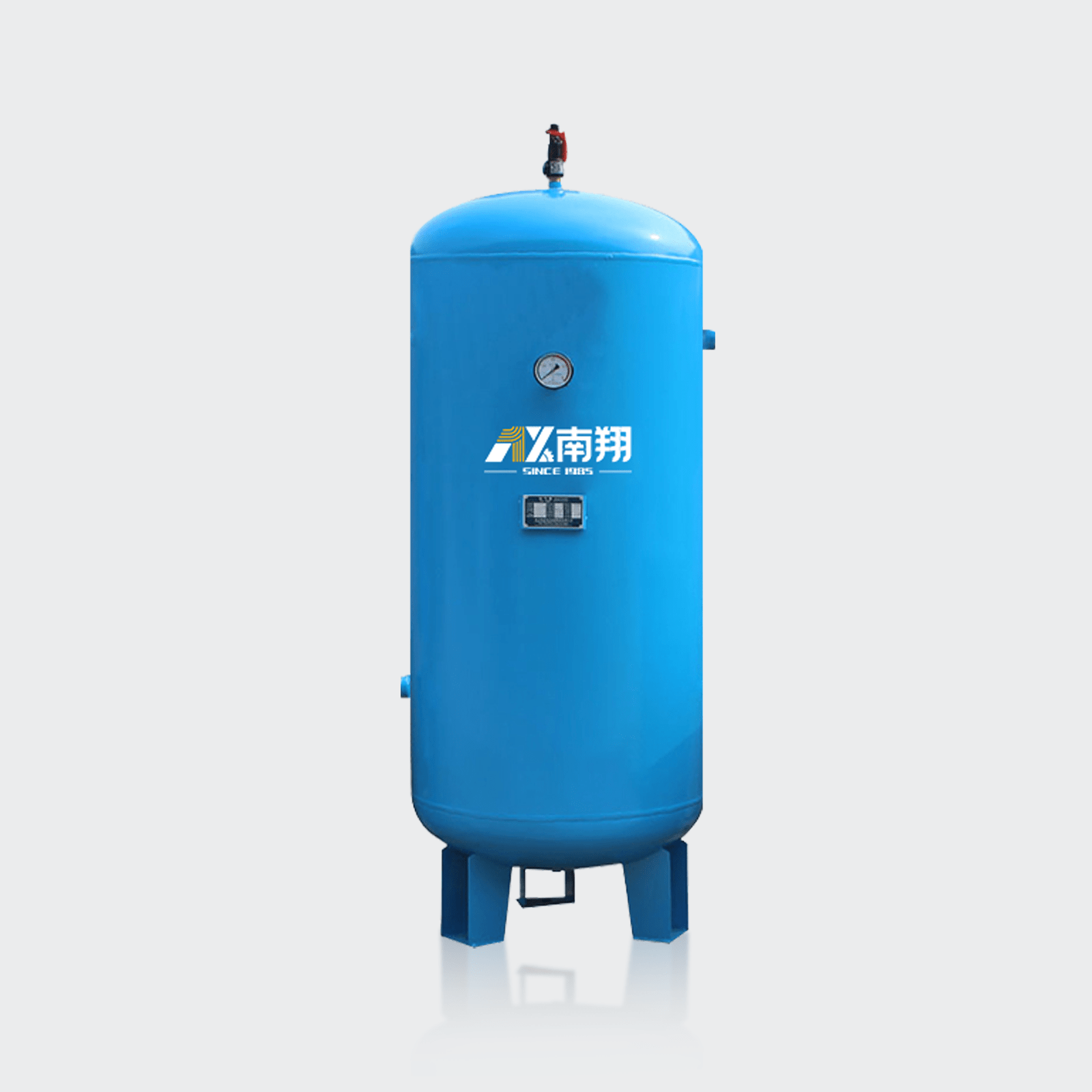
Volume determines weight, and weight determines whether the installation is actually feasible. A 1000 litre vertical receiver typically weighs between roughly 200 and 400 kg when empty, with the exact figure rising with design pressure and wall thickness; a 1000 litre vessel rated for 10 bar commonly falls in the 250 to 360 kg band, while a higher-pressure version of the same volume can weigh considerably more.
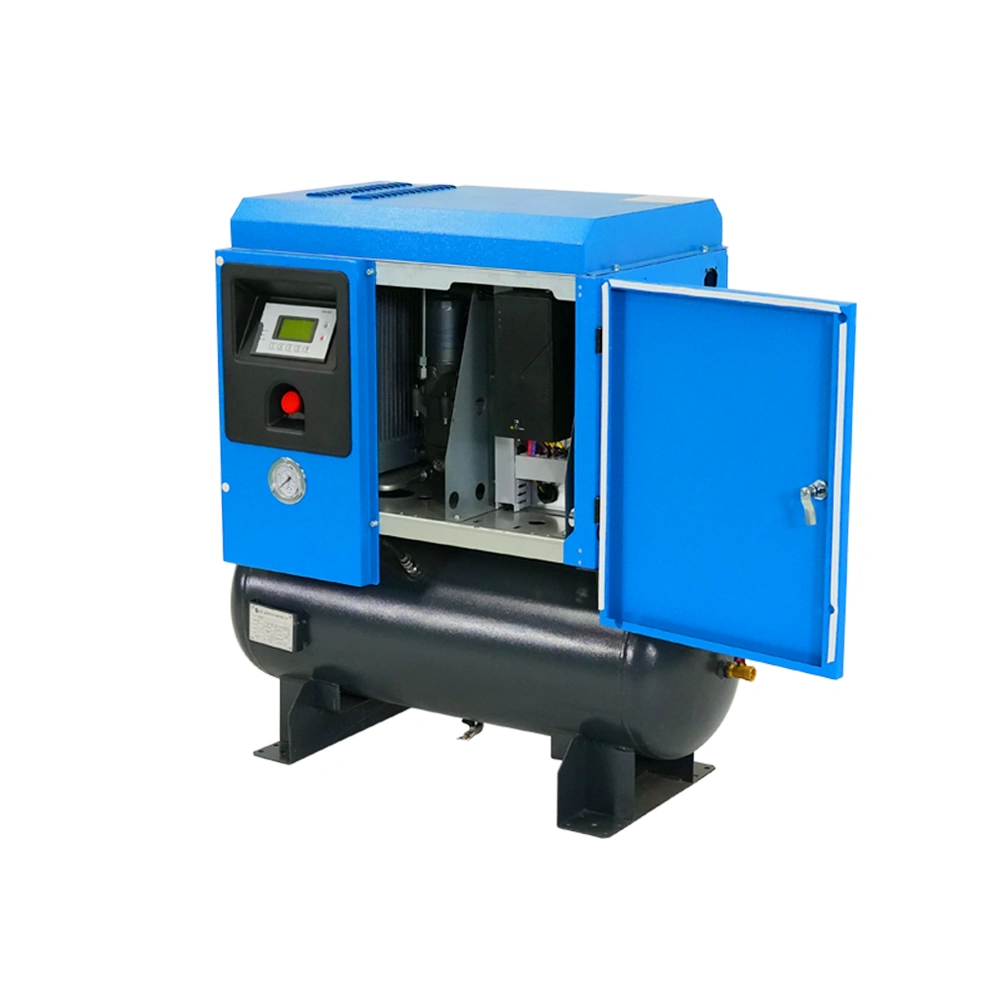
That empty weight is only the beginning of the structural assessment. Add the weight of the water and oil that condense inside, the piping and valves, and any vibration or impact loading, and the total can exceed the empty rating substantially. Before ordering, confirm that the floor or foundation can carry the combined load, that the lifting route and overhead clearance allow the vessel to reach its position, that the entire external surface can be inspected, and that drains, gauges and relief valves remain accessible after installation. Additional storage does not have to mean a larger single vessel; Horizontal Air Tanks suit low headroom and easier maintenance access, while vertical tanks reduce the floor area they occupy.
FAQ
Can I add a second receiver tank instead of replacing my existing one?
Yes, and it is often the better option. Connecting an additional receiver downstream of the primary tank increases total system storage, and placing it near a high-demand workstation reduces pressure drop that would otherwise build up across a long piping run. The second tank needs its own drain and relief protection, and piping between the two should be sized so it does not itself become a restriction. The advantage over replacement is that existing storage is retained and the two vessels can serve different zones of the plant.
How does altitude change the required receiver tank size?
At higher elevations the atmospheric pressure Pa in the formula is lower, so the same tank volume holds less free air and the system needs a larger vessel to achieve equivalent performance. As a working approximation, increase the calculated volume by about three percent for every 1000 feet of elevation above sea level. Sites above roughly 1500 metres should use the actual local atmospheric pressure in the formula rather than the sea-level default, since the difference becomes large enough to change the tank size by a meaningful margin.
Is a bigger tank always better for energy efficiency?
No. Beyond the point where compressor cycling has stopped, additional storage delivers little efficiency benefit and introduces new problems, including extra capital cost, more floor space, and longer air residence time that gives condensate more opportunity to accumulate if drains are neglected. The efficient target is the smallest volume that keeps cycling infrequent and pressure stable during real peak events, with a reasonable allowance for future demand growth rather than an open-ended margin.