
Choosing an Air Compressor by HP seems simple at first: higher horsepower should mean more power, more air, and better performance. In real workshop and factory settings, though, that assumption often causes trouble. A compressor with a big HP number may still fail to keep up if its delivered airflow is too low, while a smaller but properly matched unit may perform much better for the actual job.
The practical answer is this: HP matters, but it should not be the first number used for sizing. A smarter selection starts with air demand, measured in CFM, at the required PSI. Then HP becomes a useful reference for comparing machines in the right capacity range.
This guide explains how to think about horsepower, what numbers matter more, and how to choose an air compressor that fits the real workload instead of just looking impressive on a product label.
What Does HP Mean on an Air Compressor?
HP, or horsepower, describes the power of the motor driving the compressor pump or air end. In general, more horsepower can support more compressed air production. But that does not mean every 10 HP compressor delivers the same airflow, pressure stability, or efficiency.
A compressor is a complete system, not just a motor. Its actual output depends on:
- Compressor design
- Pump or air-end efficiency
- Motor efficiency
- Operating pressure
- Cooling capacity
- Duty cycle
- Control system
- Air treatment and piping losses
That is why two compressors with the same HP rating may behave very differently in daily use.
Horsepower Measures Motor Power, Not Total Air Performance
Horsepower is best understood as the energy available to run the compression process. It does not directly tell how much usable compressed air reaches the tools or machines.
For example, a 5 HP air compressor used for occasional tire inflation may feel powerful enough. The same 5 HP unit may struggle badly with sandblasting or continuous spray painting because those tasks consume a large and steady volume of air.
The more useful performance figure is usually delivered CFM at a stated PSI. CFM tells how much air the compressor can supply, while PSI tells the pressure level at which that air is delivered.
Why HP Ratings Can Be Confusing
HP ratings can be confusing because not all ratings are presented in the same way. Some smaller compressors may emphasize peak horsepower, while industrial compressors are usually rated more conservatively by running horsepower and delivered airflow.
Common sources of confusion include:
- Peak HP vs running HP: Peak power may only occur briefly during startup.
- Displacement CFM vs delivered CFM: Displacement is theoretical; delivered CFM is closer to real usable air.
- Different compressor technologies: Reciprocating and screw compressors may have different performance profiles.
- Pressure variation: A compressor may deliver more CFM at lower PSI and less CFM at higher PSI.
In practical buying decisions, HP should be treated as a guidepost, not the whole map.
The More Important Numbers: CFM, PSI, and Duty Cycle
Before choosing by horsepower, it is better to understand three numbers that shape real compressor performance: CFM, PSI, and duty cycle.
CFM: The Airflow Your Tools Actually Need
CFM stands for cubic feet per minute. It measures the volume of air a compressor can deliver.
Most pneumatic tools list air consumption as CFM at a specific pressure. For example:
- A small nail gun may use air in short bursts.
- An impact wrench may require moderate airflow.
- A spray gun often needs steady airflow.
- A sandblaster can consume a surprisingly high volume of air.
- CNC machines and production equipment may need stable continuous supply.
This is where many buyers make the first mistake. They ask, “What HP air compressor is enough?” when the better question is, “How much CFM is required at the working PSI?”
PSI: The Pressure Your Application Requires
PSI means pounds per square inch. It describes air pressure.
Many shop tools operate around 90 PSI, but not all applications are the same. Some industrial processes, pneumatic controls, and specialized equipment may require higher pressure.
More PSI is not automatically better. Running a system at unnecessarily high pressure can increase energy use, worsen leaks, and create more heat. The U.S. Department of Energy has long noted that compressed air is an expensive utility in industrial plants, so pressure should be managed carefully rather than increased casually.
Pressure loss also matters. Air may leave the compressor at one pressure but arrive at the tool at a lower pressure because of:
- Long piping runs
- Undersized hoses
- Dirty filters
- Dryers and separators
- Poor fittings
- Leaks
- Sharp bends in the piping layout
A compressor should be selected with enough pressure capacity to overcome normal system losses, but not so much that energy is wasted.
Duty Cycle: The Hidden Factor Behind Compressor Life
Duty cycle describes how long a compressor can run within a given time period.
A compressor suitable for intermittent use may run for a few minutes, shut off, cool down, and then restart. This is common in garages and small maintenance areas. But in a production environment, air demand may continue for hours.
When a compressor is forced to run beyond its intended duty cycle, several problems may appear:
- Overheating
- Moisture carryover
- Excessive oil consumption
- Pressure instability
- Faster wear on components
- More frequent maintenance
- Shorter service life
This is one reason horsepower alone can be misleading. A lower-quality high-HP unit may not handle continuous duty as well as a properly designed industrial compressor with the same or even lower HP rating.
Air Compressor HP Guide by Application
The following table gives broad horsepower ranges. These are not strict rules. Actual sizing should always be based on CFM, PSI, simultaneous usage, and duty cycle.
| Use Case | Approximate HP Range | Typical Air Demand | Selection Notes |
|---|---|---|---|
| Home garage | 1–3 HP | Low, intermittent | Good for inflation, cleaning, light tools |
| Tire shop | 3–7.5 HP | Moderate bursts | Tank size and recovery rate matter |
| Auto repair shop | 5–15 HP | Moderate to high | Depends on number of technicians and tools |
| Spray painting | 5–20 HP | Steady airflow | Requires dry, clean, stable air |
| Woodworking shop | 5–15 HP | Variable | Dust, moisture, and tool mix affect selection |
| Small factory | 10–30 HP | High, often continuous | Screw compressors may be more suitable |
| Industrial production | 30+ HP | Continuous and demanding | Requires system-level sizing and air treatment |
1–3 HP Compressors: Light and Occasional Use
A 1–3 HP compressor can work well for light-duty tasks such as:
- Tire inflation
- Cleaning dust from equipment
- Small nailers
- Hobby tools
- Occasional maintenance work
These compressors are usually not designed for high-demand continuous jobs. They may have smaller tanks and limited recovery capacity. For occasional use, that is acceptable. For production, it quickly becomes frustrating.
A common real-world complaint is that the compressor “runs all the time.” This often means the air demand is greater than the compressor’s recovery capability.
5–10 HP Compressors: Workshops and Small Businesses
A 5–10 HP compressor is often used in small shops, repair bays, woodworking areas, and light fabrication settings.
This range may support:
- Impact tools
- Ratchets
- Blow guns
- Tire machines
- Small paint jobs
- General maintenance operations
But the number of users matters. One technician using an impact wrench occasionally is very different from three people using tools at the same time. If several tools run together, total CFM demand rises quickly.
For small businesses, this HP range can be a good fit, but only when the airflow calculation supports it.
15–30 HP Compressors: Growing Production Needs
Compressors in the 15–30 HP range are common in small manufacturing, packaging, textile, CNC, plastics, and assembly operations.
At this level, selection becomes more serious. The compressor is no longer just a utility machine in the corner. It may directly affect production uptime.
Important considerations include:
- Stable pressure during peak demand
- Proper receiver tank sizing
- Moisture removal
- Filtration requirements
- Ventilation and cooling
- Noise level
- Maintenance accessibility
- Future expansion
A growing facility often benefits from selecting slightly more capacity than today’s exact demand, but not so much that the machine runs inefficiently.
30 HP and Above: Industrial Continuous Demand
Compressors rated 30 HP and above are normally used for demanding production environments. These systems may supply multiple machines, shifts, or production lines.
At this stage, choosing by HP alone is especially risky. The better approach is to evaluate the entire compressed air system, including piping, storage, filtration, dryers, controls, and backup requirements.
For continuous operations, energy cost also becomes a major factor. A small difference in efficiency can become significant over thousands of operating hours per year.
How to Calculate the HP You Actually Need
The best way to choose an air compressor is to calculate demand first, then match that demand to a compressor’s rated output.
Step-by-Step Sizing Method
Use this practical method:
- List every air-consuming tool or machine.
Include hand tools, pneumatic cylinders, blow-off stations, packaging equipment, and production machines. - Find each item’s CFM requirement at operating PSI.
Tool manuals, nameplates, or equipment suppliers usually provide this information. - Estimate simultaneous usage.
Do not add every tool if they never run together. But do include tools that may operate at the same time during peak demand. - Add a safety margin.
A margin of 20–30% is commonly used in many practical sizing discussions. The exact margin depends on how critical the application is. - Check the highest required pressure.
The compressor must meet the required PSI after normal pressure drops. - Compare delivered CFM, not theoretical displacement.
Look for rated or actual delivered airflow at the pressure you need. - Use HP as the final comparison point.
Once CFM and PSI are known, horsepower helps compare suitable compressor models.
Example Calculation for a Small Workshop
Suppose a small workshop expects the following simultaneous use:
| Equipment | Required CFM | Operating PSI | Runs at Same Time? |
|---|---|---|---|
| Impact wrench | 6 CFM | 90 PSI | Yes |
| Spray gun | 12 CFM | 40–60 PSI | Yes |
| Blow gun | 5 CFM | 90 PSI | Occasionally |
| Tire inflator | 2 CFM | 90 PSI | No |
During the busiest moment, the impact wrench and spray gun may run at the same time. The blow gun may also be used occasionally.
Estimated simultaneous demand:
- Impact wrench: 6 CFM
- Spray gun: 12 CFM
- Blow gun: 5 CFM
- Total: 23 CFM
Add 25% reserve:
- 23 CFM × 1.25 = 28.75 CFM
So the shop should look for a compressor that can deliver roughly 29 CFM at the required working pressure, not simply a compressor with a certain HP label.
Depending on compressor type and efficiency, that requirement might fall into a particular horsepower range, but the CFM rating should lead the decision.
Why a Safety Margin Helps
A reasonable safety margin helps because real systems are rarely perfect. Tools age, filters clog, hoses leak, and production needs grow.
A margin can help:
- Reduce pressure drops
- Prevent the compressor from running at full load constantly
- Allow modest future expansion
- Improve tool performance
- Support more stable operation
Still, oversizing too much is not ideal. A very large compressor serving a small, irregular demand may short cycle or waste energy unless it has a suitable control method.
Choosing Compressor Type After Estimating HP
Once the approximate airflow and horsepower range are clear, the next decision is compressor type. This choice can matter as much as HP.
Reciprocating Compressors
Reciprocating compressors, also called piston compressors, are common in garages, workshops, and smaller industrial sites. They compress air using pistons and cylinders.
They are often a good choice for:
- Intermittent use
- Lower budgets
- Small shops
- Maintenance departments
- Applications with short air bursts
Their advantages include relatively simple construction and lower initial cost. However, they may produce more noise and pulsation. Under heavy continuous use, maintenance demands can increase.
For occasional demand, a piston compressor can be perfectly practical. For all-day production, it may not be the most comfortable choice.
Rotary Screw Compressors
For steady demand, long working hours, and industrial production, a rotary screw compressor is often the more suitable option. These compressors use two intermeshing rotors to compress air smoothly and continuously.
They are commonly selected for:
- Manufacturing plants
- Packaging lines
- Textile production
- CNC machining
- Automotive workshops with constant demand
- Multi-user compressed air systems
Compared with many piston compressors, screw units usually offer smoother airflow, quieter operation, and better suitability for continuous duty. They may cost more upfront, but in the right application, the stability and durability often justify the investment.
Oil-Lubricated vs Oil-Free Designs
After choosing the compressor type, the next question is air quality.
Oil-lubricated compressors use oil to cool, seal, and lubricate the compression process. They are widely used in general industrial applications because they are durable, efficient, and suitable for many demanding environments. For buyers comparing general-purpose industrial systems, Oil-Lubricated Air Compressors are often a practical category to evaluate.
Oil-free compressors are different. They are designed so oil does not enter the compression chamber. This matters when air purity is critical.
Industries that may require oil-free compressed air include:
- Food and beverage
- Pharmaceuticals
- Electronics
- Medical equipment
- Laboratories
- Precision coating
- Sensitive packaging
For these clean-air applications, Oil-Free Compressors may be the safer choice because contamination risk can affect product quality, compliance, and customer trust.

Common Mistakes When Choosing an Air Compressor by HP
Many compressor problems begin before the machine is installed. They start with incorrect assumptions during selection.
Mistake 1: Buying Based on HP Alone
This is the most common mistake. HP is easy to compare, but it does not answer the main performance question: can the compressor deliver enough air at the pressure required?
A compressor should be chosen by matching delivered airflow and working pressure to the real demand. HP comes later.
Mistake 2: Ignoring Real CFM at Working Pressure
Some compressor specifications may emphasize intake displacement or theoretical airflow. The more meaningful number is delivered CFM at a stated PSI.
For example, a compressor may appear strong at a lower pressure but deliver much less air at 100 or 125 PSI. Always compare performance at the pressure your application actually needs.
The Compressed Air & Gas Institute, commonly known as CAGI, provides standardized performance information for many compressor categories, which helps buyers compare equipment more fairly.
Mistake 3: Undersizing for Continuous Use
An undersized compressor may seem acceptable during a short test. It may even run a few tools briefly. But over a full shift, problems appear.
Typical symptoms include:
- Pressure dropping during operation
- Tools losing torque
- Poor spray finish
- Compressor overheating
- Excessive moisture in air lines
- Frequent shutdowns
- Higher maintenance costs
In production, an undersized compressor can become a bottleneck.
Mistake 4: Oversizing Without Considering Control Method
Buying a much larger compressor “just to be safe” can also create problems.
If demand is low or highly variable, a large fixed-speed compressor may cycle inefficiently. This can increase electricity cost and mechanical stress. In some cases, a variable speed drive compressor may fit fluctuating demand better than a larger fixed-speed unit.
The correct choice depends on the load profile, not just the maximum possible demand.
Mistake 5: Forgetting Air Treatment
The compressor is only one part of the system. Air treatment equipment may be just as important, especially for painting, food packaging, electronics, pneumatic controls, or precision manufacturing.
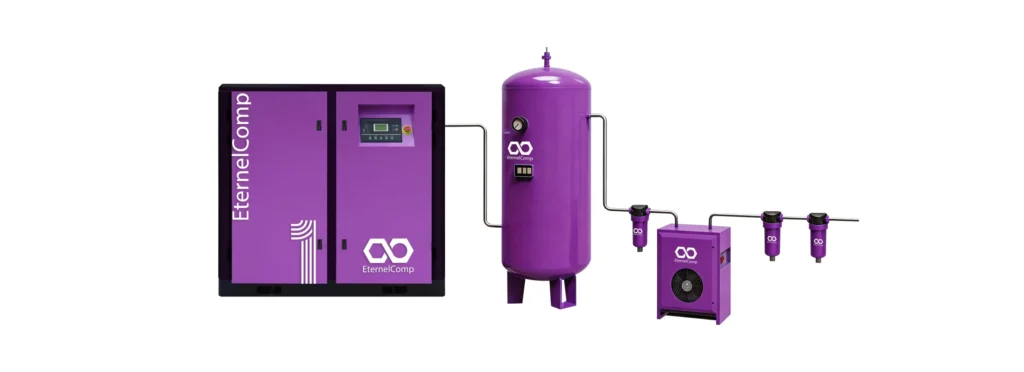
Common air treatment components include:
- Refrigerated dryers
- Desiccant dryers
- Line filters
- Oil-water separators
- Air receivers
- Automatic drains
- Pressure regulators
Ignoring air treatment can cause moisture, oil carryover, rust, product defects, and tool damage.
HP, Tank Size, and Receiver Capacity: How They Work Together
Tank size is another area where buyers sometimes get confused. A larger receiver tank can help, but it does not replace compressor capacity.
What the Tank Does—and Does Not Do
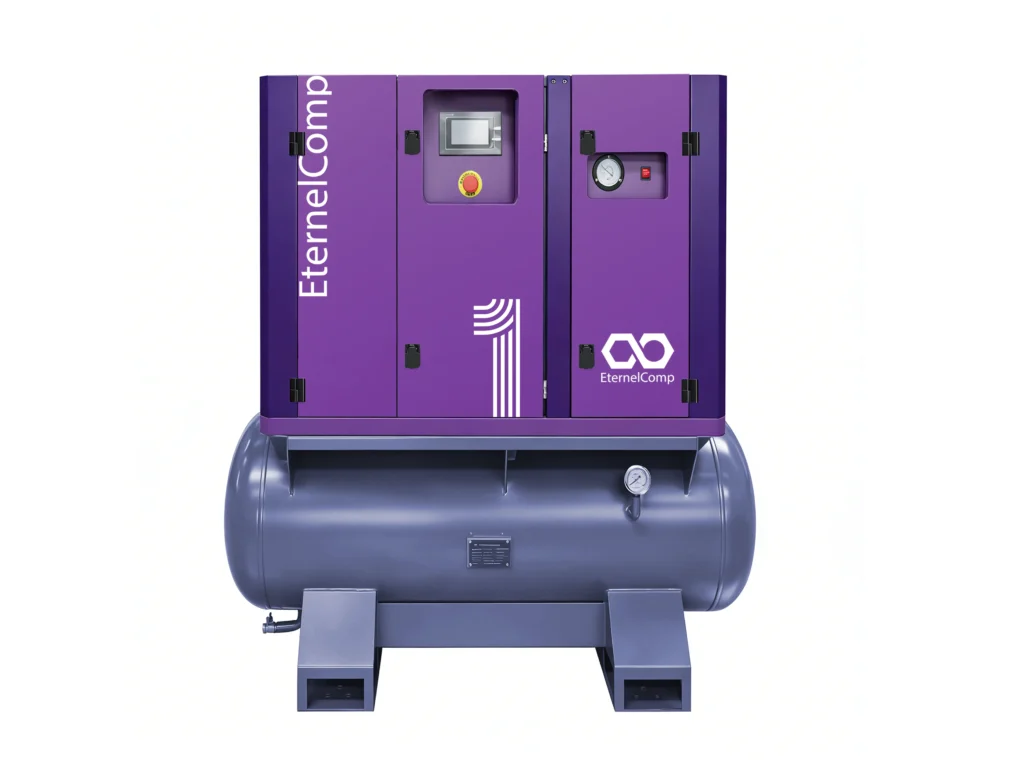
An air receiver stores compressed air. It helps smooth demand spikes and reduce rapid cycling. It can be very useful when tools use air in short bursts.
However, a tank does not create air. If the compressor cannot produce enough CFM to match ongoing demand, the tank will eventually empty faster than it refills. Pressure will drop, and tools will slow down.
In simple terms:
- HP helps power air production
- CFM measures air production
- PSI measures pressure
- Tank size stores air temporarily
All four matter, but they do different jobs.
When a Larger Tank Helps
A larger tank can be helpful when demand is intermittent. For example:
- Tire shops using bursts of air
- Small workshops using impact tools occasionally
- Blow-off applications with short cycles
- Pneumatic tools that start and stop frequently
A receiver can also help stabilize system pressure and reduce motor starts.
When More Compressor Capacity Is Better Than More Tank
If air demand is continuous, a bigger tank only delays the pressure drop. It does not solve the underlying problem.
More compressor capacity may be needed when:
- Multiple operators use tools at once
- A production machine needs constant air
- Spray finishing requires stable airflow
- Sandblasting runs for long periods
- Pressure drops interrupt production
For continuous air demand, focus on delivered CFM and duty cycle before adding more storage.
Energy Efficiency Considerations
Compressed air is convenient, clean at the point of use, and flexible. It is also expensive compared with direct electrical power. That makes sizing important not only for performance, but also for operating cost.
Why Compressed Air Is Expensive Energy
Generating compressed air requires electricity, and much of that energy becomes heat during compression. The U.S. Department of Energy has repeatedly identified compressed air systems as an area where industrial facilities can often improve efficiency through leak repair, pressure reduction, proper controls, and better maintenance.
A correctly sized air compressor can reduce waste by operating closer to its efficient range. An undersized unit may run too hard. An oversized unit may waste energy during unloaded operation or frequent cycling.
Fixed Speed vs Variable Speed
Fixed-speed compressors are often suitable when demand is stable and predictable. They run at a constant motor speed and are generally simpler.
Variable speed compressors adjust motor speed to match air demand. They can be useful when air consumption changes throughout the day.
A variable speed unit may be especially helpful when:
- Demand fluctuates by shift
- Some machines run only part of the day
- Production schedules change often
- The system has long periods of partial load
Still, variable speed is not automatically the best option for every site. Stable high-demand operations may perform very well with a properly selected fixed-speed compressor.
Leaks, Pressure Drop, and Maintenance
Even a perfectly sized compressor can perform poorly in a neglected system.
Common efficiency problems include:
- Air leaks
- Dirty intake filters
- Clogged line filters
- Poor ventilation
- Excessive pressure settings
- Undersized piping
- Infrequent oil changes
- Failed drains
- Improper dryer maintenance
OSHA also cautions that compressed air should be used safely, especially for cleaning, because high-pressure air can create injury risks if misused. Safety practices should be part of any compressed air system plan.
A good compressor selection should therefore include not only the machine, but also installation and maintenance planning.
Quick Selection Checklist
Before choosing an air compressor by HP, review this checklist:
- Required CFM for each tool or machine
- Required PSI at the point of use
- Number of tools running at the same time
- Intermittent or continuous duty cycle
- Compressor technology
- Oil-lubricated or oil-free air requirement
- Receiver tank size
- Dryer and filtration needs
- Available voltage and electrical capacity
- Installation space
- Ventilation and ambient temperature
- Noise limits
- Piping distance and pressure drop
- Future expansion plans
- Maintenance capability
- Purchase budget
- Long-term energy cost
If several items on this checklist are uncertain, choosing only by horsepower becomes risky.
A Practical Way to Match HP to Real Demand
For buyers who still want a horsepower-based shortcut, the safest version is to use HP only after estimating CFM.
A rough selection process looks like this:
- Calculate total peak CFM.
- Confirm required operating PSI.
- Add a reasonable reserve.
- Choose compressor type based on duty cycle.
- Compare models that meet the CFM and PSI requirement.
- Review HP, efficiency, voltage, noise, and service needs.
- Confirm air treatment requirements.
- Plan for installation and maintenance.
This method prevents the most common sizing error: buying a compressor with enough motor power on paper but not enough usable air in practice.
General HP Thinking by Demand Level
Small, occasional tasks usually require low HP. Multi-tool workshops often need medium HP. Production systems may require higher HP and more advanced controls.
But the dividing line is not always clean. A single sandblasting cabinet may need more air than several small tools. A cleanroom packaging line may require not only enough air, but extremely clean air. A paint booth may require moderate pressure but very stable, dry airflow.
That is why application context matters.
Conclusion: Choose HP After Understanding Air Demand
Choosing an air compressor by HP is understandable because horsepower is easy to see and compare. But it is not the best starting point.
A better approach is to determine:
- How much air the application needs
- What pressure is required
- How many tools or machines run at once
- Whether demand is intermittent or continuous
- What air quality level is necessary
- Which compressor type fits the duty cycle
After those details are clear, HP becomes useful for narrowing the options. In practice, the best air compressor is not always the one with the biggest motor. It is the one that delivers the right CFM at the right PSI, runs reliably under the real duty cycle, and supports the air quality your process requires.
Would you like me to create a flowchart or illustrative diagram prompt for this article next?
FAQ
How many CFM does one horsepower produce?
There is no universal conversion because compressor design, pressure, efficiency, and air-end type all affect output. As a rough industry habit, some people estimate around 3–5 CFM per HP at common shop pressures, but that should never replace checking the manufacturer’s delivered CFM rating at the required PSI.
Is a higher HP air compressor always better?
Not always. Higher HP may support greater capacity, but it can also increase purchase cost, electrical requirements, and energy use. If air demand is low or irregular, a properly sized smaller compressor may be more economical and easier to operate.
Can one air compressor run multiple machines at the same time?
Yes, but only if its delivered CFM and pressure capacity meet the combined simultaneous demand. The piping layout, receiver tank, filters, dryers, and regulators also affect whether each machine receives stable air at the correct pressure.