The perception that oil-free air compressors require less maintenance than their oil-lubricated counterparts is widespread across industrial procurement teams. In part, this reputation is justified: eliminating the oil circuit removes a significant category of routine tasks. There are no oil changes to schedule, no oil filters to replace, no oil sampling to send to the lab, and no risk of lubricant degradation contaminating downstream equipment. However, the idea that oil free air compressor maintenance is negligible or that these machines can be operated with minimal oversight is not only inaccurate but financially dangerous. The maintenance tasks that remain on an oil-free machine are concentrated on fewer, more critical components that fail more expensively when neglected.
An oil-free air compressor requires disciplined maintenance focused on three areas: air filtration (intake filters and downstream filtration), cooling system integrity, and the mechanical condition of the air end itself. The total annual maintenance time for a well-engineered oil-free compressor in a clean industrial environment is approximately 40 to 80 hours — substantially less than a comparable oil-lubricated machine, but not zero, and the cost of deferring any single task can equal or exceed the annual maintenance budget for the entire machine.
This article breaks down exactly what maintenance an oil-free compressor needs, how frequently each task should be performed, what happens when maintenance is deferred, and how to budget for maintenance over the full operating life of the equipment. It draws on manufacturer service schedules, field data from industrial installations, and the operational experience of maintenance teams across industries including food processing, pharmaceuticals, electronics manufacturing, and medical device production. Buyers evaluating the full oil-free compressor product range should consider not only the purchase price but the maintenance profile of each technology type — scroll, screw, and centrifugal — as maintenance requirements and costs differ significantly between them.
Why Oil-Free Maintenance Is a Different Discipline
Oil-free compressor maintenance differs from oil-lubricated maintenance in one fundamental way: there is no lubrication system to buffer component wear, so every operating hour directly stresses the air end bearings, coatings, and sealing surfaces. This makes predictive and preventive maintenance more important, not less, than on an oil-lubricated machine.
In an oil-lubricated rotary screw compressor, the injected oil performs four simultaneous functions: it seals the clearance between the rotors, it lubricates the bearings, it cools the compression chamber, and it carries away wear particles. When the oil is changed on schedule, it removes accumulated contaminants before they cause damage. The oil circuit also provides a buffer — if filtration degrades slightly or ambient conditions worsen, the oil absorbs some of the impact before component damage occurs.
An oil-free compressor has none of this buffering. The air end rotors never touch each other or the housing wall — they are synchronized by timing gears and separated by a precise clearance measured in microns. The bearings that support the rotors are sealed and grease-packed at the factory. The coatings on the rotors (typically PTFE, ceramic, or proprietary polymer blends) provide the wear surface. Every contaminant that enters the compression chamber — dust, chemical vapors, moisture — contacts these precision surfaces directly. There is no oil to flush contaminants away, and there is no oil analysis program to provide early warning of component wear.
This means the maintenance team’s job shifts from fluid management to environmental management. The question is no longer “when was the oil last changed?” but “what is entering the compressor intake, how hot is the cooling air, and are the bearings still within tolerance?” This requires different tools, different inspection frequencies, and a different mindset than the maintenance team may bring from years of managing oil-lubricated equipment. Understanding the benefits of oil-free technology helps place these maintenance requirements in context — the trade-off for eliminating oil-related contamination risk is accepting a more focused but still essential maintenance discipline.
Daily Inspection: What Every Operator Should Check
The daily inspection for an oil-free compressor takes approximately 5 to 10 minutes per machine and covers five checkpoints: intake filter condition indicator, discharge temperature, condensate drain function, control panel alerts, and unusual noise or vibration. These checks catch the problems that develop fastest and cause the most expensive damage if missed.
Daily inspections are the first line of defense because they detect conditions that can damage an oil-free air end within hours. A clogged intake filter, for example, increases the pressure differential across the compression stage and forces the motor to work harder. In an oil-lubricated compressor, the extra heat would be partially absorbed by the oil. In an oil-free compressor, the extra heat goes directly into the air end bearings and rotor coatings. Operating 8°C above rated temperature can cut bearing life by 50%, and the effect is cumulative.
The daily checklist should be documented, and any reading outside the normal range should trigger a corrective action before the machine returns to production. A daily log that records discharge temperature, intake restriction, and any alerts from the controller provides the trend data that supports predictive maintenance decisions weeks or months before a failure occurs.
| Checkpoint | Normal Reading | Action If Abnormal |
|---|---|---|
| Intake filter restriction indicator | Green zone | Replace filter immediately if in red zone |
| Discharge temperature | Within 5°C of baseline | Inspect cooling system; reduce ambient temperature or load |
| Condensate drain operation | Drains on cycle without blockage | Clean drain valve and trap |
| Controller alerts | No active alarms | Investigate alarm code per manual; do not reset without diagnosis |
| Noise and vibration | No change from baseline | Shut down and inspect air end bearings |
Monthly Maintenance: Filters, Drains, and Cooling System Cleaning
Monthly oil free air compressor maintenance adds approximately 2 to 4 hours of active work per machine and covers the replacement or deep cleaning of intake filters, inspection of all condensate management components, thorough cleaning of coolers and cooling air pathways, and a physical inspection of all accessible seals, gaskets, and connections.
Intake filter management is the single most impactful maintenance action for oil-free compressor longevity. The filter is the only barrier between ambient air — which in most industrial environments contains dust, chemical vapors, and humidity — and the precision surfaces inside the air end. Oil-free compressor manufacturers typically specify filter replacement at pressure differentials of 15 to 25 mbar, not at calendar intervals. A filter operating in a clean environment might last six months. The same filter in a foundry, cement plant, or textile mill might need replacement every two weeks.
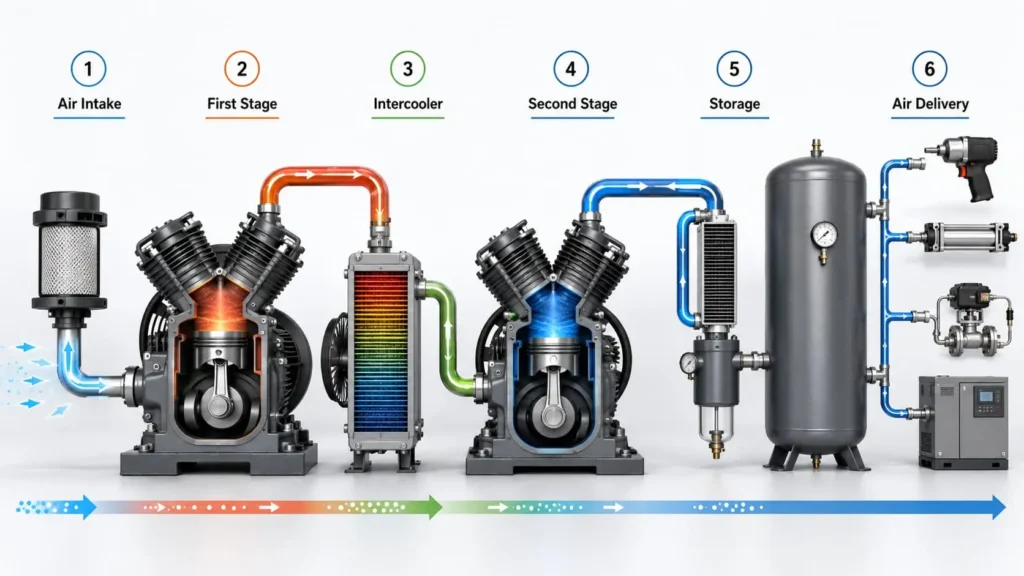
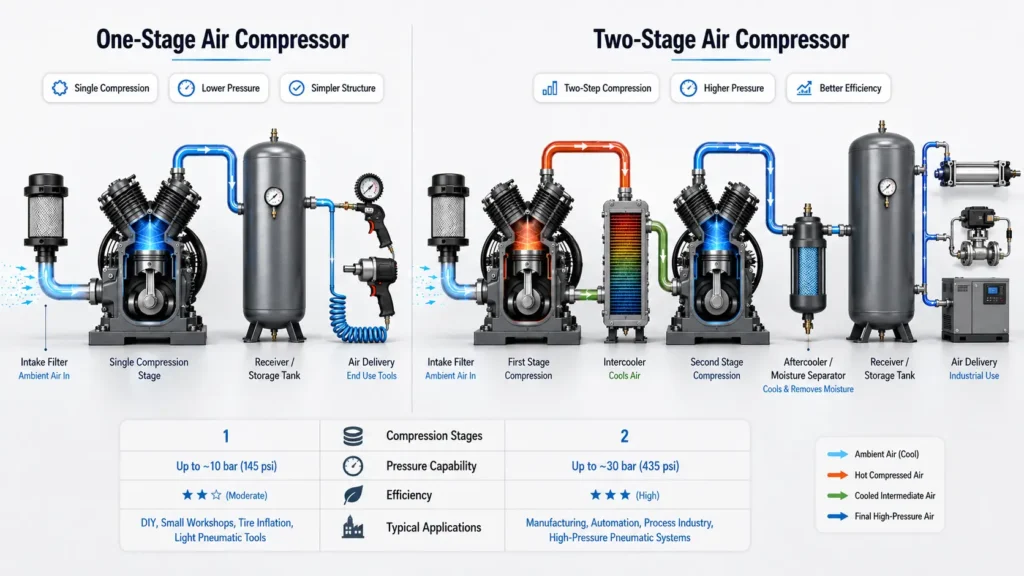
The monthly cooling system cleaning is equally critical. Oil-free compression generates more heat than oil-lubricated compression because there is no oil injection to absorb thermal energy mid-cycle. The discharge temperature of an oil-free screw compressor typically runs 180°C to 220°C, compared to 80°C to 100°C for an oil-injected screw. All of this heat must be rejected through the aftercooler and, in multi-stage machines, through intercoolers between stages. Even a thin layer of dust on the cooler fins can raise discharge temperature by 5°C to 10°C — enough to measurably accelerate bearing wear.
Monthly Maintenance Task List
- Replace or clean intake air filters based on restriction indicator readings
- Inspect and clean all cooler surfaces with compressed air or soft brush
- Verify condensate drain operation; disassemble and clean if slow or blocked
- Check all flexible connections, couplings, and hose clamps for tightness
- Inspect V-belt tension and condition on belt-driven models
- Test safety relief valves for free movement
- Clean the cabinet interior, removing accumulated dust from electrical enclosures
- Verify the accuracy of temperature and pressure sensors against calibrated instruments
- Record all readings in the machine log for trend analysis
- Lubricate the motor bearings if the motor has grease fittings and is due per the motor manufacturer’s schedule
Air End Life: The Critical Maintenance Window That Determines Total Cost of Ownership
The air end is the single most expensive component in an oil-free compressor, accounting for 40 to 60 percent of the machine’s replacement value. Air end life is determined almost entirely by maintenance quality — specifically by intake filtration performance, cooling system effectiveness, and the timely replacement of timing gears and bearings at manufacturer-specified intervals.
Oil-free screw air ends typically achieve 20,000 to 40,000 operating hours between overhauls when maintained to manufacturer specifications. Some high-quality industrial designs, particularly those with water-cooled jackets and advanced rotor coatings, can reach 50,000 to 60,000 hours. The difference between 20,000 hours and 50,000 hours — approximately 4 to 6 additional years of single-shift operation — is almost entirely a function of how well the maintenance tasks described in this article are executed.
The air end overhaul itself is a factory or authorized service center procedure, not an in-house task. It involves disassembling the air end, inspecting and replacing bearings, checking rotor tip clearances, reapplying or replacing rotor coatings, replacing all seals and gaskets, and dynamic balancing the rotor assembly. The cost of a professional overhaul ranges from 30 to 50 percent of a new air end, and the downtime is typically 2 to 4 weeks. This cost and downtime should be budgeted as a predictable expense, not an emergency.
The key maintenance actions that maximize air end life are:
- Never operate with a clogged or bypassed intake filter
- Keep discharge temperature within 5°C of the manufacturer’s maximum continuous rating
- Replace timing gear oil (in oil-free screw designs that use oil-lubricated timing gears) on schedule
- Monitor vibration levels quarterly and investigate any upward trend
- Perform a borescope inspection of rotor coatings every 8,000 to 10,000 operating hours
A well-maintained oil-free compressor can achieve a total service life of 15 to 20 years with one or two air end overhauls. The oil-free compressor lifespan is directly proportional to maintenance diligence — there is no design feature that compensates for neglected filtration or cooling.
Cooling System Maintenance: The Thermal Management Imperative
Cooling system maintenance accounts for approximately 30 percent of the total annual maintenance hours on an oil-free compressor and is arguably the most important single system after the intake filtration. A poorly maintained cooling system will cause progressive heat damage to the air end, aftercooler, and downstream treatment equipment in a cascade that can make the machine uneconomical to repair within two to three years.
Oil-free compressors use either air cooling or water cooling, and each presents distinct maintenance challenges. Air-cooled machines rely on finned heat exchangers (radiators) with electric fans that draw ambient air across the cooling surfaces. The maintenance challenge is keeping those surfaces clean and ensuring the fans are delivering rated airflow.
Water-cooled machines use shell-and-tube or plate heat exchangers that transfer compression heat to a cooling water circuit. The maintenance challenge is managing water quality to prevent scaling, corrosion, and biological fouling inside the heat exchanger passages. A water-cooled machine operating on untreated hard water can lose 30 to 50 percent of its cooling capacity within 12 months due to scale buildup alone.
Cooling System Maintenance Schedule
| Component | Air-Cooled Interval | Water-Cooled Interval |
|---|---|---|
| Cooler surface cleaning | Monthly | Annual (internal chemical cleaning) |
| Fan motor and blades | Quarterly inspection | Not applicable |
| Cooling water quality test | Not applicable | Monthly |
| Thermostat/thermal valve | Annual function test | Annual function test |
| Aftercooler condensate separator | Monthly | Monthly |
| Intercooler (multi-stage machines) | Monthly | Quarterly |
For water-cooled systems, the cooling water should be maintained to the quality standards specified by the compressor manufacturer, typically including pH control, total dissolved solids below specified limits, and biocide treatment to prevent legionella and other biological growth. A water treatment program that costs $500 to $1,500 per year will prevent heat exchanger damage that costs $5,000 to $15,000 to repair.
Condensate Management and Moisture Control
Condensate management is a maintenance task that directly impacts compressed air quality, environmental compliance, and the mechanical condition of downstream equipment. Oil-free compressors produce condensate that is free of oil contamination, simplifying disposal, but the volume of condensate can be higher than oil-lubricated machines because there is no oil injection to elevate the air temperature and reduce relative humidity inside the compression cycle.
Every cubic meter of ambient air contains water vapor. When that air is compressed to 7 to 10 bar, the water vapor concentration increases proportionally, and when the compressed air cools in the aftercooler, the water condenses into liquid. A 37 kW oil-free compressor operating in a humid environment can produce 10 to 20 liters of condensate per hour. If the condensate drains are not functioning, this water accumulates in the air receiver, corrodes the tank, enters the downstream piping, and degrades the performance of air dryers and filters.
Condensate drain maintenance involves three levels of attention:
- Daily verification that drains are cycling and discharging water
- Monthly disassembly and cleaning of drain valves, traps, and strainers
- Annual replacement of drain valve seals and diaphragms
Automated electronic drains reduce the daily inspection burden but do not eliminate the need for monthly cleaning. A drain that is not discharging because of a blocked strainer is functionally identical to a drain that was never installed.
The Parts That Wear: Budgeting for Consumables
A realistic annual budget for oil free air compressor maintenance consumables ranges from $1,500 to $5,000 per machine depending on size, operating environment, and duty cycle. This includes intake filters, downstream filtration elements, timing gear oil (where applicable), grease for motor bearings, condensate drain service kits, and a reserve for unscheduled repairs.
The single largest consumable cost is typically the intake filter, which may need replacement every 500 to 4,000 operating hours depending on environmental dust loading. At $50 to $200 per filter, annual intake filter costs range from $200 to $1,600 per machine. Downstream filtration — coalescing filters, particulate filters, and activated carbon filters if used — adds similar costs on a 2,000 to 4,000-hour replacement interval.
A realistic five-year consumables budget for a mid-size oil-free screw compressor (30-55 kW) in a typical industrial environment:
| Year | Intake Filters | Downstream Filters | Timing Gear Oil | Grease & Seals | Unscheduled Reserve | Total |
|---|---|---|---|---|---|---|
| 1 | $400 | $600 | $150 | $100 | $500 | $1,750 |
| 2 | $400 | $600 | $150 | $100 | $500 | $1,750 |
| 3 | $400 | $600 | $150 | $200 | $800 | $2,150 |
| 4 | $400 | $600 | $150 | $100 | $500 | $1,750 |
| 5 | $400 | $600 | $150 | $200 | $1,500 | $2,850 |
Years 3 and 5 show higher reserves to reflect the increased probability of unscheduled repairs as operating hours accumulate. Year 5 anticipates the approach of the first major air end service interval. Access to genuine replacement parts from the original manufacturer is essential — aftermarket filters and seals that do not meet OEM specifications are a leading cause of premature air end failure.

Common Failure Modes and How Preventive Maintenance Prevents Them
The most common failure modes on oil-free compressors — bearing failure, rotor coating degradation, cooler blockage, condensate drain failure, and control system faults — share a common characteristic: each one provides detectable early warning signs that preventive maintenance is designed to catch before catastrophic failure occurs.
Bearing failure is the most expensive common failure. The symptoms — increased vibration, rising discharge temperature, and audible noise changes — appear weeks to months before complete failure if anyone is looking for them. A quarterly vibration analysis program that costs $500 to $1,000 per year can detect bearing degradation early enough to schedule a replacement during planned downtime rather than responding to an emergency shutdown that costs $10,000 to $30,000 in lost production alone.
Rotor coating degradation is the second most expensive failure and the hardest to detect without a borescope inspection. The coatings wear gradually, and the first sign is often a slow decline in compressed air output for the same motor current draw. A 3 to 5 percent efficiency loss over 12 months is difficult to notice without baseline performance testing. Annual or biennial performance testing — measuring free air delivery against motor power consumption at a standard discharge pressure — provides the trend data needed to identify coating wear before it affects production.
The table below summarizes common failure modes, their prevention, and the relative cost of preventive versus reactive maintenance:
| Failure Mode | Early Warning | Preventive Action | Reactive Cost | Preventive Cost |
|---|---|---|---|---|
| Air end bearing failure | Vibration increase, temperature rise | Quarterly vibration analysis, annual bearing inspection | $15,000-$40,000 | $500-$1,000/year |
| Rotor coating wear | Gradual efficiency decline | Annual performance test, borescope at 8,000 hours | $20,000-$50,000 | $1,200-$2,000/inspection |
| Cooler blockage | Rising discharge temperature | Monthly cleaning, quarterly deep cleaning | $3,000-$8,000 | $200-$400/year |
| Condensate drain failure | Water in downstream piping | Monthly drain cleaning, annual seal replacement | $2,000-$5,000 | $150-$300/year |
| Control system fault | Intermittent alarms, sensor drift | Annual sensor calibration, firmware updates | $1,500-$4,000 | $300-$600/year |
In-House Maintenance vs. Service Contracts
Most industrial facilities can perform 70 to 80 percent of oil-free compressor maintenance in-house with properly trained personnel. The remaining 20 to 30 percent — air end overhauls, major control system repairs, and certain warranty-sensitive procedures — should be performed by the manufacturer or an authorized service provider.
The skills required for in-house maintenance are achievable by an experienced industrial maintenance technician with specific training on the compressor model. The core competencies are mechanical inspection, basic vibration analysis, electrical troubleshooting, and disciplined documentation. A two-day factory training course, typically included in the machine purchase or available for $1,000 to $2,000, provides the model-specific knowledge needed to perform all routine maintenance tasks.
Service contracts fill two roles: they provide access to specialized procedures that require factory tools or diagnostic equipment, and they provide insurance against the cost and downtime of major failures. A comprehensive service contract covering all scheduled maintenance, emergency call-outs, and air end overhaul typically costs 8 to 12 percent of the machine’s purchase price annually. For a $60,000 compressor, that represents $4,800 to $7,200 per year.
The decision between in-house maintenance, a service contract, or a hybrid approach should be based on three factors: the criticality of the compressed air supply to production (a food processing line that stops without air justifies more coverage than a general workshop), the availability of trained personnel (a three-shift factory with four maintenance technicians covering all equipment can absorb compressor maintenance more easily than a single-shift operation with one technician), and the proximity of authorized service (a facility located within two hours of a factory service center can rely more on emergency call-out than a remote site). Facilities that need professional maintenance support should verify that the service provider has oil-free-specific training — the diagnostic approach and repair procedures differ substantially from oil-lubricated machines.
Conclusion
Oil free air compressor maintenance is not optional, not negligible, and not something that can be deferred until a problem becomes visible. It is a structured, documented program that requires approximately 40 to 80 hours per year of active maintenance labor and a consumables budget of $1,500 to $5,000 annually. When executed correctly, it extends air end life from a baseline of 20,000 hours to 50,000 hours or more, prevents unscheduled downtime that costs orders of magnitude more than the maintenance itself, and ensures that the compressed air quality the machine was purchased to provide remains consistent throughout its operating life.
The maintenance program described in this article — daily inspections, monthly filter and cooling system service, quarterly vibration analysis, annual performance testing, and air end overhaul at manufacturer-specified intervals — represents the standard of care that separates a machine that operates reliably for 15 years from one that becomes a maintenance burden in three. The choice between those outcomes is made not at the time of purchase but every day that the machine runs, by the maintenance decisions made on the production floor.
FAQ
Can I use an oil-free compressor in a dusty environment, or will the maintenance be too demanding?
Oil-free compressors can operate in dusty environments, but the maintenance burden increases substantially. Intake filters may require replacement every 100 to 500 hours instead of every 2,000 to 4,000 hours, and cooler cleaning may be needed weekly instead of monthly. If the application requires oil-free air and the environment is dusty, budget for 2 to 3 times the standard filter consumption and install the compressor in the cleanest available location, ideally with a dedicated intake duct drawing air from outside the dust zone.
What happens if I skip maintenance for a year on an oil-free compressor?
Skipping a year of maintenance on a moderate to heavily used oil-free compressor will almost certainly cause measurable damage. The intake filters will clog, raising compression temperatures and stressing bearings. The coolers will foul, compounding the temperature problem. The condensate drains may block, allowing water into the air receiver and downstream piping. The compressor will continue to run — oil-free machines do not seize from lack of lubrication — but the accumulated thermal and mechanical stress will permanently reduce the remaining air end life. A machine that could have reached 50,000 hours with proper maintenance may require an air end overhaul at 25,000 hours, at a cost of $15,000 to $30,000.
How does the maintenance cost of oil-free compare to oil-lubricated over 10 years?
Over a 10-year period, oil-free compressor maintenance costs are typically 20 to 40 percent lower than comparable oil-lubricated machines when both are maintained to manufacturer standards. The oil-lubricated machine requires oil changes, oil filter replacements, oil sampling and analysis, and separator element replacements — costs that total $1,500 to $3,500 annually. The oil-free machine eliminates these costs entirely. However, the oil-free machine’s air end overhaul cost (typically at 40,000 to 50,000 hours) tends to be higher than the oil-lubricated equivalent. The 10-year total cost comparison favors oil-free in most industrial scenarios, with the advantage widening in applications with high running hours.