
Choosing the right compressed air hose is essential for maintaining the safety, efficiency, and reliability of your compressed air system. The following factors will help you select a hose that suits both your equipment and working environment.
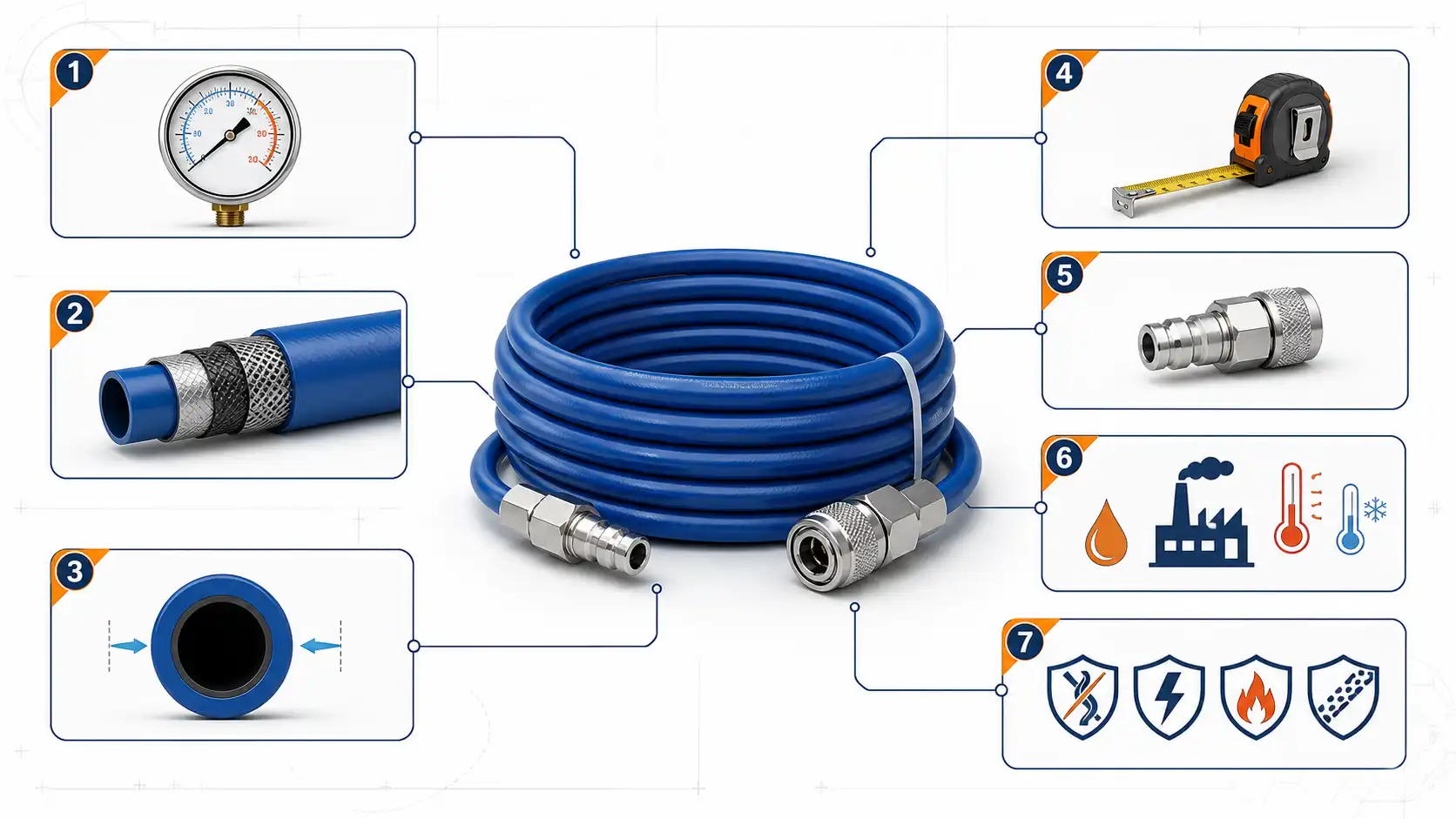
1. Working Pressure
Check that the hose’s maximum working pressure meets or exceeds the highest operating pressure of your system. Using a hose with an insufficient pressure rating may result in air leaks, premature failure, or potentially dangerous hose bursts.
2. Hose Material
The hose material affects its flexibility, durability, weight, and resistance to wear. Common options include PVC, rubber, polyurethane, and hybrid materials.
- PVC hoses are lightweight and economical.
- Rubber hoses offer good flexibility and durability in demanding environments.
- Polyurethane hoses are lightweight and highly resistant to abrasion.
- Hybrid hoses combine flexibility with reliable performance across a wide temperature range.
The best choice will depend on the conditions in which the hose is used.
3. Internal Diameter
Select an internal diameter that can deliver the required airflow without causing excessive pressure loss. A hose that is too narrow may restrict airflow and reduce the performance of pneumatic tools and equipment. Applications with higher air consumption generally require a larger hose diameter.
4. Hose Length
Choose a hose that provides sufficient reach while remaining as short as practical. An unnecessarily long hose can increase pressure drop, create trip hazards, and make handling more difficult.
5. Fittings and Connections
Make sure the hose fittings are compatible with the couplings, connectors, and thread types used in your system. Correctly matched fittings provide a secure connection, minimize leakage, and simplify installation and maintenance.
6. Application and Working Environment
Consider where and how the hose will be used. Exposure to oil, chemicals, moisture, abrasion, UV radiation, or extreme temperatures may require a hose with specific resistance properties. Outdoor, workshop, automotive, and heavy-industrial applications may each call for a different hose construction.
7. Safety Features
For demanding or high-traffic environments, additional features can improve safety and service life. Depending on the application, these may include kink resistance, anti-static construction, flame resistance, abrasion protection, or reinforced hose walls.
Making the Right Choice
The right compressed air hose should provide the required airflow, withstand the system’s operating pressure, and remain reliable under actual working conditions. Evaluating pressure, material, diameter, length, connections, and environmental requirements will help you achieve safer operation, greater efficiency, and a longer service life.
EternelComp Air Compressor Industrial provides compressed air hoses, pipework, and air preparation solutions for a wide range of industrial applications. Our team can help customers select a system that meets their specific operating and installation requirements.