It’s tempting to treat the search for a compressed air solution as a simple numbers game—find the lowest price per cubic foot and move on. That approach rarely ends well. A compressor is a long-term utility partner, and the choice of Oil free Air Compressor Manufacturer has a quiet but profound impact on production uptime, energy bills, and audit readiness.
Defining Your Actual Compressed Air Needs
The decision starts with an honest look at the air quality your process really demands. In sensitive environments like pharmaceutical packaging, dairy processing, or semiconductor fabrication, even trace oil carryover can ruin a batch or damage instrumentation. That’s where a true Oil Free Air Compressor becomes non-negotiable. The system must eliminate oil from the compression chamber entirely, not just filter it out downstream.
On the other hand, not every workshop requires zero oil. If the application is heavy-duty tool powering and the air only needs basic filtration, an Oil-Lubricated Air Compressor often delivers greater energy efficiency and a lower upfront investment. Knowing where your operation falls on that spectrum keeps you from overspending on purity you don’t need—or worse, under-specifying a machine that will contaminate the product.
Beyond the Brochure – Evaluating the Manufacturer’s Credibility
Marketing materials all start to look the same after a while. To separate a competent oil-free compressor supplier from a generic assembler, it helps to dig into two specific areas.
Certifications and ISO 8573-1 Class 0 Compliance
Class 0 is the strictest purity designation under ISO 8573-1, and it defines air with absolutely zero oil content. The nuance that often gets overlooked is where the measurement is taken. A manufacturer might test at the airend outlet while ignoring the risk of oil migration through the intake or from air treatment components. A credible oil free air compressor manufacturer will specify Class 0 across the full system boundary, typically validated by third-party bodies like TÜV. The relevant data sheets from organizations such as the Compressed Air and Gas Institute (CAGI) can also offer a transparent performance baseline, making it harder to hide underperforming packages behind glossy claims.
Manufacturing Process and Material Traceability
There’s a noticeable difference between a manufacturer that uses consistently coated rotors and exact CNC tolerances, and one that simply sources generic assemblies. Subtle details—anti-corrosion treatment on air passages, gap control under thermal load, stainless steel coolant lines—often forecast whether the unit will run quietly for a decade or develop excessive clearances and vibrations in year three. It’s worth asking how the company monitors its supply chain, not just how it designs the compressor block.
The Hidden Iceberg – Total Cost of Ownership
A cheap quote almost always hides a harsh reality. According to the U.S. Department of Energy, energy consumption can easily account for over 70% of a compressor’s total lifecycle cost. That means a machine with a slightly lower purchase price but a poor specific power rating (kW/100 cfm) will quietly drain budgets long after the warranty expires. The table below illustrates how two 100 hp-class machines can look similar on paper but diverge wildly over five years.
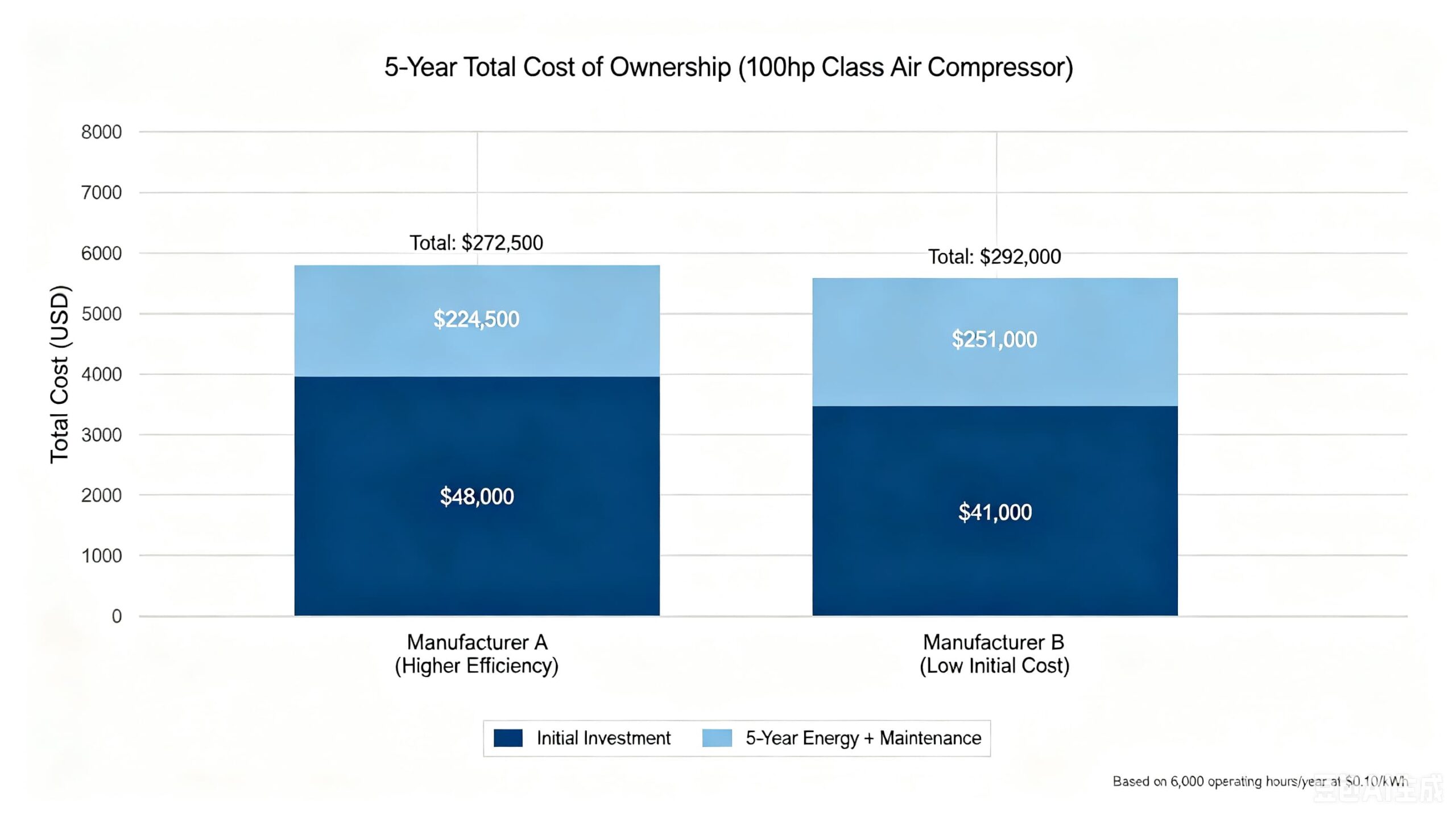
| Cost Factor | Manufacturer A (Higher Efficiency) | Manufacturer B (Low Initial Cost) |
|---|---|---|
| Initial Investment | $48,000 | $41,000 |
| Annual Energy Cost (6,000 h, $0.10/kWh) | $43,200 | $47,800 |
| 5-Year Scheduled Maintenance | $8,500 | $12,000 |
| Total 5-Year Cost | $272,500 | $292,000 |
Even without factoring in unplanned downtime, the “cheaper” option ends up nearly $20,000 more expensive. For this reason, scrutinizing the CAGI data sheet for full-load power consumption is far more revealing than haggling over the purchase price.
After-Sales Support and Local Partner Capability
A compressor is only as reliable as the support network behind it.
Spare Parts Availability and Technical Response
A machine stuck waiting three weeks for an airend element or a proprietary controller board to arrive from overseas is a production nightmare. The most underrated strength of a solid oil-free compressor supplier isn’t even in the catalog—it’s the local spare parts stock and the response time of field engineers who already understand the fleet. Before signing a contract, it’s wise to check how many service vans the distributor has in the region and whether they carry long-lead items like coated rotors, not just filter kits.
Final Thoughts
A reliable oil free air compressor manufacturer isn’t the one with the loudest advertising or the lowest sticker price. It’s the one that can reference ISO 8573-1 Class 0 system certification with confidence, publish verifiable specific power data, and back the machine with a local spare parts inventory that keeps production running. Spec sheets rarely tell the whole story—the right partner usually asks more questions about your piping configuration and duty cycle than they do about your credit terms.
FAQ
How does an oil-free compressor differ from an oil-less compressor in durability?
The distinction is often overlooked. Oil-less typically describes small reciprocating machines where the piston rings are self-lubricating and wear progressively, limiting lifespan under continuous duty. An oil-free rotary screw or centrifugal compressor from an experienced oil free air compressor manufacturer relies on precise clearances and durable coatings to prevent contact, which significantly extends service life and allows 24/7 operation without the same degradation rate.
Can a standard oil free air compressor manufacturer provide a truly Class 0 solution without expensive air treatment?
Rarely. Even when the compression chamber produces oil-free air, the intake environment and piping can introduce hydrocarbons. Most manufacturers will recommend a package that includes catalytic converters or activated carbon filters downstream to guarantee Class 0 at the point of use. Asking for a full-package validation, rather than just an airend certificate, separates the thorough supplier from one merely checking a box.
What are the energy-saving implications of switching from lubricated to oil-free rotary screw machines?
The intuition that removing oil automatically lowers energy use isn’t quite accurate. Oil-lubricated screws can sometimes be more isentropically efficient because the oil acts as a coolant and sealant. The advantage of a modern oil-free machine often shows up in the system context: there is no oil separator pressure drop, no ongoing condensate treatment costs, and heat recovery can be more straightforward. A detailed audit of current specific power and ancillary losses usually reveals whether the switch pays back.