
A compressor drawing in ambient air at 30 °C and 70 percent relative humidity pulls several litres of water vapour through its intake every hour. Once that air is compressed and cooled in the receiver and piping, the vapour turns into liquid, and the damage is slow and expensive: rusted headers, emulsified lubricant in pneumatic tools, fish eyes in paint, rejected batches in food and pharmaceutical lines, frozen pipes in an unheated bay. A dryer prevents all of it, but the two mainstream technologies work at very different depths and very different running costs.
A refrigerated air dryer cools compressed air to about +3 °C, giving a pressure dew point near 38 °F, which is enough for indoor plant air and pneumatic tools in heated buildings. A desiccant air dryer passes the air through an adsorbent bed that strips water vapour to a pressure dew point of −40 °C, or −70 °C in high-purity versions, and it is the correct choice whenever any part of the system drops below freezing or the process cannot tolerate moisture at all. The decision rests on the dew point your plant needs, not on which machine looks more capable on a quotation.
The sections below work through the physics, the running cost and the maintenance consequences of that single number.

The Real Difference Is Pressure Dew Point, Not Dryer Design
Refrigerated dryers remove water by condensation and cannot go below the freezing point of water inside their own heat exchanger, so their output sits just above +3 °C. Desiccant dryers remove water by adsorption, a surface chemistry process with no such limit, so they reach −40 °C as standard and −70 °C when specified. Cost, maintenance and complexity all follow from that one physical constraint.
Pressure dew point is the temperature at which moisture in air at line pressure begins to condense. It is measured at pressure, and the difference from atmospheric dew point is large enough to cause specification errors: air dried to −40 °C at 7 bar has an atmospheric dew point near −57 °C. A quoted figure without a stated reference tells you very little, which is why dew point in compressed air systems has to be compared at the pressure the system actually runs at. The working rule is to find the coldest surface the air will ever meet, usually an outdoor run, a line to an unheated store or a tool near a loading door, and specify a pressure dew point at least 20 °F (about 11 °C) below it.
What the ISO 8573-1 Humidity Classes Mean in Practice
Most corporate specifications now reference the international purity standard rather than a bare temperature.
| Humidity class | Pressure dew point | Water content at 7 bar | Dryer type that reaches it |
| Class 1 | −70 °C or colder | Below 0.03 g/m³ | Desiccant, high-performance bed |
| Class 2 | −40 °C or colder | About 0.12 g/m³ | Standard desiccant |
| Class 3 | −20 °C or colder | About 0.9 g/m³ | Desiccant, or refrigerated plus a speciality stage |
| Class 4 | +3 °C or colder | About 6 g/m³ | Refrigerated |
| Class 5 | +7 °C or colder | About 7.7 g/m³ | Refrigerated, high approach temperature |
| Class 6 | +10 °C or colder | About 9.4 g/m³ | Basic refrigerated, coarse duty |
The gap between Class 4 and Class 2 is roughly fifty times less water, which is why the two technologies are not interchangeable at the top of the range. The standard is published as ISO 8573-1:2010 and grades particles, water and oil as three independent axes, so a full specification reads as three numbers rather than one.
What a Refrigerated Air Dryer Does
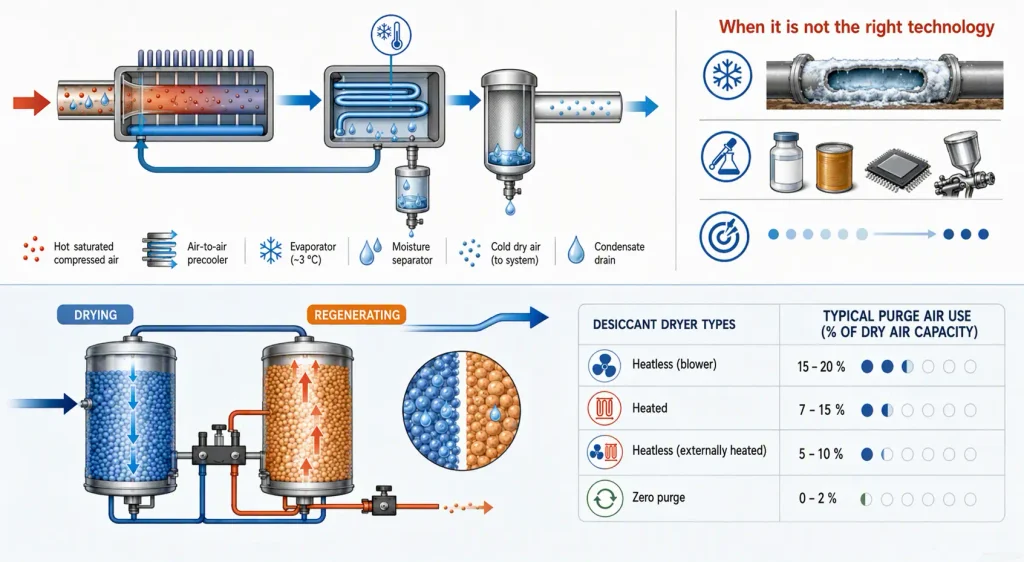
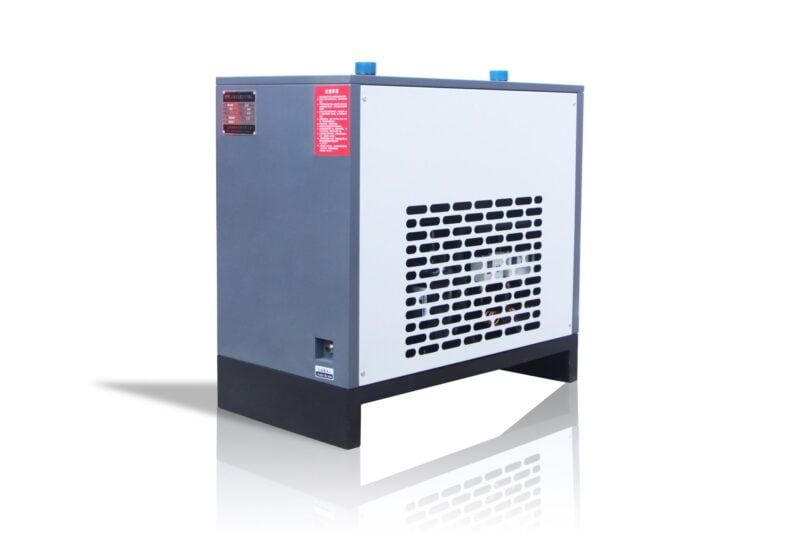
A refrigerated dryer chills compressed air to about +3 °C, lets the vapour condense into droplets, separates those droplets mechanically and drains them away. It is the default air compressor dryer in most plants because it holds a stable dew point at low capital cost and draws a modest, predictable 0.8 to 1.0 kW per 100 cfm.
The cycle has four stages. Hot saturated air is precooled in an air to air heat exchanger by the cold dry air leaving the dryer, which recovers most of the refrigeration energy. It then enters the evaporator, where refrigerant cools it to about +3 °C and the vapour condenses. A demister or gravity separator removes the droplets and a drain discharges the condensate. The cold dry air returns through the precooler, picking heat back up, which lowers its relative humidity and prevents sweating on downstream piping.
Three situations defeat the technology. A line that runs outdoors cools below +3 °C in winter, so air carrying a +3 °C dew point condenses and then freezes inside it. A moisture-sensitive process such as product-contact air in food, pharmaceutical filling, semiconductor handling or a paint booth cannot accept the residual 6 g/m³. And a specification written to Class 2 or Class 1 cannot be met by condensation alone. In each case the unit is not faulty; it is being asked to do something the physics does not allow.
How Desiccant Dryers Work and What Each Type Costs in Purge Air
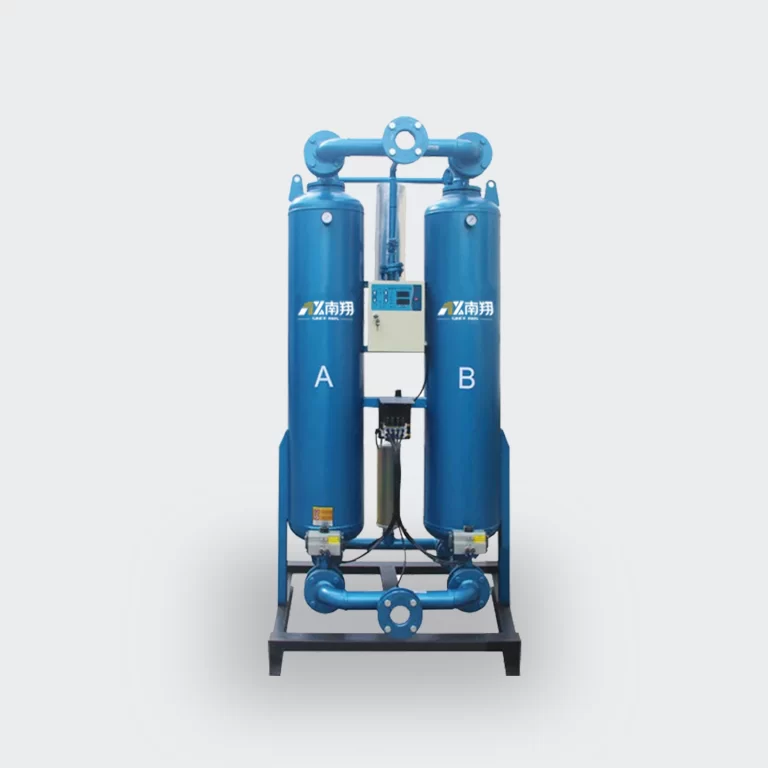
A desiccant dryer passes air through a bed of activated alumina or molecular sieve that holds water molecules on the surface of the beads. Because the bed saturates, two towers alternate: one dries while the other regenerates, switched on a fixed cycle or on a measured dew point. Regeneration is where the operating cost sits, because most designs use a portion of the dried compressed air itself to carry moisture out of the bed.
| Type | Regeneration method | Purge air as share of rated flow | Where it fits |
| Heatless (pressure swing) | Dried air expands to atmospheric pressure and sweeps the offline bed | 15 to 20 percent | Small to medium flows, low dew point on a budget |
| Externally heated | A heater raises purge air temperature, so less air is needed | 5 to 8 percent | Medium to large flows where energy matters |
| Blower purge | An external blower supplies heated ambient air, using almost no compressed air | 1 to 3 percent | Large flows with high running hours |
Why the Purge Rate Is the Number That Matters
Purge air has already been compressed, dried and filtered, and then it is thrown away. On a 500 cfm system, a heatless purge desiccant dryer at 15 percent consumes 75 cfm continuously, roughly 13 to 14 kW of compression energy for every hour the plant is pressurised. That is more than three times the electrical draw of a refrigerated dryer of the same size, before maintenance. Heated and blower purge designs cut the air loss but add heater or blower power and more moving parts, so the trade is between air, electricity and complexity rather than between cheap and expensive.
The problem compounds at part load. Without dew point demand control, a heatless dryer purges the same fixed volume whether the plant runs flat out or at a third of capacity, so halving air demand doubles the purge share. Switching towers on a measured outlet dew point rather than a timer is the single most effective addition for this reason.
Refrigerated vs Desiccant: Side-by-Side Comparison
Refrigerated dryers win on capital cost, running cost and simplicity wherever +3 °C is sufficient. Desiccant dryers win on dew point capability and are the only option when air meets freezing conditions or the process demands Class 2 or better. Neither is efficient in absolute terms; each is efficient inside its own envelope.
| Factor | Refrigerated dryer | Desiccant dryer |
| Pressure dew point | +3 °C (about 38 °F) | −40 °C standard, −70 °C available |
| Residual water content | About 6 g/m³ at 7 bar | About 0.12 g/m³ at −40 °C |
| Capital cost | Baseline | 1.5 to 2.5 times higher for the same flow |
| Energy draw | 0.8 to 1.0 kW per 100 cfm, steady | Purge equivalent plus heater or blower load |
| Operating cost | Baseline | Commonly four to six times higher for heatless designs |
| Maintenance scope | Filters, drains, refrigeration circuit | Filters, valves, mufflers, periodic media replacement |
| Consumable life | No routine consumable, sealed circuit | Media every 3 to 5 years heatless, 2 to 3 years heated |
| Footprint and weight | Compact, often skid mounted | Larger, heavier, two vessels |
| Part-load behaviour | Stable dew point, lower absolute consumption | Purge share rises sharply without demand control |
| Best fit | Indoor plant air, tools, general manufacturing | Outdoor lines, food, pharma, electronics, instrument air |
The dew point row decides capability; the operating cost row decides whether the capability is affordable. A plant that buys desiccant for air that never leaves a heated building pays that four to six times premium every month for dryness it cannot use.
What Each Type Costs to Run Over Ten Years
Energy accounts for roughly 80 percent of the cost of generating compressed air, while the equipment is a minority share. For a dryer, that means the purchase price gap between the two technologies is settled within a few years, and the electricity and purge bill decides the rest.
A worked comparison makes the gap concrete. Take a 500 cfm system running 8,000 hours a year at 0.10 per kWh.
| Cost line | Refrigerated dryer | Heatless desiccant dryer |
| Purge air consumed | None | 75 cfm continuous |
| Equivalent power | 4.5 kW, dryer only | 13.5 kW purge plus 0.3 kW controls |
| Annual energy | About 36,000 kWh | About 110,000 kWh |
| Annual energy cost | About 3,600 | About 11,000 |
| Annual maintenance, averaged | About 300 | About 900, including media amortisation |
| Ten-year running cost | About 39,000 | About 119,000 |
The refrigerated figure covers the refrigeration compressor, fans and controls, which is what an air-cooled refrigerated dryer in a typical plant draws. The desiccant figure is dominated by purge, which is why heated and blower purge variants exist: they shift cost from wasted compressed air to purchased electricity, and on large systems that shift is usually worth making.
Federal guidance reaches the same conclusion from the system side. Drying air beyond the dew point the process needs consumes energy with no operational benefit, and treatment pressure drop is itself a recurring cost, since each extra bar needed to push air through a restricted dryer adds roughly 7 percent to the energy bill. The reference is the Improving Compressed Air Sourcebook, which treats drying as one of eight system components where efficiency is won or lost.
How Long Desiccant Lasts and How Often It Must Be Replaced
The dryer vessel lasts 15 to 20 years with normal service, but the media is a consumable. Heatless dryers typically need new desiccant every 3 to 5 years, and heated designs every 2 to 3 years because repeated heating ages the adsorbent faster. Replacement is a planned service visit rather than a rebuild: spent beads are emptied and fresh media loaded, usually during scheduled downtime.
What Shortens Desiccant Life
Media failure is almost always caused upstream rather than by the beads themselves.
- Oil carryover. A saturated or missing coalescing filter coats the beads and blocks the pores, permanently destroying capacity. This is the most common cause of premature replacement.
- Liquid water entering the bed. If the upstream separator or drain fails, slugs of condensate crack and attrit the media.
- Excessive cycling. A dryer sized for peak flow but running at a fraction of it switches towers far more often than necessary.
- High inlet temperature. Capacity falls as inlet temperature rises, so a unit fed with 45 °C air instead of the rated 38 °C is effectively undersized.
- Pressure loss across a fouled bed. Rising differential pressure signals channelling or crushed media, and costs energy continuously.
Can Desiccant Be Reused
Two meanings of reuse get confused here. Inside the dryer the same beads are regenerated thousands of times, typically on a cycle measured in minutes, so the media is reused continuously by design. As a bulk material, spent desiccant can be reactivated offline by heating to roughly 175 to 350 °C with a dry sweep gas. In a plant, that is rarely economic: the media is contaminated with oil and particulate, attrition has already reduced crush strength, and handling loose beads costs more than fresh material. The realistic answer is that the bed is regenerated in service for three to five years and then replaced.
Failure shows up before the calendar says so, as a rising outlet dew point at constant load, a shortening interval between tower switches on a demand-controlled unit, bead fragments at the after-filter, or a growing pressure differential. Any one justifies a dew point check.
When the Right Answer Is Both Types
Most plants that need −40 °C need it on one line, not on every cubic metre of air. A refrigerated dryer handling the whole plant, with a small point-of-use desiccant unit on the critical line, usually costs less to buy and far less to run than a plant-wide desiccant installation.
Typical cases are a single outdoor run to a distant building, a paint booth inside a general assembly plant, a laboratory or instrument air branch, and a packaging line where product-contact air is regulated while tool air is not. Two rules govern the arrangement: the desiccant unit must be fed with dry air, so the refrigerated dryer goes first, and it needs its own coalescing filter, because a bed exposed to oil carryover fails early regardless of how well the main dryer performs.
How to Specify the Right Dryer
Five inputs determine the selection: maximum flow in the units the supplier rates in, minimum and maximum inlet pressure, maximum inlet air temperature, the required pressure dew point at pressure, and the allowable pressure drop. A supplier given only a flow figure will size on assumptions, and the assumptions will be optimistic.
Inlet conditions are where most specifications go wrong. A dryer rated at 38 °C inlet loses a significant share of its capacity at 45 °C, and air leaving a compressor without adequate aftercooling easily reaches that. Correcting for inlet temperature, pressure and ambient conditions is the difference between a dryer that holds its dew point in August and one that does not.
Five Specification Errors That Recur
- Quoting atmospheric dew point when the process is judged at line pressure, overstating dryness by roughly 17 °C.
- Sizing on nameplate flow rather than measured peak demand, which usually means oversizing and, for desiccant units, excessive cycling.
- Omitting the coalescing filter ahead of a desiccant bed, which cuts media life to a fraction of its rating.
- Ignoring pressure drop across the dryer, then raising the compressor setpoint to compensate and paying 7 percent more energy per bar indefinitely.
- Buying desiccant capability for a plant that never sees freezing conditions.
Which Dryer Does Your Plant Need
Take the coldest temperature any part of the system will reach, subtract 11 °C, and compare the result with +3 °C. If the answer is +3 °C or warmer, a refrigerated dryer covers the requirement. If it is colder, or the process calls for ISO 8573-1 Class 3 or better, a desiccant dryer is required on that portion of the system.
| Your situation | Recommended selection |
| Indoor plant air, heated building, pneumatic tools | Refrigerated |
| Lines to outbuildings, loading docks, unheated stores | Desiccant on those branches |
| Food, beverage, pharmaceutical product contact | Desiccant, Class 2 or better |
| Electronics, semiconductor, instrument air | Desiccant, often Class 1 |
| Paint and finishing, where moisture causes defects | Desiccant on the booth line |
| Mixed plant with one critical branch | Refrigerated base plus point-of-use desiccant |
| Refrigerated dryer installed, water still appearing downstream | Verify dew point against the coldest surface before replacing anything |
Frequently Asked Questions
How can I confirm the dew point my dryer actually delivers?
Measure at the outlet with a sensor rated well below the target, since a Class 2 claim cannot be verified by an instrument that bottoms out at −40 °C. Use a flowing sample rather than a dead-ended stub, keep the sensor at line pressure for a pressure dew point reading, and allow hours for it to dry down when starting from ambient air. Log the reading at several load levels, because a dryer that holds dew point at full load may drift at 40 percent.
Is a membrane dryer a practical alternative to desiccant?
For small flows and moderate dew points it can be. Membrane dryers use hollow fibres that let water vapour permeate away faster than air, and they suit point-of-use instrument air at a few cfm with no moving parts and no electrical supply. Their purge is a continuous percentage of flow, they struggle to reach −40 °C at higher flows, and they are sensitive to oil and particulate, so they compete with small desiccant units rather than with plant-wide drying.
My inlet air is hotter than the dryer rating. Do I need a bigger dryer?
Correct first, then resize. The usual cause is inadequate aftercooling or a receiver located too far downstream, and fixing the inlet condition is cheaper than buying capacity to absorb it. If the temperature cannot be brought to the rating, apply the supplier’s correction factor for inlet temperature and pressure rather than a flat margin, because capacity loss is non-linear and a guessed margin either oversizes the unit or leaves the dew point short in summer.